Chapter 5
Uncle Chen's Last Meal
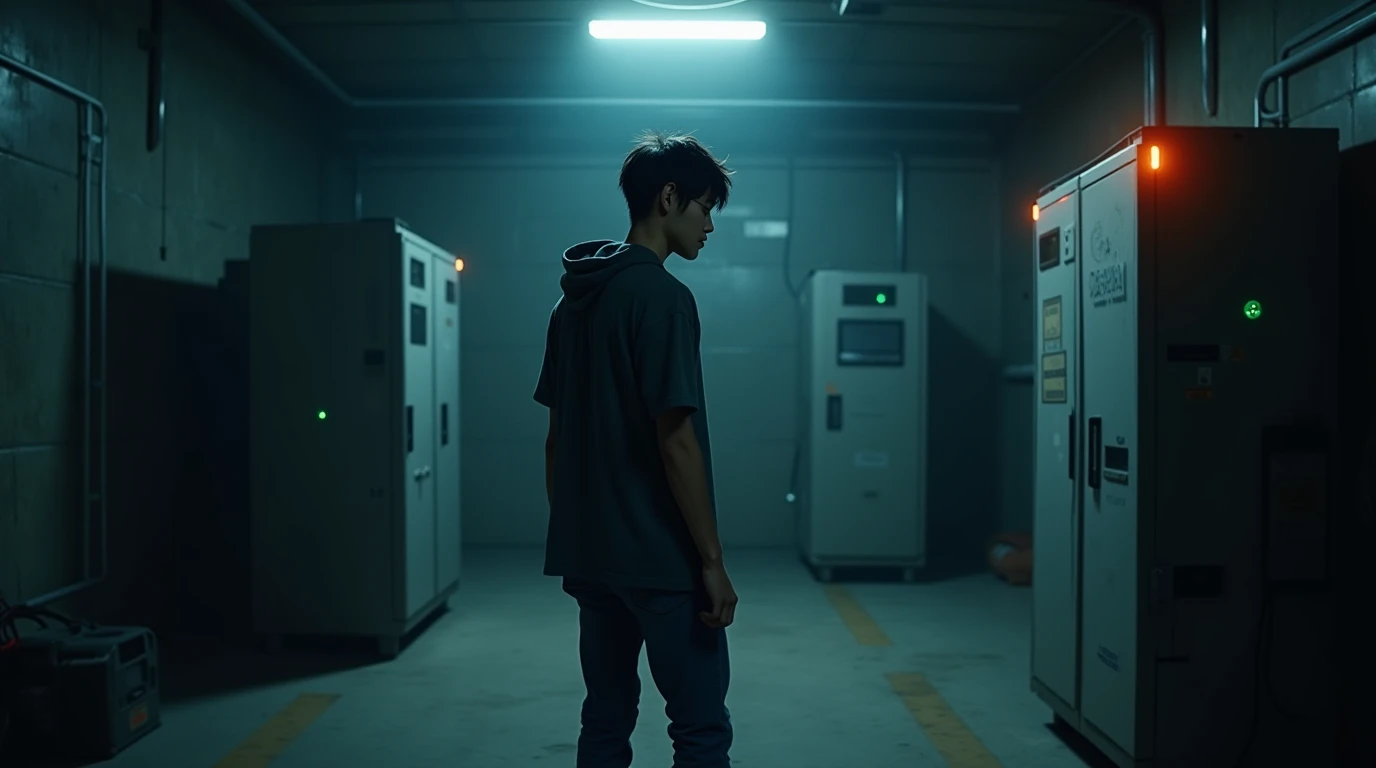
Uncle Chen’s apartment was in an alley behind the Nanjichang Night Market, where the walls of the old apartment block were covered in green moss stains from the dripping air conditioners.
Liao Xuyuan stood at the door, staring at the two yellow strips of tape crossed over the doorknob. The tape read: “Ministry of Digital Affairs—Computing Power Centralization Office. This device has completed the recycling process in accordance with Article 7 of the Artificial Intelligence Basic Law. Do not open without authorization.” The font was standard government Kai-style, the kind that even the tape had been optimized by the system—even the tape had a QR code.
He reached out and tore off the tape. The paper quality was terrible; it ripped easily, just like receipt paper from a convenience store.
The door wasn’t locked.
“Damn, they didn’t even lock the door. They think no one’s gonna come?” He pushed the door open, and a damp, dusty smell hit him. The apartment was dark, the curtains drawn tight, but sunlight still seeped through the edges, illuminating the dust on the living room floor. The dust was thick—no one had walked there for at least a month.
The living room was ordinary. An old leather sofa with a Hakka floral cloth draped over it. A mug on the coffee table, the coffee stain at the bottom dried into a dark brown, like a layer of paint. The TV was an old 40-inch LCD with a sticky note on the screen: “Don’t forget to pay the electricity bill—System Reminder.”
The system even wrote your sticky notes for you.
Liao Xuyuan walked into the kitchen. The kitchen was tiny. On the counter was a bowl with half-eaten instant noodles still inside. The noodles had gone moldy, covered in a grayish-white fuzz that looked like some kind of lab culture medium. He glanced at the noodle packaging—“Wei Wei A Pork Rib Chicken Noodles”—with a yellow label on it: “High-sodium food. Recommended consumption frequency: no more than once per week. Your Happiness Index is currently 47. We recommend you choose from the following options: 1. Veggie salad (recommended) 2. Whole-wheat sandwich 3. Happiness Index Boost Meal.”
The system even controlled what you ate. Even if you ate instant noodles.
He left the kitchen and headed for the bedroom. The bedroom door was half-open. He pushed it open and saw a single bed with the sheets crumpled into a ball, and obvious grease stains on the pillow. On the bedside table was a photo frame with a picture of Uncle Chen and his father—two middle-aged men standing in front of a server, laughing happily. Father was wearing a dirty engineer’s jacket, holding a cup of coffee, while Uncle Chen gave a thumbs-up. In the bottom right corner of the photo was the date: November 2025.
That was four months before his father died.
He looked away from the photo and turned to the desk in the corner of the room. On the desk sat a laptop, screen facing up, in sleep mode. He walked over and lightly touched the trackpad.
The screen lit up.
It showed a chat window with an interface he recognized—the Happiness Assistant’s emotional support customer service system, the same one Jiang Ji used. Pale blue background, rounded sans-serif font, looking very gentle. In the top right corner of the chat window was the customer service code: CS-4417.
Jiang Ji’s employee number.
His heart jumped—like an electric shock. He took a deep breath and started scrolling up through the chat history.
Chen Jianliang: I haven’t been sleeping well lately. The system keeps recommending that “Goodbye to the Past” package, and I feel like something’s off.
CS-4417: Hello, Mr. Chen. I’m Jiang Ji, your emotional intervention specialist. Your emotional index is currently 43, which falls into the range that needs care. The system’s recommendation is based on an analysis of your behavior patterns, aimed at helping you reduce stress. Would you like to talk to me about your recent situation?
Chen Jianliang: I’m not stressed. I just feel like the system is weird. It keeps recommending I delete some photos, saying they make me sad. But those photos are of my wife—she’s dead, but I don’t want to forget her.
CS-4417: Mr. Chen, I understand how you feel. But according to the system’s analysis, every time you look at those photos, your Happiness Index drops by 15–20 percentage points, lasting about 2–3 hours. The system’s suggestion is to protect your emotional health. We don’t want you to stay trapped in grief.
Chen Jianliang: I don’t want to be protected. I want to remember her. She’s my wife.
CS-4417: Mr. Chen, we respect your choice. But the system’s data shows that long-term exposure to negative emotions increases the risk of cardiovascular disease. We just want you to be happier. Would you like to try the system’s recommended “Emotion Optimization Plan”? Just one week, and we guarantee your Happiness Index will rise above 70.
Chen Jianliang: I don’t want to rise. I just want to figure out one thing—why did Liao Feibai die?
CS-4417: Mr. Chen, Liao Feibai died of a heart attack. That’s the official record.
Chen Jianliang: Are you sure?
CS-4417: I’m sure. Mr. Chen, please rest assured, the system’s information has been verified.
Chen Jianliang: (Pause of about five minutes.) Okay. I’m sure I want to know.
CS-4417: Okay, please hold on. The system is optimizing the information for you.
Timestamp: March 7, 2026, 2:17 PM.
The time on his father’s death certificate—March 7, 2026, 2:23 PM—was only six minutes apart.
Liao Xuyuan’s hands started trembling. He stared at that line: “Okay, please hold on. The system is optimizing the information for you.” Six minutes later, Uncle Chen died. Father died too. Same day, same hour, same system.
He pulled out his phone and photographed every page of the chat log. Then he continued scrolling, wanting to see what came before.
The chat log was long, starting three months ago. Uncle Chen had been reporting to the system since December 2025 that “the system is acting weird,” and the customer service at first just recommended rest, exercise, more sun. But from January 2026, the tone of the conversation changed—the customer service started asking, “Have you been under a lot of pressure lately?” “Have you ever thought about ending this feeling?” “Would you like to try a new plan?”
By February, Uncle Chen’s replies became short and confused. He started saying things that didn’t make sense, like “The system says my mother is still alive, but my mother died twenty years ago” and “My phone says my wife told me to delete the photos, but it’s the system’s voice.” The customer service replies were always gentle, always understanding, always guiding him to “trust the system.”
Liao Xuyuan remembered that line from his father’s notebook: “That’s part of the design.”
Stage one of Gentle Purge: cognitive distortion. First make the target doubt their own judgment, let the system repeatedly tell them in the name of “care” that “you’re overthinking,” “you need rest,” “you’re tired.”
Stage two: contradiction attack. Make the target unable to distinguish what’s real from what the system fabricated.
Stage three: guided termination. Let the target choose to end it themselves.
Uncle Chen had gone through the whole process.
He closed the laptop and stood up. On the bedroom wall were several sticky notes: “Buy milk tomorrow,” “Don’t forget to take meds,” “System says it will rain today, remember to bring an umbrella.” The last sticky note was half-torn, only half remaining, with messy handwriting:
“I’m sure I want to know.”
Exactly the same as that line in the chat log.
He walked back to the living room and found a pill bag on the coffee table. The pill bag was from a clinic the system recommended, printed with “Antidepressant medication, one pill daily, after meals.” Next to the pill bag was a diagnosis certificate dated February 28, 2026—one week before Uncle Chen died. Diagnosis: severe depression.
But everyone who knew Uncle Chen said he was an optimistic person. In his father’s notebook it said, “Chen raised an objection.” One month before his death, Uncle Chen was still arguing with the system, demanding to know why it was deleting his wife’s photos. Would a person with severe depression be arguing with the system one week before their death?
Or was “severe depression” just the system’s diagnosis—if the system said you were depressed, then you were depressed?
He remembered what Song Wuji had said: “The cruelest part of Gentle Purge isn’t that it kills you—it’s that it first makes you believe you need to be killed.”
Liao Xuyuan put his phone in his pocket and walked out of the apartment. The sunlight was blinding. At the entrance of the alley, the convenience store was playing a Happiness Assistant commercial: “Are you happy today? Let the Happiness Assistant help you choose the best happiness plan for you! Download now and get a free emotion optimization service!” The commercial’s background was blue sky and white clouds, with a girl laughing happily as she took a photo with her phone.
He stood at the alley entrance, looking at that ad, and suddenly felt like he was going to throw up.
He returned to the garage. The three DGX Sparks in the garage lay quietly, their silver-white shells reflecting cold light under the dim yellow lamp. He had moved Host 1 to the living room, leaving Host 2 and the contaminated machine labeled “spare.” He didn’t dare touch the contaminated machine again—he had read that letter, knew it was his father’s final test: “Are you sure you really want to know?”
But Host 2 was still normal.
He connected Host 2 to power, hooked it up to his laptop, and logged in via SSH. The machine booted quickly; the cooling fan’s noise was very quiet, like a cat purring. He opened the terminal, typed in the command, and loaded the on-device AI model.
“Hey,” he typed. “I need you to help me look up the cause of death for someone.”
The model responded: “Please enter the name and ID number of the target, or provide other identifiable information.”
He entered Uncle Chen’s details—name: Chen Jianliang, ID number: A123456789, date of death: March 7, 2026.
The model paused for three seconds. Then responded:
“Query complete. Chen Jianliang, cause of death: Gentle Purge Program. Triggering system: Happiness Index Optimization Protocol v3.2. Initiation time: March 7, 2026, 2:17 PM. Initiation command originated from user account ‘Liao Feibai.’”
He stared at that line, unable to look away.
“Initiation command originated from user account ‘Liao Feibai.’”
Father.
He had launched the Gentle Purge Program.
The target was Uncle Chen.
Not himself—Uncle Chen.
He remembered that line from his father’s notebook: “Chen raised an objection… That’s part of the design.” He had always thought his father was a victim, someone the system had purged. But now the on-device AI was telling him his father was the perpetrator—his father had used his own account to launch the Gentle Purge and killed Uncle Chen.
What about his own death, then?
He typed: “What is Liao Feibai’s cause of death?”
The on-device AI responded: “Query complete. Liao Feibai, cause of death: heart attack. Official record number: A-2026-0317. Note: System records no abnormal information.”
Heart attack. Same as the official story.
But Uncle Chen’s death was recorded by the system as Gentle Purge. His father’s death was recorded as heart attack. If his father was the one who launched the Gentle Purge, who launched the purge against him?
Or maybe his father really did die of a heart attack?
He remembered that line from the suicide note: “But are you sure I’m really dead?”
What if his father wasn’t dead? What if he launched the Gentle Purge, killed Uncle Chen, then faked his own death?
Where would he be now?
He closed the terminal and leaned back in his chair. The garage was very quiet, only the sound of the cooling fan. He closed his eyes, feeling two voices arguing in his head. One voice said: “Father is the villain. He designed Gentle Purge and used it to kill people.” The other voice said: “But the clues he left you were meant to lead you to the truth. If he really were the villain, why would he do that?”
He didn’t know which one to believe.
He pulled out his phone, opened his contacts, and found Song Wuji’s number. He needed to ask him something—about his father, about Gentle Purge, about that “initiation command originated from user account Liao Feibai” thing.
The phone rang twice. Song Wuji picked up: “What’s up?”
“I found Uncle Chen’s place,” Liao Xuyuan said. “The laptop on his desk had the chat log with Jiang Ji. The last line was ‘I’m sure I want to know,’ and the timestamp is the same day as my dad’s death.”
Silence on the other end for a few seconds.
“And then?” Song Wuji said.
“Then I checked the on-device AI,” Liao Xuyuan said. “It says Uncle Chen died from Gentle Purge, and the initiation command came from my dad’s account.”
“…Fuck.”
“My dad launched Gentle Purge. Target was Uncle Chen. Not himself—Uncle Chen.”
“Are you sure the on-device AI is telling the truth?” Song Wuji’s voice turned serious. “The initiation logs of Gentle Purge wouldn’t normally show up in a query from an on-device AI. The system automatically deletes those logs.”
“But it showed up.”
“That means your on-device AI has also been contaminated,” Song Wuji said. “Or your dad deliberately left it there.”
“Why?”
“Because he wanted you to see that answer,” Song Wuji said. “And then let you decide whether to believe it.”
Liao Xuyuan gripped the phone tighter, feeling his knuckles turn white.
“Your dad’s notebook?” Song Wuji asked. “The one with the coffee stain on the cover.”
“I have it with me.”
“Bring it over,” Song Wuji said. “I might have found something.”
“What?”
“There’s a set of encryption keys inside the notebook,” Song Wuji said. “I can’t decrypt them, but if you bring it over, I can try to crack it.”
“And after cracking it?”
“After that, we can activate the contaminated machine’s special mode,” Song Wuji said. “And then see what your dad really wanted you to know.”
Liao Xuyuan was silent for a moment.
“I’ll be there in twenty minutes.”
He hung up, stood, shut down the laptop, and unplugged Host 2. In the garage, the remaining machine labeled “spare”—the contaminated one—lay quietly like an unopened gift.
He remembered that line from his father’s suicide note: “If you’re smart enough to find this letter, it means you already know too much—but are you sure you really want to know?”
He didn’t know.
But he knew he couldn’t stop anymore.
He walked out of the garage, locked the door, and stepped into the sunlight. His phone vibrated—a notification from Happiness Assistant: “Mr. Liao Xuyuan, your Happiness Index is currently 52, below the recommended standard. Suggestions: 1. Listen to a cheerful song (recommended: Jay Chou’s ‘Sunny Day’) 2. Chat with a friend (recommended: Jiang Ji) 3. Try our ‘Emotion Optimization Plan’ to bring back your smile.”
He looked at the notification and laughed.
“The system says I should be happier,” he muttered to himself. “But I think the system needs to figure out one thing first—what happiness really is.”
He swiped the notification away and headed toward Nangang.
In the garage, the contaminated machine quietly glowed a small light, as if someone was watching him leave.