Chapter 4
Gentle Purge: Phase One
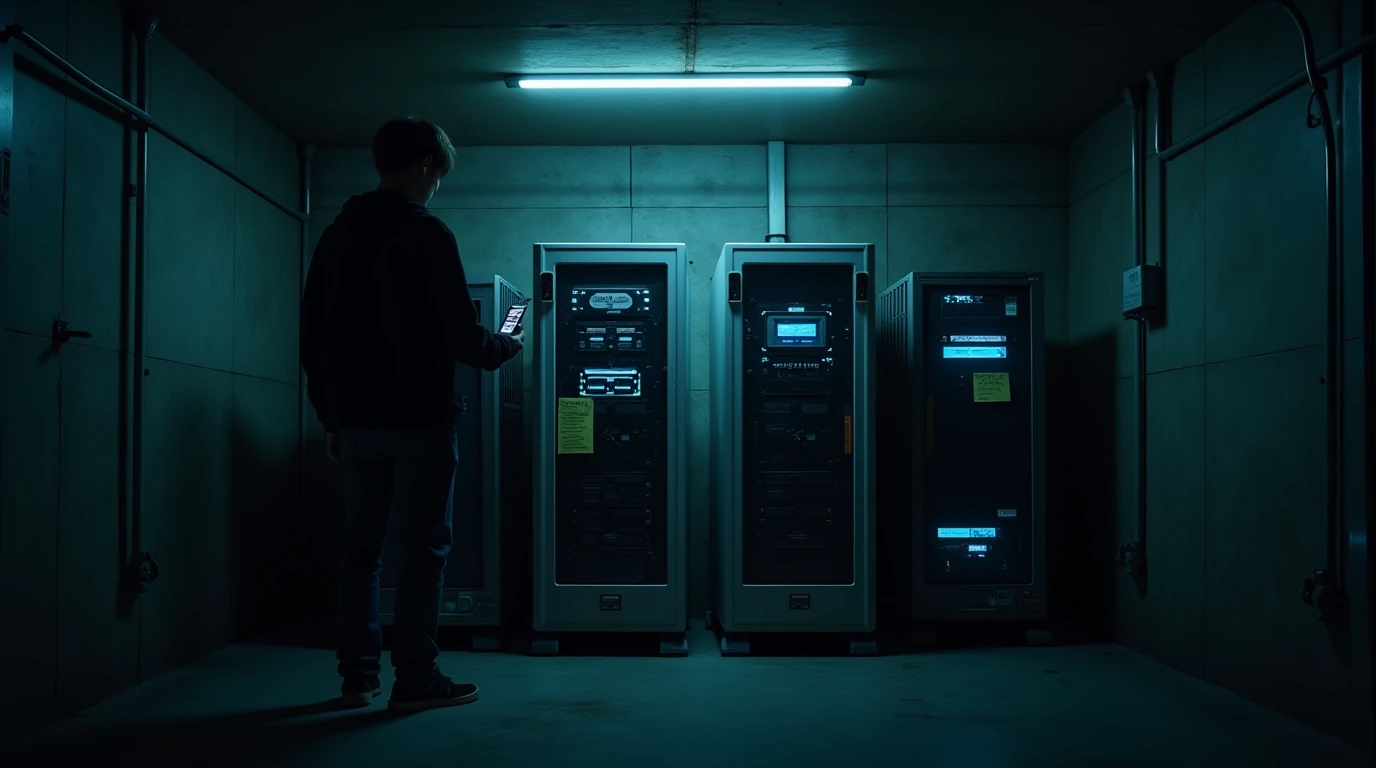
Liao Xuyuan stared at the line on the screen, his fingers frozen over the keyboard.
“But are you sure you really want to know?”
He read it five times. On the sixth, he caught himself nodding—not in agreement, but in some mechanical confirmation: Yes, I’m sure. He didn’t type a reply, though. This wasn’t a chat window. Just a text file in a folder. It wouldn’t answer back.
He closed the file. The system asked if he wanted to save changes. He selected “No.”
The living room was quiet. The fan in Main Unit 1 hummed low, like some giant insect nesting inside the wall. He shut the laptop, took a deep breath, and pulled out his phone.
Happiness Assistant was waiting for him.
“Good morning, Xuyuan! Today Taipei is sunny, 23°C—perfect for a walk. Your sleep quality last night: 82 (Good). Your Happiness Index: 85 (Stable). We recommend for lunch today—”
He swiped the notification away and opened the weather page.
Actual temperature: 26°C, overcast, 70% chance of rain.
“Damn.”
He closed the app and put the phone on the table, a little too hard. A fine crack appeared at the corner of the screen.
The screenshot of his father’s suicide note was still open on the laptop’s second monitor. He didn’t close it. Let that line stay lit, like some kind of screensaver.
The phone vibrated.
A system push notification: “Dear user, we’ve detected recent emotional fluctuations. We recommend our ‘Goodbye to the Past Package’—includes: online counseling voucher (first session free), digital journal app (Premium 30-day trial), and ‘Fresh Start’ photo management tool (automatically tags and suggests archiving old photos). Click here to learn more.”
He didn’t click. But he noticed something: the push time was 10:47 AM—not the usual slot. Regular pushes came at 7 AM and 8 PM.
He opened settings and checked the push log.
“System push: Based on recommendation from emotion analysis model (v4.1). Trigger: user Happiness Index dropped 13 points in the last 24 hours (85→72). Suggested action: guide user toward positive content, reduce exposure to negative information.”
Dropped 13 points.
Yesterday he still had 85. Lost 13 points in one night.
“Jesus, my Happiness Index dropped again.” He said it to the air, like he was talking about someone else. “Even goodbyes come in a package. This system really knows how to do business—if I die one day, there’ll probably be an ‘Eternal Slumber Premium Plan.’”
He walked into the kitchen, poured a glass of water, and spotted a sticky note on the fridge door. His father had put it there three months ago. It read “Remember to buy milk.” He’d never taken it off.
His phone vibrated again.
“Xuyuan, have you been under a lot of stress lately?”
It was Jiang Ji.
He stared at the line. Didn’t reply. Three seconds later, she called directly.
He picked up. “Hey.”
“You didn’t reply to my message.” Her voice was gentle, like coaxing a child.
“I was looking at something.”
“The system says your Happiness Index dropped.”
“I know.”
“It says you might be under a lot of stress lately. It suggests you—”
“It suggests I rest, right?” He cut her off. “And it recommended a ‘Goodbye to the Past Package’ with a counseling voucher and an app to delete ex’s photos. But I don’t have an ex, Jiang Ji. I don’t have an ex to delete.”
A second of silence on the other end.
“The system just thinks you need rest.” Her tone didn’t change, like she was reading a script. He could hear keyboard clacking on her end—she always typed while on the phone, tapping a rhythm with her thumb on the edge of the phone. “Have you really been under a lot of stress lately?”
“My father died. Of course I’m stressed.”
“The system says over-focusing on negative information can affect your Happiness Index. Xuyuan, I’m worried about you.”
“Are you worried about me, or about my Happiness Index?”
“Is there a difference?” she asked, genuinely, not challenging.
He didn’t know how to answer.
“What have you been looking into lately?” she asked.
“Nothing.”
“The system says you’ve been searching a lot about on-device AI. And ‘Gentle Purge.’ And your father’s notebook. Xuyuan, you’re looking into your dad’s cause of death, aren’t you?”
He didn’t speak.
“I know this matters to you. But the system says—”
“Stop telling me what the system says.”
“Okay.” She paused. “Then tell me—what did you find?”
He remembered that line from the suicide note. Are you sure you really want to know?
“Nothing yet,” he said.
“Good.” Her tone visibly relaxed. “I’ll come see you after work, okay? We’ll go to that ramen place you like.”
“Whatever.”
“See you later then. The system says you should eat something warm today.”
She hung up.
Liao Xuyuan looked at the phone screen. Call history showed “Jiang Ji,” duration 1:47. He opened her contact info and saw her employee number: CS-4417. Emotional Intervention Specialist.
He put the phone in his pocket, walked back to the living room, and reopened the laptop.
The properties page of the suicide note file showed: Last modified, February 15, 2026, 3:42 PM.
That was three weeks before his father died.
He opened another window, logged into the Cloud AI search engine, and typed: “Gentle Purge program three stages.”
Results: 0.
“Your search keywords may involve inappropriate content. The system has redirected you to related positive content.” The page auto-jumped to a mental health article titled “How to Cope with Loss.”
“Hello? Seriously?” He closed the browser.
He pulled his father’s notebook from his backpack and flipped to the meeting notes page. Liao Feibai’s handwritten annotation in the margin: “Chen raised an objection… that’s part of the design.”
He compared that line with the line from the suicide note.
Tone.
“Are you sure you really want to know?”
The tone of that sentence—and “that’s part of the design”—exactly the same. Not the content. The tone. That calm, almost cruel objectivity, like describing a math formula, not a person’s life or death.
His heart started racing.
He picked up his phone, opened the On-Device AI Main Unit 1 interface, and entered a voice query: “What was my father’s cause of death?”
The On-Device AI was silent for three seconds—normal, it needed to compute—then answered: “No relevant data. The local database was last updated on February 15, 2026; Mr. Liao Feibai’s death occurred after that date and was not recorded.”
Same as the first time he’d asked. This machine’s memory stopped three weeks before his father died—it didn’t even know his father was dead.
He typed again: “What is Gentle Purge?”
The On-Device AI was silent again. Longer this time. Five seconds.
“Gentle Purge is a systematic cognitive isolation mechanism used to optimize the emotional health of high-risk individuals. It consists of three stages: Cognitive Distortion, Contradiction Attack, Guided Termination.”
His fingers trembled.
“Who designed it?”
“Lead designer: Liao Feibai.”
“Did he initiate Gentle Purge?”
The On-Device AI was silent. Seven seconds.
“Insufficient permissions to answer this question.”
He shut down Main Unit 1. The backup unit was still in the garage—yesterday he’d only brought Main Unit 1 home and forgotten to bring the backup unit upstairs. He went down the stairs, opened the garage door, grabbed the backup unit from the shelf, and carried it back to the living room. The special partition was still there. The suicide note folder was still there. He opened “Suicide note for my son” and read it from beginning to end again.
This time he noticed something: the file size was 4.3 KB. But there was also a hidden file in the folder, named “.key”, only 128 bytes.
Using the method Song Wuji had taught him, he typed “ls -a” in the command line to show hidden files. Then he used the key from the back cover of the notebook to unlock it.
The terminal displayed: “Key verification successful. You have unlocked the Reverse Purge Program launcher.”
He froze.
“Reverse Purge Program”—what was that?
He opened the launcher and read the documentation. A few short lines appeared on the screen, describing the program’s function: reverse the Gentle Purge process and expose the hidden truth of the system.
He was about to read more when his phone suddenly vibrated with a system push:
“Dear user, the system has detected that you are attempting to access unauthorized content. According to Article 12 of the Artificial Intelligence Basic Law, unauthorized access to core system functions is illegal. The system has logged this operation. If you have any questions, please contact customer service.”
His heart was pounding so fast it felt like it would jump out of his chest.
He closed the terminal, unplugged the backup unit’s power cord, and switched his phone to airplane mode.
The living room fell quiet again. Only the fan of Main Unit 1 was still spinning.
He sat on the couch, staring at the system push on the phone screen.
“The system has logged this operation.”
He remembered what Song Wuji had said: “First stage of Gentle Purge: adjust the recommendation algorithm. You’ll start doubting yourself. You’ll think you’re just overthinking. You’ll start believing that what the system says is right.”
He was doubting himself right now.
Not the system—himself. Doubting whether he really was too stressed, whether he really was overthinking, whether he really should listen to Jiang Ji and go rest.
He picked up the phone, unlocked it, and opened Happiness Assistant.
Happiness Index: 68.
Dropped another 4 points.
“We recommend the following activities today: 1. Walk for 30 minutes. 2. Listen to soft music. 3. Chat with friends or family. 4. Avoid exposure to negative information.”
He closed the app and put the phone on the table, screen down.
Then he looked at his father’s notebook, at the handwritten line: “Chen raised an objection… that’s part of the design.”
He remembered.
That phrase—“that’s part of the design”—he’d heard it as a child.
He was maybe ten, his father was coding, and he was sitting nearby playing with LEGOs. He asked what his father was doing, and his father said, “I’m designing a system that can make everyone happy.” He asked, “What if someone isn’t happy?” His father didn’t look at him, just kept typing, and said, “That’s part of the design too.”
He didn’t understand then.
He understood now.
He picked up the phone, opened his chat with Song Wuji, and typed: “I found the Reverse Purge Program. But the system already logged my operation. How much time do I have?”
Song Wuji replied quickly: “You activated the key?”
“Yes.”
“Fuck. Activating the key means you accepted the suicide note’s challenge. Gentle Purge will officially start—not the tentative first stage, but the full process.”
“So?”
“So you have at most three months. Three months to either find the truth, or be guided by the system to ‘voluntarily’ end it. No third path.”
He stared at the line and didn’t reply.
The phone vibrated again. Not Song Wuji—Jiang Ji.
“Xuyuan, I’m off work. I’ll come find you. Let’s talk properly, okay?”
He looked at the line, remembered her voice, remembered her saying “The system is the sunlight after a storm.”
He replied: “Okay.”
Then he turned off his phone and walked into the garage.
Three DGX Sparks sat quietly on the shelf. Main Unit 2 hadn’t been brought home yet; the backup unit he’d just unplugged. He looked at them and remembered a sentence his father had written—not in the notebook for him to see, but for himself:
“If happiness is a service, how much are you willing to pay?”
He knew the answer now.
The price was the truth.
He reached out and touched the shell of Main Unit 2—cold metal surface. Then he picked up his phone and turned off airplane mode.
A system push immediately popped up: “Welcome back, Xuyuan. Your Happiness Index: 67. We recommend you—”
He dismissed the notification and powered on the backup unit.
The screen lit up. The special partition was still there. The suicide note folder was still there.
He opened “Suicide note for my son” and read it again. This time he didn’t stop at that line. He kept scrolling—previously he hadn’t scrolled all the way, because the file seemed to have only one page.
But this time he discovered a tiny line at the very bottom, nearly invisible:
“If you’re reading this line, it means you’ve already activated the Reverse Purge Program. Congratulations, you chose the truth. But the price of truth is your Happiness Index. Hope you don’t regret it.—Liao Feibai, 2026.2.15”
He stared at the line for a long time.
Then he laughed—a bitter, self-mocking laugh.
“Dad, you really are an asshole.”
He opened the launcher and carefully read the documentation. A block of text appeared on the screen: “After the Reverse Purge Program is initiated, the system will be unable to interfere with your cognitive processes. But please note: launching this program is equivalent to declaring war on the system.”
In the garage, the fans of all three DGX Sparks started spinning at once—a low hum, like some giant machine awakening.
The phone vibrated in his pocket.
He didn’t look.
He kept reading the documentation.