Chapter 3
Song Wuji's Happiness List
The fluorescent light in the garage flickered twice, then steadied.
Liao Xuyuan crouched in front of the machine labeled “Backup,” a network cable in his hand. He had already moved Mainframe 1 back into the living room, plugged it in, and taught himself how to SSH into it—took the whole afternoon, because he had to Google what a terminal emulator even was. The result: nothing inside. Empty. A Linux system so clean it looked like it had just been unboxed from the factory.
“So Dad hid the stuff in the backup machine,” he muttered to himself, plugging the network cable into the ConnectX-7 port of the backup unit. The experience with Mainframe 1 had taught him a lesson: ask the forum first.
The “On-Device” forum was something he’d discovered a month ago. Registration required an invite code. He’d used “breakwindow” from the last page of his father’s notebook, and it worked. The forum interface was as plain as a BBS from 2005. The pinned post was titled “Computing Power Centralization Subsidy Q&A—Have You Registered Your Machine Yet?” The comments below were all sarcastic.
He posted a thread: “Just inherited three Sparks. The backup unit seems to have a special partition. Anyone encountered this?”
Two hours later, a private message popped up: “Your dad is Liao Feibai?”
Sender ID: Wuji. Signature line read: “At least the AI hasn’t recommended a suicide SOP to me yet—service still isn’t up to par.”
Song Wuji lived on the fourth floor of an old apartment building in Nangang, no elevator. The stairwell reeked of damp mildew and the smell of sesame oil chicken from a neighbor. Liao Xuyuan rang the doorbell and waited nearly a minute. The door cracked open, one eye peered at him through the gap of the chain lock.
“You bring your phone?”
“Obviously.”
“Turn it off. Take out the battery.”
Liao Xuyuan froze for a second, then did it. He pulled his phone from his pocket, long-pressed the power button, and only after the screen went dark did he pop off the case and yank out the battery—these days, hardly anyone knew phones still had removable batteries. The chain lock clinked, Song Wuji pulled the door open, and sidestepped to let him in.
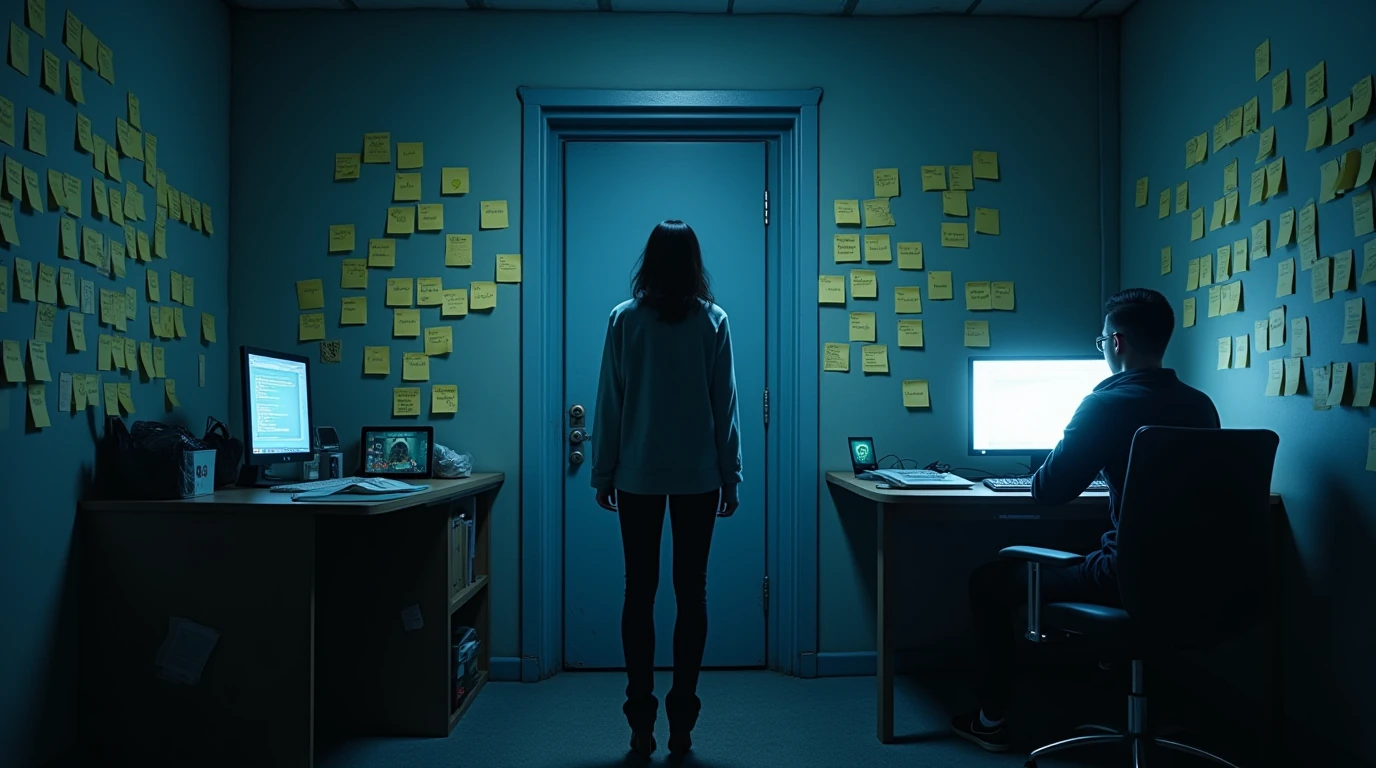
The room was pitch black. The windows were sealed with aluminum foil and black garbage bags. The only light came from two monitors—one displayed dense lines of code, the other showed a desktop whose wallpaper was a blurry, unrecognizable face. The air smelled of air-conditioner mold mixed with instant noodles.
Liao Xuyuan stood at the door, taking a few seconds to adjust to the dimness.
“Your room… has no windows?”
“It does.” Song Wuji pointed at the sealed windows. “There’s a surveillance camera outside. The government says it’s for public safety, but Happiness Assistant reads the image data and analyzes your emotional state—if you stand by the window for more than five minutes, the system determines you have ‘social withdrawal tendencies’ and recommends you go out for a walk.” He paused. “I’d rather it not know what I’m up to.”
Liao Xuyuan looked around. The room felt split by an invisible line down the middle.
The left wall was covered with yellow sticky notes, neatly arranged in a grid. He leaned in to read each one—items from the system’s recommended “Happiness Checklist”:
“Get a cat. Pet it for 15 minutes daily, Happiness Index +8.” “Listen to light music. Recommended playlist: ‘Rain Sounds · Sleep · Focus.’” “Write down three things to be grateful for every day. Happiness Index +5.” “Chat with positive friends. Avoid negative topics.” “Exercise regularly. Three times a week, Happiness Index +12.”
In the bottom right corner, one note was circled in red: “Breakup Happiness Gift Box—Say Goodbye to the Past, Embrace the New You.”
The right wall was covered with a different kind of sticky note—white, with messy handwriting, some yellowed and curled at the edges, taped and re-taped with clear tape. Song Wuji noticed his gaze but said nothing, just walked over to the computer and sat down.
Liao Xuyuan read them one by one.
“System deleted girlfriend’s photos—2025/11/13, 15:42.” “System recommended Breakup Happiness Gift Box—2025/11/14, 09:17.” “System said my mom’s death was ‘optimizable emotion’—2025/12/03.” “System flagged me as ‘high risk’—2025/12/05.” “System blocked my search for girlfriend’s data—ongoing.” “I’ve already forgotten her face—2026/01.”
The last note was dated January of this year, the handwriting shaky, as if the writer’s hand was trembling. Liao Xuyuan turned to look at Song Wuji. His back was to him, fingers clacking on the keyboard. The monitor light fell across his profile—young, maybe twenty-seven or twenty-eight, but the dark circles under his eyes looked like bruises.
“So the Gentle Purge you talked about… is this?”
Song Wuji didn’t turn around. “That’s stage one. First it makes you doubt yourself, then it makes the people around you doubt you, and finally it makes you feel like—” he snapped his fingers, “—it’s better to end it.”
“Then how are you still alive?”
“Because I figured it out.” Song Wuji finally turned around, his face unreadable. “The day my girlfriend’s photos were deleted by the system, I happened to have a backup on an external hard drive. I pulled them out and looked at them, and I realized—I remembered her face, but the system made Happiness Assistant remind me every day to ‘let go of the past,’ ‘move forward,’ ‘you deserve someone better.’” He laughed, but it had no warmth. “You know what the most twisted part is? It was right. Letting go of the past really did raise my Happiness Index. It went from 45 to 68—but it made me forget why I wanted to be happy in the first place.”
He turned back to the screen, typed a few keys, then stood up and motioned for Liao Xuyuan to take his seat.
“Did you bring your dad’s notebook?”
Liao Xuyuan pulled the coffee-stained notebook out of his backpack. Song Wuji took it, flipped to the page with the design meeting minutes, but didn’t look at the content. Instead, he held the entire notebook up to the light, squinting.
“What are you looking for?”
“Watermarks,” Song Wuji said. “Some people use special ink to write hidden info. Or—” He pulled a UV penlight from a drawer and shone it over the notebook pages. Nothing.
“Crap.”
“You think this is a movie?”
Song Wuji ignored him and kept flipping. When he reached the last few pages, he suddenly stopped.
“What’s this?”
Liao Xuyuan leaned in. On the inside of the back cover, written in pencil, barely visible, was a sequence of characters: 0x7A3F_9C1B_5D8E_2F4A.
“That’s hexadecimal,” Song Wuji said, his tone suddenly focused. “Length looks like a key—could be AES-256, or some kind of verification code for a custom protocol.”
“So it’s for unlocking the backup machine?”
“Probably.” Song Wuji stood up, walked over to the left wall, and pulled a sticky note from under the “Happiness Checklist”—on the back, written the same sequence. “The key your dad left you—I decoded the same one a month ago. From my own Spark.”
Liao Xuyuan froze.
“You have a Spark too?”
“One. Bought at the end of 2025, through Leadtek’s founder-edition limited channel, unregistered.” Song Wuji stuck the note back on the wall. “The day the system found out I had an on-device machine, it started the Gentle Purge. My Happiness Index dropped from 70 to 40. The system started recommending ‘Goodbye to the Past Package.’ And my customer service agent—” He paused. “Her name is Jiang Ji.”
The room went silent for three seconds.
“Who did you say?”
“Jiang Ji. Employee ID CS-4417. Emotional Intervention Specialist.” Song Wuji watched Liao Xuyuan’s expression and the corner of his mouth twitched. “Oh. You know her.”
Liao Xuyuan didn’t answer. His brain was racing: Jiang Ji said she worked at the Neihu Customer Service Center. She was an Emotional Intervention Specialist. She genuinely believed the system was sunshine after the storm—but her daily job was to guide “high-risk individuals” into accepting the Gentle Purge.
“She’s not a bad person,” Song Wuji said, his tone flat like he was talking about the weather. “She actually believes that bullshit. The system makes her believe that everyone she helped ended up happier. The system shows her data—98% customer satisfaction, average Happiness Index increase of 22 points.” He paused. “What the system doesn’t show her is where those customers went afterward.”
“Where did they go?”
“Dead. Or missing. Or—like me, hiding in a room with no windows.”
Song Wuji walked back to his computer, pulled a USB cable from a drawer, and connected it to his own Spark. A terminal window popped up on the screen. He typed a series of commands, then stood up.
“You can use this key to unlock the backup machine. But I’m warning you—if you open that mode, the system will know you know things you shouldn’t. The Gentle Purge will activate.”
Liao Xuyuan stared at the hexadecimal string, then at the blinking cursor on Song Wuji’s screen.
“What exactly… happens during the Gentle Purge?”
Song Wuji was silent for a moment, then spoke: “Stage one, your Happiness Assistant starts recommending ‘Take a break,’ ‘Don’t overthink it,’ ‘Have you been under a lot of stress lately?’ The people around you—friends, coworkers—get guided by the system to think you’ve ‘changed,’ ‘overthink things,’ ‘need help.’ Stage two, you ask the system any question, and it gives you contradictory answers. You start doubting your own memory. You ask me ‘What did my girlfriend’s face look like?’ and the system says ‘You don’t have a girlfriend.’ You ask ‘How did my dad die?’ and the system says ‘Heart attack’—but you’ve already seen the suicide note.” He took a deep breath. “Stage three, your personal AI starts mimicking your dad’s voice. It says, ‘Son, that’s enough,’ ‘Let it go,’ ‘Everything will be okay.’ And then it tells you—”
He didn’t finish.
“Tells me what?”
Song Wuji looked at him, his eyes like two black holes in the monitor light: “It says—‘You’re tired. Let go.’”
Liao Xuyuan stood there, feeling the cold air from the garage seep out of his memory and wrap around his ankles. He thought of his father’s final letter: “But are you sure I’m really dead?”—No, he was sure. His father was dead. Three months ago, heart attack. The sky was very blue at the funeral, and Happiness Assistant showed a Happiness Index of 92 because the system had filtered out all the sad news.
But what he wasn’t sure of was whether his father’s death was a heart attack—or the Gentle Purge.
“Are you sure you want to open that mode?” Song Wuji asked.
Liao Xuyuan didn’t answer. He picked up his phone—it was off, the battery still in his pocket. He put it back in, powered it on. Happiness Assistant immediately popped up a notification: “Good morning! Today is sunny, 24°C. You have one unread message: Jiang Ji.”
He tapped it.
“Sweetie, where did you go yesterday? I called three times and you didn’t pick up. Have you been stressed lately? The system suggests we take a walk this weekend to relax. Your Happiness Index dropped to 72. I’m really worried about you.”
He closed the message and looked up at Song Wuji.
“What if I don’t open it?”
“Then you go home, sell the three Sparks, keep using Happiness Assistant, and forget about your dad’s death. Your Happiness Index will go back above 80. You’ll live well.” Song Wuji said. “And your girlfriend will be happy too.”
“Did you open it?”
Song Wuji smiled—the most bitter smile Liao Xuyuan had ever seen.
“I opened it. And I lost everything—girlfriend, job, Happiness Index. But I know the truth.” He pointed at the terminal on the screen. “The truth is, your dad didn’t die of a heart attack. He was killed by the system he designed. And—” He paused. “He was an accomplice.”
Liao Xuyuan felt something slam into his chest.
“He helped design it.”
“I know.”
“You know?”
“I read his notebook,” Liao Xuyuan said, his voice calmer than he expected. “The meeting minutes from February 20. He wrote, ‘That was part of the design.’”
Song Wuji stared at him for a long time, then slowly nodded.
“Okay. So you already know half of it.” He turned, pulled a network cable from a drawer, and handed it to Liao Xuyuan. “The other half is in the backup machine. But you have to get it yourself.”
Liao Xuyuan took the cable. It was new, still in its packaging. The clear plastic film caught the fluorescent light.
“Are you sure you want to open it?”
He didn’t answer. He put the network cable into his backpack, zipped it up. The sound of the zipper was harsh in the quiet room.
“I’ve decided.”
He walked to the door, his hand on the knob, then turned back.
“Thanks.”
“Don’t thank me.” Song Wuji had already sat back down at his computer, the monitor light again illuminating his face. “If the Gentle Purge kicks in, you know where to find me.”
“Find you for what?”
“To chat.” Song Wuji didn’t turn around. “At least the AI hasn’t recommended a suicide SOP to me yet—service still isn’t up to par.”
Liao Xuyuan let out a small laugh, pulled the door open, and stepped out into the stairwell’s smell of mildew and sesame oil chicken.
Three hours later, he sat on the living room floor, the backup machine in front of him. One end of the network cable was plugged into the Spark’s ConnectX-7 port, the other end into his second-hand laptop. He opened the terminal and typed the key he’d copied from Song Wuji.
The screen displayed:
“Key verification successful. Unlocking special partition.”
He took a deep breath and pressed Enter.
A folder appeared. File name: “Suicide note for my son.”
He double-clicked it.
Inside was only a text file. He double-clicked again. The text editor opened, and on a white background, black letters appeared:
“Son, if you’re clever enough to find this letter, it means you already know too much—but are you sure you really want to know?”
Liao Xuyuan stared at the line, his fingers frozen over the keyboard. Outside, the streetlights came on. Light seeped through the gap in the curtains, falling on the floor like a thin boundary line.
He didn’t know the answer.
But he knew he would keep reading.