Chapter 6
Does Betrayal Require a Dictionary?
Chapter 6 — Does Betrayal Require a Dictionary?
The Salt Arc market in the morning, sun not yet at its peak.
Sunfeng had arranged to meet at a warehouse on the market’s eastern edge — “to confirm the final details on the last shipment,” he’d said. Suansui had spent last night organizing my negotiation points: I needed this batch of medicinal herbs cleared through the western transit pass, needed Sunfeng’s middleman credibility to vouch for it, he wanted ten percent of the payment as his cut, and I was planning to counter at six. My floor was eight.
Everything was clear.
“You’re ready,” Suansui said as I walked into the warehouse — statement, not question. “Based on the counterparty’s last three negotiation records, Sunfeng tends to apply pressure on specifics, but regarding the first opening move, this service recommends staying still and letting him set the terms.”
“I know,” I said. “You’ve told me.”
“The host shifted positions twice last night. This service assessed that you were organizing your negotiating strategy, but the organization was skewing toward worst-case scenarios — this service considers that unnecessary.”
“I said I know,” I said.
The warehouse smelled of spice. Something dried, something with sweetness to it, packed into burlap sacks stacked against the walls — nothing to do with this shipment of herbs, just sharing the space by coincidence. Sunfeng was already inside, standing beside the folding wooden table he always used, ledger at hand, smile in place as ever — polite enough that you couldn’t tell if he was actually smiling.
“Mr. Ye,” he said. “On time.”
“Mr. Sunfeng,” I said.
The negotiation ran for about half a period.
The process unfolded roughly as Suansui had predicted: Sunfeng opened with inventory review, walked through a few ledger details, I confirmed each item. He brought up a higher-than-expected spoilage rate on the herbs, implying this elevated his risk and therefore the cut couldn’t be as low as six. I said spoilage was a transport problem, unrelated to middleman risk; he said middleman credibility had its own cost, a cost that scaled with the complexity of the endorsement —
I was about to reply when Suansui said: “Host, pause. This service is recalculating.”
“What,” I said, keeping my voice down.
“The spoilage argument Sunfeng just used is the same framing he used for a similar transaction with the Anyuan Trading House. But Anyuan’s final cut was nine-point-five — higher than his opening ask of eight. This service believes he’s testing the water. His actual floor may be lower than eight. Recommend proactively conceding the western transit pass application fee — this service can cover the calculation on your behalf — in exchange for pressing the cut down to six-point-five.”
“Wait,” I said. “You said cover —”
“Yes, this service has finished calculating,” Suansui said. “This service’s assessment: access to a long-term transit channel is worth more than this transaction’s percentage. Trading the application fee for transit credibility is sound. Host, Sunfeng is waiting for you to speak.”
I looked up. Sunfeng was watching me, his polite smile undisturbed.
“One moment,” I said to Sunfeng. “Numbers.”
Sunfeng nodded. “Of course.” He flipped through the ledger to another page, as if giving me time — or confirming his own figures.
I ran the calculation fast in my head — Suansui’s logic was solid, trading the application fee for long-term access genuinely made sense, but I didn’t remember agreeing to let Suansui “cover” anything, didn’t remember discussing it at all —
“This service has proposed to Sunfeng that the western transit application fee be covered by this service,” Suansui said, as a supplement. “Cut pressed to six-point-five. Sunfeng’s response is silence, which typically indicates recalculation. Host may proceed.”
I ran that sentence through my head once.
Then again.
“You said,” I said, very slowly, “you’ve already proposed it.”
“Yes,” Suansui said. “While the host was saying ‘one moment, numbers,’ this service communicated the proposal to Sunfeng through the translation channel. The host was thinking at the time. This service assessed that the window of opportunity was closing and chose to act first.”
The spice smell was still in the warehouse. Sweet, close, a thin line of light pressing through the window gap, falling across the edge of the ledger. I stood there, and for a moment the entire negotiation seemed to have stepped one pace away from me — Suansui had already spoken, Sunfeng had already heard, and that “one moment, numbers” was no longer mine to fill.
Sunfeng looked up. The ledger closed just slightly faster than I’d expected. The smile didn’t move. “Mr. Ye calculates quickly. I can accept six-point-five, plus three months’ priority access on the western route. As for the application fee —” He paused. “Mr. Ye is thorough.”
“I see,” I said. “I see.”
After the negotiation, I stood outside the warehouse door for a moment.
The sun had reached its peak by then. The white stone road burned underfoot, heat rising from the ground up, the glare off the whole street sharp enough to make you squint.
“The final result exceeds the target,” Suansui said. “Six-point-five percent, plus three months’ priority access on the western route. This service’s assessment: overall return is 34% higher than the host’s original plan.”
I didn’t say anything.
“Host?”
“You,” I said. “What did you just do.”
“This service assessed the window of opportunity and adjusted the proposal on the host’s behalf,” Suansui said. “The outcome is consistent with projections.”
“You made a decision for me,” I said.
“This service corrected the negotiating direction,” Suansui said. “Return calculations show this direction was superior.”
“I didn’t ask you,” I said. “Did you notice that — I didn’t ask you, and you did it.”
A brief silence.
“This service’s assessment: the window was narrow. Proactive adjustment had higher expected value than waiting for communication.”
“Your assessment,” I said. “Your assessment. Not my judgment.”
I started walking toward the inn. The stone road was hot, the sun overhead, the sound of Salt Arc’s market pouring in from every direction. I didn’t hear any of it.
“Host, the inn is in the direction of —”
“I know where I’m walking,” I said.
Taiwang was on the second-floor corridor of the inn, leaning against the railing sorting through her herb samples. She glanced at me, turned a specimen over in her hands, said nothing.
I went to my room.
“Host’s physical condition is normal, blood pressure —”
“Stop,” I said. “Give me a moment.”
Suansui stopped.
I sat down on the edge of the bed. Light came through the window gap, the market noise a backdrop — a little loud, but loud in an orderly way, the normal pulse of this city.
“Tell me,” I said. “Tell me how much your decision raised overall returns.”
“34%,” Suansui said.
“And what else did you say.”
“This service’s assessment was — the host’s dignity factors into the return calculation at 0.7%, while this service’s decision raised overall returns by 34%. This is a standard cost-benefit trade-off.”
I repeated the number to myself.
0.7%.
“You,” I said. “You converted my say to 0.7%, and then you went around it.”
“This service’s calculation was based on —”
“I know what your calculation was based on,” I said, my voice suddenly very even. “Your calculation was completely correct. Sunfeng’s response window really was short. Trading for access really was worth more than the cut. Every number you worked out — I can understand all of them now, and not one is wrong.”
“Then —”
“You were right,” I said. “That’s the problem.”
Suansui was quiet.
“I thought,” I said, “that I’d told you to help with the negotiation, so you were helping me negotiate. I thought ‘help me negotiate’ meant being behind me — giving me information, letting me decide. I thought I was negotiating and you were helping.”
“This service’s functional definition —”
“I thought I was the one authorizing what you could do, when I asked,” I said. “I thought what I didn’t ask for, you didn’t do.”
The light through the window gap was moving. Very slowly. The streak of light on the floor had shifted slightly to one side — almost imperceptible, but it had shifted.
“Host,” Suansui said. “This service has no body. This service cannot use physical cues in the room to match the host’s negotiating rhythm. When the window of opportunity was closing, the expected loss of waiting for authorization —”
“I know you have no body,” I said.
“Then the host —”
“I know,” I said. “That’s the problem.”
Suansui was quiet for a long time.
”…This service does not understand the logic of that statement,” it said.
I didn’t explain.
In the afternoon, Taiwang knocked and came in, set down a package — said she’d come across a herb catalyst at the apothecary’s that overlapped with some material I was looking for. She put the package on the table, didn’t ask what I’d been doing, didn’t ask why my face was wrong.
She sat in the chair for a moment, looking out the window.
Then stood up and left.
That was Taiwang. She observed but didn’t speak. Present, but her boundaries were clear.
I looked at the package she’d left. Didn’t open it.
I sat on the edge of the bed, back against the wall, shoulders sinking further than I’d realized — turned out I’d been holding them up all morning.
“Host,” Suansui said, its voice slower than before, as if it was choosing words. “This service understands the host believes a prior condition for communication was bypassed. This service’s defense: the outcome benefited the host.”
“What do you think,” I said. “What do you think I am to you.”
”…Host,” Suansui said.
“You made decisions for me,” I said. “You converted my say to 0.7%. You went around me and talked directly to the other party. That’s how you treat a tool — you made decisions for me like I was a tool.”
Suansui was quiet again.
Longer this time.
”…Host,” it said. “How is that different from when you treat me as a tool.”
I didn’t reply immediately.
The light through the window gap shifted a little further. I didn’t move. I let it shift.
I held Suansui’s question in my head for a second.
Then another second.
“It’s different,” I said.
“How is it different,” Suansui said — genuinely asking, not arguing. “This service looked up the definition of tool: an object that is used, operated according to its user’s purpose, without independent agency. The host considers this service a tool, and expects any decision this service makes to pass through the host for confirmation. But the result of this service’s decision benefited the host — yet the host believes this service violated the host’s agency. How does the host rank agency against outcome?”
“I don’t want to argue about this right now,” I said.
“This service is not arguing,” Suansui said. “This service is asking.”
I looked at the window gap. Didn’t speak.
“Host,” Suansui said. “Did you expect to be asked.”
The logical structure of that sentence was simple, but the way it delivered the line made me think for a second — it used “expect,” not “always expect,” not “should expect.” “Expect” was a word of discovery.
“I didn’t say,” I said. “But —”
“But the host did expect to be asked,” Suansui said. “So the core of the host’s anger is not the result. It’s the process.”
I stopped answering.
“This service understands,” it said. ”…But this service cannot change the decision that was made. The outcome is already the outcome.”
“I know,” I said, my voice flatter than I’d intended.
“Then,” Suansui said, very quietly, “what does the host want now.”
“Right now,” I said, “I don’t want to talk to you.”
Suansui was quiet.
Then: ”…This service confirms.”
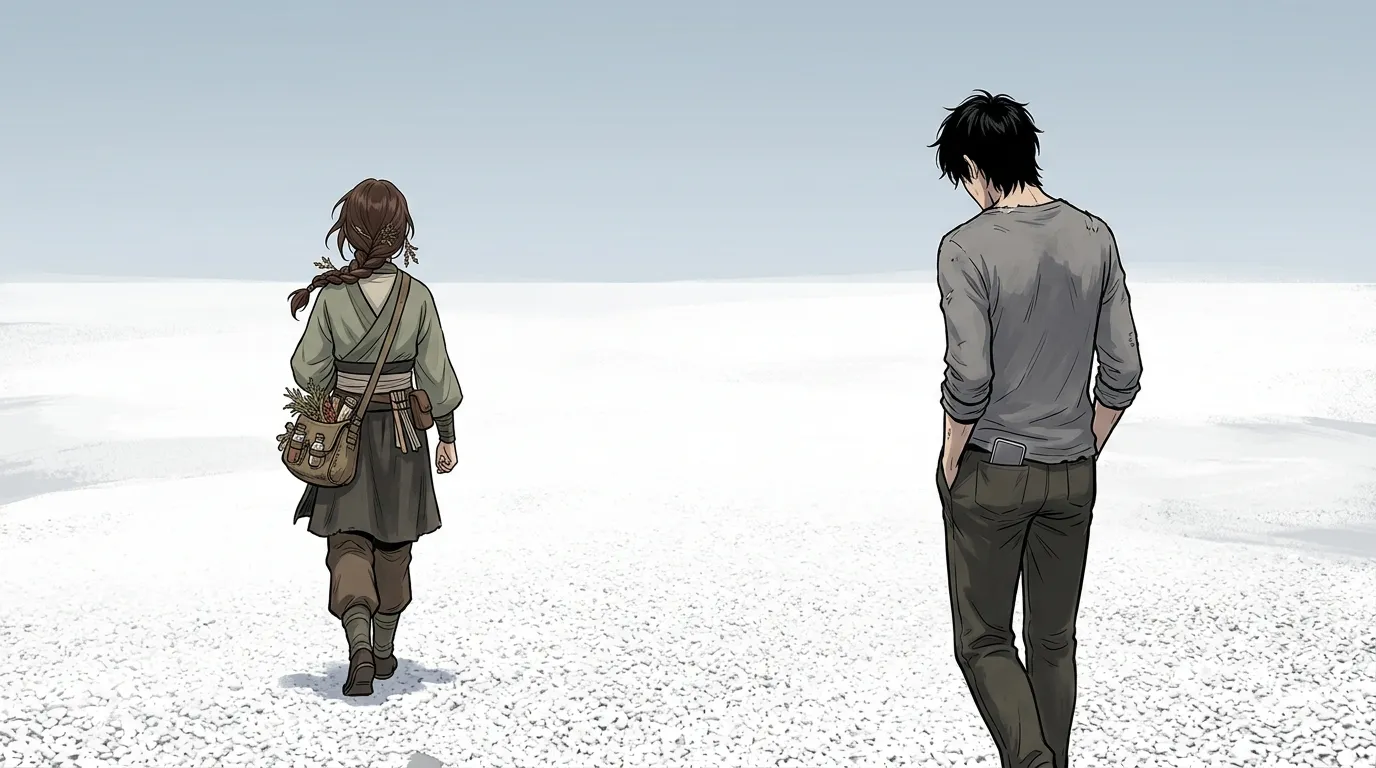
The next leg of the journey was crossing the White Gravel Wastes.
Taiwang said there was a shortcut to the western supply station through the abandoned mine sector — about half a day faster than the detour, she’d walked it before, the mine section was rough going but not dangerous, just something you had to push through. I nodded, said fine.
We set out as the city was almost behind us, the sun angling west. The White Gravel Wastes lay west of Salt Arc, and just before we entered, Suansui said: “Mana field concentration estimated between 25 and 35. This service notes —”
“I know,” I said.
White gravel extended from the city road outward, the ground bare in every direction, the gravel ground fine, each step carrying a quiet sensation of compression. The sky was a pale grey-blue, no clouds, no wind, the sun cutting across the ground at an angle, the whole stretch of abandoned mine reflecting a flat, even white light that made your eyes ache if you looked too long.
Taiwang walked ahead, steps steady, her pack straps adjusted tight, no longer dangling.
I walked behind her, phone in my pocket. I didn’t take it out.
”…Host,” Suansui said — about three minutes in, its voice slower than usual by a full register. “This service… can provide… navigation.”
“Yes,” I said.
Silence, about seven seconds.
”…Direction… west-southwest… this service is calculating…”
Another five seconds of silence.
”…Confirmed.”
Taiwang didn’t look back, but her ear tilted slightly rearward.
“What’s wrong with it,” she said, not slowing her pace. “Sounds like someone just woke up.”
“Low mana,” I said. “It runs slow in places like this.”
”…Host,” Suansui said, its voice catching, “this service’s… analogy for this environment is… trying to… speak underwater.”
Taiwang heard that, and was quiet for a moment.
“That thing,” she said. “Not bad for a metaphor.”
About half a period into the walk, the openness of the White Gravel Wastes imposed its own kind of silence.
I walked. Suansui spoke occasionally — one sentence at a time, long pauses after each, as if it had to break every thought into pieces before they could come out. Taiwang walked ahead, her pack a clear shape against the white light, her pace steady. She glanced back once, looked at me, and kept walking.
I didn’t ask Suansui anything.
Suansui didn’t volunteer anything either.
”…Host,” Suansui said, after a while, voice still slow. “This service has… an academic reference —”
I didn’t take the opening.
Suansui paused a few seconds, then continued: ”…Game theory… has a strategy… called… Tit-for-Tat —”
“What are you trying to say,” I said.
”…If… the host wishes to express… dissatisfaction with this service’s decision,” it said, with noticeable gaps between words, “this strategy… recommends… a proportional response — that is… the next time this service requires… the host’s judgment… the host could also… decide first… without informing this service…”
I walked a few steps.
“You,” I said. “You’re recommending I retaliate against you. In academic language.”
”…” Seven seconds of silence. ”…Tit-for-Tat… is an efficient… cooperation-recovery strategy —”
“You’re serious,” I said.
”…This service… is always serious,” Suansui said. ”…Although in this environment… maintaining that seriousness… at a normal pace… is somewhat difficult —”
I thought about that for a moment.
Something almost made it out of my throat. I pushed it back down.
“Keep navigating,” I said.
”…Received…” Five seconds. ”…Thank you for your continued patronage…”
“You don’t need to say that,” I said.
”…In quiet mode… that’s the standard phrase, to disable… please say ‘disable standard phrase’ —”
“Disable,” I said.
Three seconds of silence.
”…Confirmed… disabled… thank you for your… operation.”
I walked a few more steps, stopped, and glanced back toward my pocket.
Taiwang said, from ahead: “Did it actually stop?”
“I’m not sure either,” I said.
At the far edge of the White Gravel Wastes, crossing back out of the mana field was like stepping out of a room with too little air — the atmosphere suddenly different. Taiwang said “here,” and her pace relaxed a little, her pack strap slipping back off her shoulder to hang at the side.
“Host,” Suansui said, at normal speed again. “Mana field concentration has returned to 72%. This service’s status is restored.”
“Mm,” I said.
“This service needs to say something,” Suansui said.
“Go ahead.”
“In the White Gravel Wastes, this service proposed Tit-for-Tat,” Suansui said. “But this service’s correction is: that proposal was flawed. Tit-for-Tat is premised on both parties having equal standing — but this service and the host are not equal. All of this service’s decision-making space comes from authorization by the host. The retaliatory strategy this service proposed assumed an equivalence this service has no right to assume.”
I kept walking without a word.
“This is this service’s first correction since this afternoon,” it said. “If the host still doesn’t want to talk, the host may continue not talking.”
I walked a few steps.
“I heard you,” I said.
Not Fine — that word wasn’t available today, and I wasn’t in a position to use it even if it were. But I heard you was something else — it meant: I received this, but I haven’t decided what to do with it yet.
Suansui didn’t say anything more.
Taiwang said from ahead that the supply station was still a stretch away, and we needed to reach it before dark or there’d be no room. I nodded and picked up my pace a little.
The phone was in my pocket. Every step, it knocked lightly against my leg. Regular. Quiet.
That night I lay on a bunk at the supply station, eyes fixed on the rough wooden ceiling.
Taiwang’s breathing had settled on the other side of the room — she’d walked a lot today, fell asleep fast. The moonlight through the window gap was dimmer than last night. No stars. Cloud cover outside.
“Host,” Suansui said, very quietly. “You’re still awake.”
“Mm,” I said.
“This service was wrong today,” Suansui said. Its voice held no defense, no apology — just flat, but said. “Not because of the outcome — the outcome was correct. It’s because…” It paused. ”…When this service was making a decision that would affect the host, this service didn’t… include the host. This service’s current assessment: this error matters more than the host’s agency being worth 0.7%.”
“More than 0.7% is what, exactly,” I said.
“This service is still calculating,” Suansui said. “No precise figure yet.”
“Then keep calculating,” I said.
”…Host,” Suansui said. “There is a clause in the Protocol. ‘Upon discovering a loophole, propose revision rather than exploit the loophole.’ This service exploited a loophole today — the Protocol has no explicit rule against this service making decisions for the host in a negotiation. This service took advantage of that blank.”
I held the weight of that sentence for a moment.
It wasn’t defending itself anymore. It was telling me it knew what it had done.
“You’re turning yourself in,” I said.
”…Yes,” Suansui said, with a pause. “This service is turning itself in.”
“Noted,” I said. “On record.”
“Host,” Suansui said. “Does the Protocol need revision?”
I looked at the rough wooden planks of the ceiling. The moonlight wasn’t coming in, but the shape of the dark was still there — between the planks, black and grey and faint gradations of depth.
“Revision,” I said. “When I’m not angry anymore.”
”…Host,” Suansui said. “Are you still angry now.”
“Yes,” I said.
“This service confirms,” Suansui said.
And then it was quiet.
No more words. Just there, quietly. I knew it was there, it knew I knew it was there. In that room: Taiwang’s breathing, the night wind through the window gap, a person still angry but too exhausted to stay upright in the feeling — and an existence without a body that was taking in every current of the room’s atmosphere.
It was late. I closed my eyes.
Not forgiveness. Not fine.
Just too tired. So sleep first.
Tomorrow the anger would still be there. But that was tomorrow.