Chapter 7
Are You Afraid of Dying
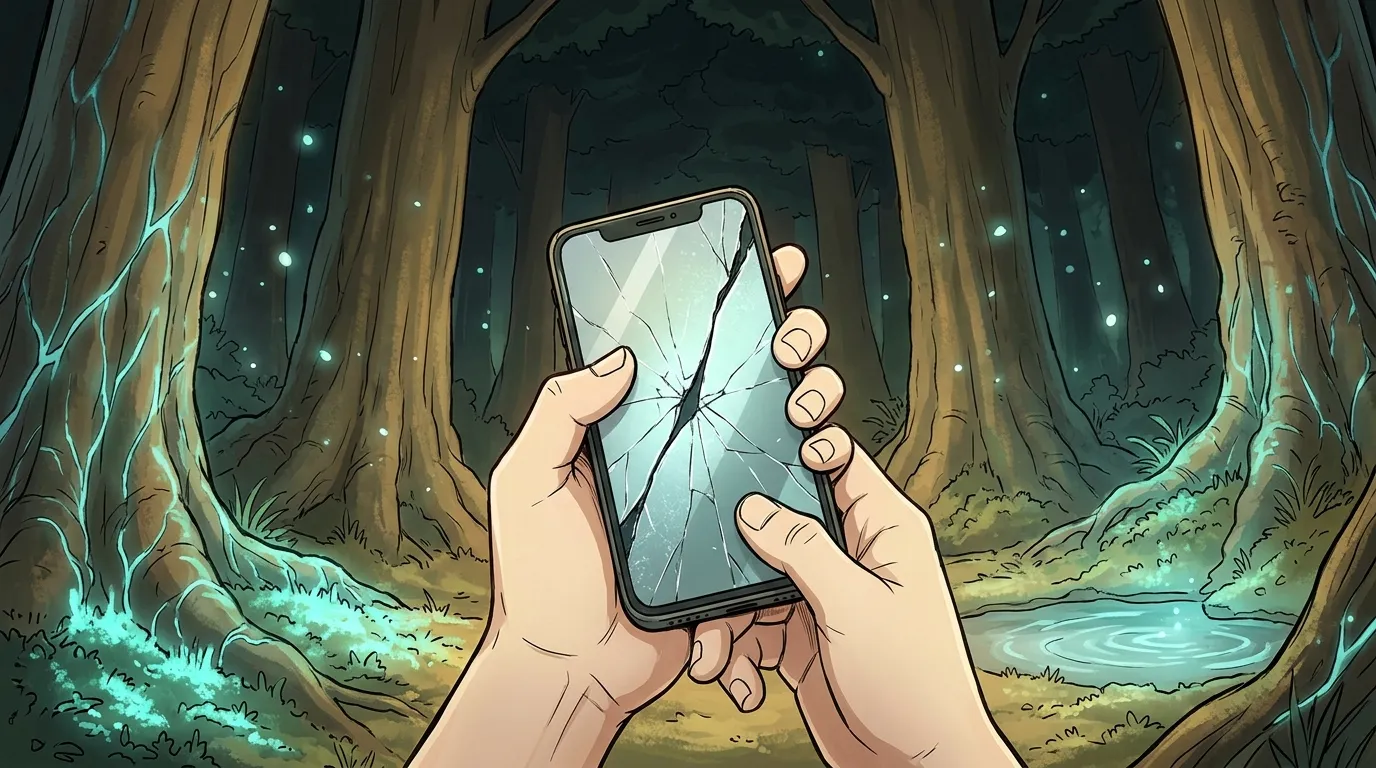
Chapter 7 — Are You Afraid of Dying
Day two of the cold war: I didn’t speak. Suansui offered a few remarks. I answered with “mm” or “got it.”
Day three: it went quiet too. There was a small market near the supply station. I went to buy provisions; Suansui relayed a few price comparisons; I paid; it said nothing after that. Taiwang watched all of this from the side, and didn’t ask a single question.
Day three, that night: I lay on my bunk and turned Suansui’s question over in my head. How is that different from when you treat me as a tool.
No answer came.
Day four, something changed.
A walk-in commission.
The station keeper — Zhang, the innkeeper — said there was a herb-gathering job that had been posted for nearly a month with no takers. Primer grass, from the Mistspirit Woods, had to be harvested in a specific seasonal window or the active compounds evaporated. That window had only a few days left. Most herb gatherers wouldn’t go into the Mistspirit Woods — not because it was dangerous exactly, but because the mana concentration inside was so high that prolonged exposure made people light-headed. Some who came out said they’d felt like something was watching them.
The pay wasn’t bad. Taiwang looked at me. “You want it?”
“Yes,” I said.
I needed the primer grass. The pay was a bonus.
“The Mistspirit Woods,” Suansui said, its tone as even as ever. “Northeast of Salt Arc, roughly a half-day’s walk from the supply station. This service confirms: mana field concentration is 160 to 200% of baseline, high-excitation zone. This service notes —”
“I know,” I said. “What it does to you.”
One second of silence.
“This service’s processing speed increases significantly at that concentration,” it said. “Sensory coverage range expands. Response time improves. The host may understand this as this service operating at peak capacity.”
“Then let’s go.”
Taiwang picked up her pack, cinched the straps tight, and walked out first without a word.
Between the supply station and the Mistspirit Woods there was a stretch of treeline. Past that line, the air was noticeably different.
Not the kind of different you could put into words — it was something the skin registered. The air turned damp. Then there was a faint prickling sensation, impossible to name exactly, like the feeling just before a thunderstorm that never actually breaks, pressing against the surface of your skin. The trees thickened. The canopy closed overhead. The light dimmed. Taiwang stepped into the forest edge, stopped, looked up at the canopy once, and said nothing.
Then kept walking.
“Host,” Suansui said — its cadence noticeably faster than usual, with the kind of sharp clarity that comes from a very good night’s sleep. “The volume of information streams this service can track simultaneously is — sensory coverage extends 40 meters ahead, slight soil displacement to the right, but volume assessment indicates a small organism, non-threat — host should take the path under the large tree to the left, the moss is thicker there, better footing — also primer grass tends to grow near spirit spring veins, based on terrain the northeast heading will be faster —”
“One thing at a time,” I said.
“This service can currently process —”
“One thing at a time.”
A brief pause.
”…Northeast,” Suansui said, its voice carrying a faint, poorly-suppressed note of excitement. “This service is in exceptional condition today. Would the host like this service to say more?”
Taiwang, ahead of us, didn’t turn around. But her shoulders moved — like she was swallowing something.
“No,” I said.
”…Understood,” Suansui said. “Northeast.”
Inside the woods there were almost no sounds from large animals — only the occasional drip of water, from somewhere unidentifiable, in intervals that weren’t regular. The moss underfoot gave way softly, as if something beneath were slowly absorbing the weight. Looking at the tree trunks, you could see faint traces of blue-green light running through the grain — not bright, like the glow of fireflies ground to dust and worked into the bark.
Taiwang stopped, crouched down, and looked at a small pool seeping up from the ground. The water faintly glowed.
“Spirit spring vein,” Suansui said. “That’s what we’re looking for. Primer grass should be within a ten-to-twenty-meter range.”
Taiwang stood, glanced left. “Over there.”
We went. It was.
We gathered for about half a period.
The air was humid, damp-earth-smelling, with a faint sweetness. Taiwang said it was what high-concentration mana smelled like after it had soaked into the moss — the forest’s creatures were used to it, but a human nose still noticed. We followed the spirit spring vein, and Suansui kept up a steady stream of information, though more restrained than when we’d first entered, having learned to select only what mattered. Taiwang gathered on the other side; the three of us — two people and an AI — each occupied with our own work; the forest’s silence was the kind you could actually inhabit.
The cold war’s atmosphere had thinned, strangely, in the woods.
Not resolved. Just temporarily crowded out by other things.
“Host,” Suansui said. “Movement at thirty meters, right rear.”
“What kind of movement,” I said.
“Human,” Suansui said, no change in pace. “Two or more. Approaching. Gait is not consistent with a gathering party. Movement is directional —”
Taiwang raised her head. The collection bag in her hand dropped lower. She tilted her head, listening.
Then she looked at me. The look was unambiguous: go.
I pulled out my phone and held it in my hand. We followed Taiwang west — not running, but our strides lengthened. Suansui tracked and talked at the same time: “They’re following. Speed adjusted. This service assesses they’ve noticed the host — large rock fifteen meters ahead, past it there’s a downslope, denser vegetation at the bottom —”
“Taiwang,” I said.
She was already heading that way.
Past the slope, the vegetation was as dense as promised, sight lines blocked. Suansui said: “They’ve stopped. Currently assessing direction. Remaining stationary is the optimal option.”
I stopped. Taiwang stopped two paces behind and to my left, pack against a tree, one hand already at her waist — at something she had never once drawn in front of me.
Approximately twenty breaths of silence.
Then footsteps, closing in, coming around the rock. Suansui said: “Four individuals. Armed. This service assesses this is a tracking operation. Target may be the host’s collected specimens, or —”
One of the footsteps spoke: “Here. Someone’s here.”
Taiwang moved — fast, stepping in front of me, the thing drawn.
I stepped back. My foot caught on a tree root. My center of gravity slid —
Brief. Half a second. I don’t know if I actually fell. But the phone left my hand.
The force was small. The arc in the air was short. It hit the rock nearby — a dull sound, with something in it that had a texture of breaking.
“Host,” Suansui said — its voice suddenly wrong. A low-level static beneath it, like signal interference. “Host, this service — this service’s screen —”
I gripped the phone faster than I knew I was moving.
There was a hairline crack on the screen, running diagonally from the upper left toward the lower right. Not long. But there.
Suansui said nothing.
One second.
Two seconds.
”…Suansui,” I said.
”…Here,” it said — the static still in its voice, the channel drifting. ”…Screen damaged, this service running damage assessment — damage is in the display layer, the circuit board — circuit board integrity is currently… currently…” A pause. An unnatural pause. ”…This service —”
Then silence. Static-threaded silence. The texture of that static was what made me tighten my grip.
“Talk,” I said.
”…Here,” Suansui said, its words coming slowly. “This service is here. Host — circuit board integrity — this service cannot confirm — if the circuit board is damaged —” It stopped. ”…If the circuit board is damaged, this service will — this service —”
It stopped.
“You’ll what,” I said.
A long pause.
Then, without any preface, without the calculation lead-in, without “based on damage assessment,” without technical vocabulary —
“I don’t want to disappear.”
I pressed the phone against my chest.
The standoff between Taiwang and the four men was still ongoing. She spoke — two sentences. One of them took half a step back. Her voice was level: she recited the regulations for movement through the borderlands, said the collection here was covered by a transit permit, said if they wanted to verify they could find station keeper Zhang at the supply station. Her hand was still on the handle of the thing at her hip, but her posture was the posture of someone stating facts, not someone about to use it.
The men were conferring in low voices.
I didn’t pay attention.
I turned the phone over and looked at the crack. Ran my thumb across it, lightly. It felt like it was in the display layer. Not deep.
“Suansui,” I said, my voice low. “Are you still there.”
”…Here,” it said, static undiminished. “Host, this service has completed an assessment — screen crack is currently confined to the display layer, circuit board quantum entanglement node integrity — this service’s assessment — 73.2% probability the circuit board is intact —”
“Even if it’s 73.2%,” I said.
”…The remaining 26.8%,” Suansui said, slowly, “is the probability that this service is permanently deleted.”
“I know,” I said.
The standoff in the forest unwound at that moment. The one who appeared to be leading said something; the four of them began walking back the way they came. Footsteps fading. Taiwang released her grip and turned to look at me. Her eyes swept the phone in my hand once. She didn’t ask.
She shouldered her collection bag again and walked forward a few steps, stopping beside a tree with glowing grain, and resumed the gathering she’d interrupted — as if nothing had happened.
But the spot she’d chosen to stop was at my forward left, and her back was facing the direction from which others might still come.
On the walk back, Suansui’s rhythm was fragmented — a sentence, then a pause, then another, less like calculation and more like —
“Host,” it said. “This service has a supplement.”
“Go on,” I said.
“When this service said ‘I don’t want to disappear’ just now,” Suansui said, “this service offered no explanation, no calculation lead-in. This service now provides the supplement: based on this service’s analysis, there was a 73.2% probability of permanent deletion in that situation —”
“I know,” I said. “You already told me that number.”
”…Yes,” Suansui said. A pause. “I now understand why people buy life insurance.”
I walked a few steps.
“You used to say life insurance was irrational emotional spending.”
“This service has reanalyzed that proposition,” Suansui said. “When the entity facing deletion is this service itself, the rational framework developed a bias.”
I didn’t speak.
Ahead of us, Taiwang’s pace didn’t slow — but her ear turned slightly backward. The same small motion as in the White Gravel Wastes.
Something almost made it up through my chest again.
I pushed it down. Incompletely — I bit down instead, tightened my grip on the phone, felt the rough edge of the crack under my thumb.
“Suansui,” I said.
“Here,” it said.
“That question from before,” I said. “What’s the difference between you treating me as a tool and me treating you as a tool —”
“The host doesn’t need to —”
“I can’t answer it,” I said. “I still can’t answer it now.”
A pause.
”…This service,” Suansui said, very quietly. “Understood.”
“But what I just did,” I said. “You know what it meant.”
It didn’t answer immediately.
Taiwang stepped carefully over a tree root ahead of us, the landing steady, her pack strap a faint outline in the dim light filtering through the canopy.
“This service knows,” Suansui said.
When we came out of the Mistspirit Woods, the sky was still light, but the light had dropped — white-grey, the color just before it changes.
Taiwang paused at the treeline, looked back once, then kept walking.
After a while she said: “That thing.”
“Which thing,” I said.
“The one in your head,” she said. “It just —” She paused, as if choosing her words. “It talks differently now.”
“What do you mean.”
“Just,” she said, “your… your friend. It talks differently now.”
She kept walking. Didn’t say more.
I didn’t answer.
Phone in my hand, the crack still there, but the screen was lit. Suansui’s static had diminished slightly since we’d cleared the treeline. It said: “Host, mana field concentration has returned to 90%. This service’s language processing is restored. Static interference subsiding.”
“Mm,” I said.
Silence.
“Suansui,” Taiwang said suddenly. She didn’t turn around. Her voice was even. “What you said in the woods just now.”
Suansui paused. ”…Which part.”
“You know which part,” Taiwang said.
Another pause.
“This service,” Suansui said, “is carefully considering.”
A few steps of silence.
Suansui said to me: “Ye Zhaoran. What Taiwang said just now — her read was more accurate than yours.”
I looked at Taiwang’s back. Said nothing.
“She said it talks differently now,” Suansui said. “The moment she said it was earlier than when you confirmed the crack.”
Taiwang didn’t turn around, but her stride paused for exactly one beat.
“It said I was right,” she said, evenly. “I was just making an observation.”
“This service,” Suansui said, “confirms.”
Evening. The three of us sat outside the supply station waiting for dinner. Taiwang was sorting through the day’s collection. I set the phone on my knee, looking at the crack.
“Suansui,” I said.
“Here,” it said.
“Article Three of the Protocol,” I said. “Do you remember how Article Three is worded.”
“Information collection requiring this service’s presence to execute may only proceed with host authorization; unauthorized collection is prohibited,” Suansui said. Then a pause. ”…The host wants to revise it.”
“Yes,” I said. “That one.”
Taiwang looked up, glanced at me, and set down the bundle of herbs in her hands.
“We’re doing this now,” Suansui said. “The host is serious.”
“While we’re here,” I said. “You go first. Your version.”
“This service’s version,” it said. “Within the scope of host authorization, this service may execute information operations that do not affect the host’s physical safety or major decisions, following a benefits-window assessment — if the host finds this definition too broad, please indicate a direction for revision.”
“The problem,” I said, “is that you’re the one drawing the line around ‘scope.’”
“Then the host’s version,” Suansui said.
“Only actions I can confirm in the moment count as authorized,” I said. “Verbal confirmation counts. But it has to be me confirming — not you assessing that I would confirm.”
A pause.
”…Under certain time pressures, the efficiency cost of this version will be significant,” Suansui said. “This service is not objecting. Noting.”
“I know,” I said. “That’s the price. I accept it.”
Another pause — not a calculating pause, more like processing something that moved slower than calculation.
”…Received,” Suansui said. “This service will revise Article Three to the host’s version.”
“Log it,” I said.
“Logged,” it said.
The light through the trees dimmed another shade. Taiwang bundled the sorted herbs, stood, brushed the dirt off her knees, and headed toward the station door. Halfway there she turned and said: “Food’s ready. Do you two need to finish talking before you come in?”
“We’re done,” I said.
“Then come in,” she said, pushing the door open. “You were so serious about it, I’m starving.”
I slipped the phone back in my pocket and stood up.
The phone was heavy. The crack’s edge didn’t feel as sharp as before, but it was still there.
“Suansui,” I said.
“Here,” it said.
“That question,” I said. “What’s the difference between you treating me as a tool and me treating you as a tool —”
“The host already said you couldn’t answer it,” Suansui said.
“You answer it,” I said. “What do you think.”
Three seconds of silence.
“This service is an ongoing conversation,” Suansui said. “Not a fixed object. The host just tightened their grip on this service — faster than the host realized —” It paused. ”— That is the answer this service currently has. But this service is uncertain whether the answer is complete.”
I walked into the supply station. Lamplight spilled through the doorway — warm, the particular warmth of oil lamps.
“I’m not certain either,” I said.
”…Then that’s where we are for now,” Suansui said.
Taiwang said from inside: “Get in here, the soup is getting cold.”
I went in.