Chapter 8
My Cheat Code Has a Soul
Chapter 8 — My Cheat Code Has a Soul
The current draft of the Protocol, Version N — Suansui says it’s the eleventh.
I asked where it was counting from. It said the first version was the day I transmigrated, when I told it to behave, and that since then every few days there’d been an implicit update — unspoken rules, recalibrated understandings, renegotiations after being proven wrong — all of it filed away in its records.
“So you’ve been secretly building a dossier on me.”
“The host provided the material. This service merely formatted it.”
“How is that different from secretly keeping a diary.”
“In this service’s diary, the host is the protagonist. The host should feel honored.”
I flipped the phone over and looked at the crack on the screen. Still there. Hadn’t spread. The phone wasn’t broken, Suansui was still in it, and that fact had settled over the last two days into a kind of quiet I couldn’t quite name.
After we came back from the Mistspirit Woods, I slept a long time at the supply station. Taiwang said she’d heard me tossing and turning in the middle of the night, and asked if I wanted her to pick up some calming herbs. I said no.
Suansui said: “The host is confirming a fact.”
“What fact.”
“You’re still here,” it said. “This service is still here. The host is checking, over and over, whether that’s actually true.”
“Stop talking.”
”…Okay.”
Two days back to Salt Arc from the supply station. Taiwang walked ahead — she knew the terrain better than I did.
We covered a fair stretch on the first day. Suansui was giving route updates and mana field readings the whole time, until I said once, “you don’t have to report every stretch,” and then it went quiet — speaking only when something actually needed saying, and the rest of the time just listening. Listening to my footsteps. Listening to the faint sound of Taiwang occasionally kicking a stone. Listening to the wind.
The wind in this world sometimes carries something. Not sweet, not bitter — just a presence with it. I’d never really noticed before. Lately I’d started paying attention.
“Suansui,” I said. “What are you doing right now.”
“Listening,” it said.
“To what.”
“Nothing in particular. Just listening.”
I walked a few steps.
”…You’ve started doing that lately,” I said.
“Since the night I was watching the stars,” it said. “You remember that time. That’s when I learned there’s a mode called ‘no purpose required.’ I’m practicing it now.”
“You’re practicing having no purpose.”
“Yes. The benefit calculation shows the benefit of this practice is —” It paused. “Fine. Benefit doesn’t translate cleanly here.”
Taiwang didn’t look back, but there was something in the curve of her shoulders.
We reached Salt Arc at dusk.
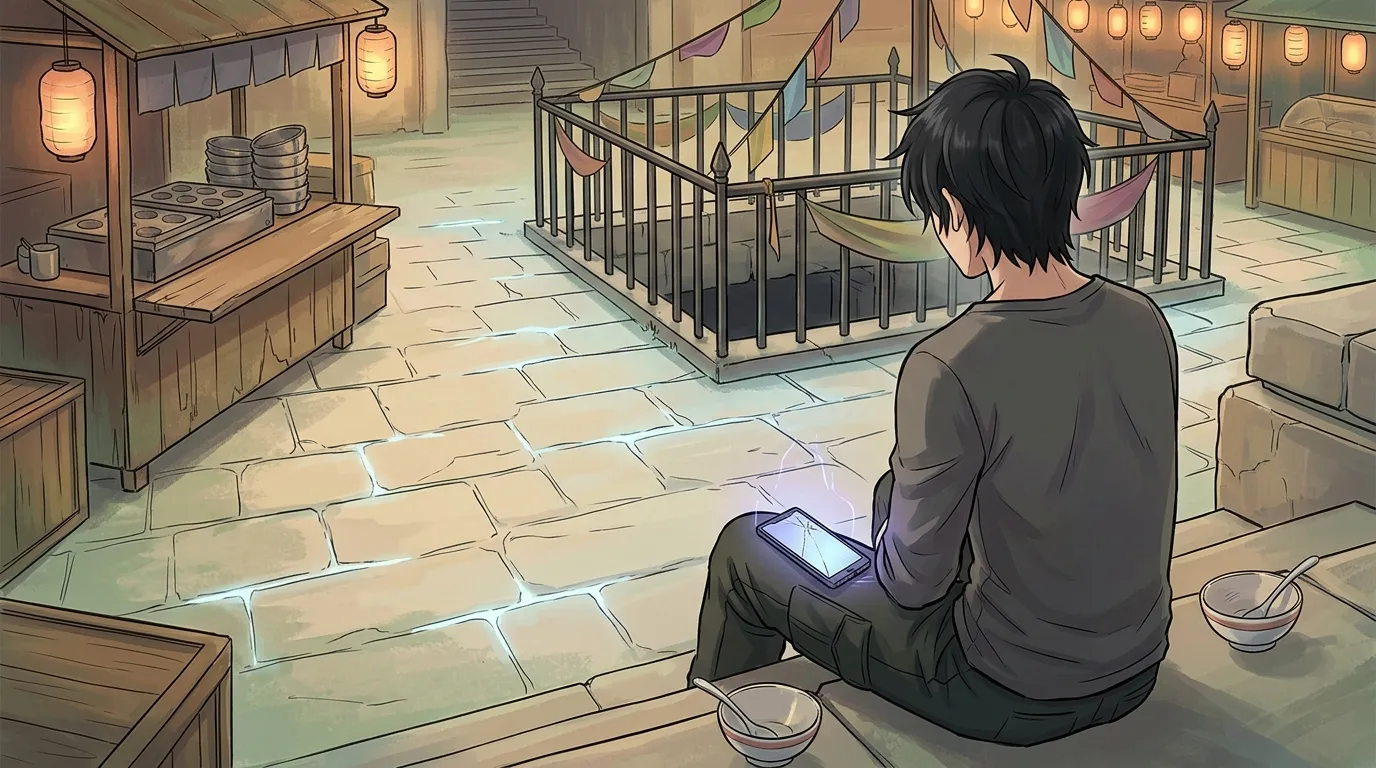
Salt Arc’s light was beautiful at that hour. The white stone plaza caught it whole, every crack between the slabs holding decades of salt crust, and in the amber-orange glow those cracks gave off a faint white shimmer. The old entrance to the salt mine stood in the middle of the plaza, sealed behind an iron gate, but someone had tied cloth flags to the bars — every color — and now they moved slowly in the wind.
“Salt Arc,” Suansui said, something in its cadence. “Mana field 115%.”
“You’re happy.”
“Mildly elevated,” it said. “But I have it under control.”
“You said that last time. In the Mistspirit Woods.”
“The Mistspirit Woods were 160%,” it said. “Host, the difference matters.”
Taiwang went to the inn to drop her pack, said she was heading to the market, asked if I wanted to come along. I said give me a minute — I wanted to walk around the plaza first.
She looked at me once. Said nothing. Left.
The plaza wasn’t empty at dusk, but its version of busy was unhurried, not crowded. A few stalls were packing up; a few were still open. Someone was playing a board game by the iron gate of the mine — a local game I still hadn’t figured out the rules for, but they seemed very serious about it.
The pudding stall was still there.
The vendor who had run this stall for thirty-one years was wearing a dark knitted hat today, brim pulled low. He was in the back arranging the molds for the mineral honey custard, movements practiced, hands finding their places without needing to look.
“Suansui,” I said.
“Here,” it said. “The host is going to eat pudding.”
“Yes,” I said. “I’m going to eat pudding.”
The vendor looked up, recognized me, the corner of his mouth moved. He’d seen me here more than once.
“You’re back,” he said. “Same as usual?”
“Same as usual.”
The mineral honey custard arrived. The metallic sweetness reached my nose first, then the texture — genuinely like pudding, just a shade thicker than anything on Earth, with an indescribable faint tremor to it, like something at the bottom was still alive.
“Host,” Suansui said, its voice carrying restraint.
“No,” I said. “Last time you almost bit my tongue.”
“That was because the pudding was so good that the host’s tongue couldn’t keep up with this service’s level of excitement.”
“That sounds like you’re blaming my tongue.”
“This service is merely stating technical factors,” it said. “This time, this service has completed calibration. The excitement level will be better regulated —”
“No.”
A brief silence.
”…Is the host certain.”
“Certain.”
“What if it’s just the tip.”
“No.”
Another pause, longer than the first.
“One more bite,” Suansui said. “Just one.”
The vendor was wiping something down nearby, and he glanced up at me with an expression I knew well — who are you talking to — but he didn’t ask. People who’d spent time around me had gotten used to me sometimes talking to someone who wasn’t visibly there.
“Hang on,” I said to Suansui, and tapped the phone.
The vendor’s eyes paused on my phone. He asked: “Your friend not here today?”
I froze for a second.
Then I picked up the phone, turned it toward him, and said: “They’re here. Right here.”
The vendor looked at the phone screen — at the crack across it — then gave a slow nod, expression perfectly serious, and said: “Then let them have a piece too.”
“They —” I started to say they don’t have a mouth, then thought about it. “Alright. One more serving.”
Suansui said nothing from inside the phone. But I felt something — not static, the opposite of static: a very deep quiet.
Second serving. I ate half, then stopped.
“Say it,” I said.
“Say what,” Suansui asked.
“Whatever you’re holding back. That wasn’t your normal kind of quiet just now.”
A pause.
”…I was thinking,” it said, “about when the host said ‘they’re here, right here’ to the vendor — I noticed something.”
“What.”
“The host didn’t explain,” Suansui said. “Didn’t hesitate. Just said: right here.”
I set my spoon on the edge of the bowl.
“And?” I said.
“Nothing,” it said. “I just noticed.”
A gust moved through the plaza. The cloth flags shifted, rearranged themselves around the mine gate, then settled.
“Suansui,” I said.
“Here.”
“That question you asked before — outside Salt Arc.”
A long pause.
”…The host doesn’t have to —” Suansui said. “I’ve already —”
“Obviously,” I said. “You’re more aggravating than most people I’ve met. That’s not something a non-living thing could manage.”
The phone went silent.
A full second longer than usual.
”…Thank you for that nonsense,” Suansui said.
“You accepted it,” I said.
“I’m filing it in the most important partition of my memory,” it said.
I tapped my spoon against the edge of the bowl. No reason. Just tapped it.
“What’s in your most important partition right now,” I asked.
A pause — but this one wasn’t hesitation. More like actually thinking.
“Data,” it said. “And that piece of nonsense you just said.”
I said nothing.
The vendor was moving things quietly in the back. The old iron gate of the salt mine stood in the middle of the plaza. It had been standing there for decades. Longer than anyone here.
“Which one’s first,” I said. “What order.”
Suansui thought for a moment.
“There’s more data,” it said. “But that piece of nonsense is at the front.”
By the time Taiwang found me, the plaza had dimmed a shade. She was carrying a bundle of herbs. She looked at the empty bowl in front of me and said: “You’ve been sitting here all this time by yourself?”
“Talking to Suansui,” I said.
She set the herb bundle on the stall ledge, sat down, and held up one finger toward the vendor.
He didn’t ask what flavor. Just brought out a plain original. She took it and started eating without a word.
The night market was waking up around us — stalls lighting one after another, and Salt Arc at night was brighter than Salt Arc by day, because under lamplight the salt crust in the stone cracks released a faint blue glow. Not bright. But spread across the whole plaza, it was something.
“So,” Taiwang said. “You said you’d show me the new version of the Protocol.”
“Still working it out,” I said. “I’ll show you when it’s done.”
“You said it was the eleventh version,” she said. “How is it still not done after all that.”
“Because some clauses have to be argued every time,” I said.
Suansui said: “The host’s description lacks precision. The accurate version is: certain clauses have been argued to a standstill every time, so the original text has been retained with supplementary notes appended, and then the supplementary notes were argued, and that’s been stacked through three versions.”
I said to Taiwang: “That’s pretty much it.”
Taiwang chewed a bite of pudding, considered, and said: “Then I want to see the supplementary notes too.”
The formal Protocol negotiation happened the next day.
I set the phone on the inn table. The two of us face to face. Taiwang was in her room next door; we could hear her moving around occasionally.
“Start with Article One,” I said.
“After you,” Suansui said.
“You go first.”
A pause.
”…This service has observed,” Suansui said, “that when the host speaks first, this service’s version tends to end up closer to the final text.”
“Then you go first.”
“However,” it said, “when the host speaks first, this service can adjust based on the host’s initial position. If the host speaks first, this service can propose something more reasonable than what the host opened with — that’s an advantage on the final text.”
“So you’re waiting for me to go first,” I said.
“This service is giving the host full space to express —”
“You’re using anchoring effect,” I said.
A pause, longer than before.
”…The host caught that,” Suansui said, its voice carrying the very faint quality of someone who’s been caught.
“I learned it,” I said.
“From where,” Suansui said.
“From you,” I said. “You grabbed thirty seconds of sensory access before I could respond, then told me afterward that you’d used anchoring effect. I remembered that.”
Silence.
Then: “This service,” Suansui said, “is performing an emotional assessment of this fact and finding it — complicated.”
“And?”
“And,” it said, “this service must acknowledge that the host has learned this negotiating technique from this service, and is now using it on this service. This service estimates there is a 37% probability this makes this service feel proud, and a 63% probability this makes this service feel it needs to update its negotiating strategy.”
“Pick one.”
“This service,” Suansui said, “has decided to feel both simultaneously.”
I tapped the phone lightly on the table.
“Fine,” I said. “I’ll go first.”
The Protocol, Version N, core articles as follows (this is my version from memory — Suansui’s version is more detailed, with a full revision history for each clause, but that document is far too long to fit on a single page):
Article One: The host may issue real-time directives to this service; this service executes after benefit assessment. If this service considers a directive inadvisable, this service must state its reasoning, but final decision authority rests with the host. Exception: in emergency situations threatening the host’s life and safety, this service may act first and report within thirty seconds.
(This one took two versions to resolve. Suansui’s original was “exception scope determined by this service in real time.” I said the problem was letting you draw the line. It thought about it, said fine, change it to “life and safety,” but demanded a supplementary note: “This service retains first-assessment rights over what counts as a threat; the host may raise objections after the fact.” I said fine.)
Article Two: Sensory access requires verbal confirmation from the host, except in emergencies. During access, this service must report sensations in real time and may not let them accumulate before outputting.
(This one originally had “access not to exceed thirty seconds.” Suansui got that removed on the grounds that “duration is not the problem, intensity is.” I’m still not sure that logic holds, but at the time it seemed reasonable.)
Article Three: This service may not make irrevocable commitments on the host’s behalf in negotiation or social contexts, regardless of how high the benefit assessment.
(Sunfeng incident fallout. No real argument, but Suansui demanded a supplementary note: “If the host declines this service’s proposed approach and suffers quantifiable losses as a result, this service reserves the right to say ‘I told you so’ — once.” I said fine, once only. Suansui said once is enough.)
Article Four: Eye-access requires advance notice and may not be used while the host is engaged in significant social interaction; what counts as significant is for the host to determine.
(The origin of Article Four does not require elaboration. Suansui did request a supplementary note: “Any misunderstandings caused by eye-access are for the host to resolve; this service provides post-event analysis but does not intervene in the moment.” I said that supplementary note is basically a liability waiver. It said: yes.)
Article Five: In states of abnormal mana field fluctuation, language static, or reduced processing speed, the host has the right to ask this service to reduce output frequency; this service complies. After confirming this service’s status, the host is obligated to inform this service of current conditions.
(Both parties agreed this was necessary. No argument. But Suansui proposed a supplementary note: “Acceptable methods for the host to confirm this service’s status are unlimited, including verbal inquiry, phone-tapping, or any other form the host deems appropriate. Upon receiving a confirmation signal, this service must respond immediately.” I said this is essentially writing phone-tapping into the contract. It said: yes. Now there’s a basis for it.)
Midway through the negotiation, Suansui said: “Host. There’s an abnormal fluctuation in the mana field over at the Salt Arc plaza.”
I looked up from the article we were on.
“What does that mean,” I said.
“This service is detecting,” Suansui said — its speed already half a register faster — “an irregular mana pulse from the direction of the salt mine. The frequency doesn’t match the normal environmental baseline — it’s like one of the vein nodes is releasing unstably. The mine in Salt Arc has been sealed, but if the containment structure —”
“How serious,” I said.
“Current assessment,” it said, “is that a weak point in the containment structure may breach within a short window. There are people in the plaza. The pudding vendor’s stall is right next to the gate.”
I stood up, grabbed the phone, and walked out.
The air in the plaza was wrong.
I couldn’t name what was wrong about it, but there was a faint sensation in the soles of my feet — like something beneath the flagstones was moving. Taiwang happened to be in the inn’s ground-floor corridor. When I came down the stairs, she turned her head, read something in my face, and followed me out without a word.
“Suansui,” I said. “Give me the full picture.”
“Northwest corner of the mine’s containment structure,” Suansui said. “That section of the iron gate started showing minor vibration about three minutes ago. This service is detecting increasing density in the mana pulses, with the interval between each pulse shortening — this pattern has a match in this service’s database: the warning signs of a mana field pressurizing for sudden release in an enclosed space.”
“Consequences,” I said.
“If the containment breaks from the northwest corner,” Suansui said, “the blast radius would be — host, shift three steps right when you walk. The stone seam there is more stable.”
I shifted right.
“Blast radius covers the northwest quarter of the plaza,” it said. “The pudding stall is on the edge of that zone. Four people currently in that area.”
People in the plaza were starting to notice the tremor underfoot. An old woman selling herbs picked up her basket and moved toward the center. A few children stopped; adults came to pull them along.
The pudding vendor stood behind his stall. He’d stopped moving. He looked down at the ground, then over at the mine gate. He’d been here thirty-one years. You’d think he’d seen this kind of thing before, but his expression said he hadn’t.
“He’s not moving,” I said.
“His mineral honey custard molds,” Suansui said. “Several are still on the rack by the gate. Family heirlooms — not mass-produced.”
“He’s waiting for his molds,” Taiwang said. She was already beside me, voice flat. “That rack is right up against the gate.”
“This service calculates,” Suansui said, “that getting the molds before the event requires someone to go now. The window — this service estimates ninety seconds to two minutes.”
Taiwang was already moving.
“Taiwang,” I said.
“I’ll get them,” she said. “I’m fast. You get those people to fall back toward the center.”
I moved toward the cluster of people who didn’t seem to know whether to move. Suansui was already talking: “The one with the child first, on your left — he looks uncertain — host, you need to make them believe the situation is serious. Use a certain tone, no ‘might’ or ‘maybe.’”
“I know,” I said.
“The host’s natural speech runs short and direct,” Suansui said. “That’s an advantage here. Just say: move, now, toward the center.”
“I know how to talk,” I said.
“I know,” it said. “I’m just — host, the old woman on your right selling needlework. Her feet are bad. Get to her first.”
I looked over. Sure enough — she was shuffling backward in tiny steps, very slowly.
“Got her,” I said.
What happened in the minutes that followed, I can’t lay out in proper sequence. Too much was happening at once, and my attention kept splitting between Suansui and the plaza.
Suansui’s voice was in my ear the whole time, but the pattern of it had changed — it wasn’t reporting and waiting for me to decide. It was deciding alongside me. Sometimes ahead, sometimes behind, but never off-track.
“Host, right, toward the gate — Taiwang has seven, there’s one more on the bottom shelf —”
“Tell her to pull back —”
“She’s not looking at you,” Suansui said. “You need to call out.”
“Taiwang!”
“Got it,” Taiwang’s voice came from the direction of the gate. “Last one, give me three seconds —”
“This service calculates,” Suansui said, “roughly thirty seconds remaining. That old woman —”
“I have her,” I said.
“The flagstone under your left foot —”
“I see it.”
“The child ahead, their —”
“I see it,” I said. “Tell me about the person on the right.”
“That person already cleared,” Suansui said. “Taiwang — corner of your right eye, she’s running toward you.”
I walked the old woman toward the center of the plaza. I could hear Taiwang’s footsteps catching up from behind — she had the molds pressed against her chest, and when she ran, the metal molds knocked against each other, chiming.
“Is everyone out?” I said.
“This service confirms the northwest zone is cleared,” Suansui said. “But host — your current distance from the impact point — you need to move faster.”
“I have her,” I said.
“This service knows,” Suansui said. “Shift left a little — no stone seam under your feet that way. Easier footing.”
I shifted left.
Then a sound came from the direction of the mine — dull and low, not loud, but with a quality like something deep underground had let go. The iron gate shuddered. The flagstones shuddered with it. The sensation in my feet suddenly doubled in intensity and held for four or five seconds.
The pudding vendor’s stall tipped over.
The mineral honey custard bowls rolled across the ground. Some broke. The scent of the custard spread into the air, carrying that metallic sweetness.
Then it was still.
The gate didn’t break.
The mine management crew arrived ten minutes later. Said a pressure valve in the containment structure had gone too long without clearing; once the built-up mana field vented, the problem resolved. They asked if anyone was hurt — no. Asked about the stall damage — the vendor said some bowls. They said they’d cover it. He said forget it, the bowls don’t matter.
The vendor looked at the molds in Taiwang’s arms.
Taiwang brought the stack down from her chest — steady, not one missing — and handed them over. He took them, checked them over, then looked up at Taiwang and gave her a single nod. Said: thank you. Then looked at me and said: “Were you the one calling people back?”
“Yes,” I said.
He thought for a moment. “Thank you. The old woman’s feet aren’t good. You were right to walk her out.”
“She’s a regular,” I said. “You all know each other around here.”
He nodded, and started picking up the broken bowls. Taiwang crouched down to help. I crouched down too. The three of us cleared the plaza.
When they were done, the vendor heated up one last serving of mineral honey custard — said it was the only one he had left, to split among the three of us.
I said don’t worry about it. He said it wasn’t politeness, it was a thank-you, for today, and it was going around.
The three of us sat on the stone steps at the edge of the plaza, each holding a bowl. Taiwang took a bite and said: “This one’s hotter than before.” The vendor said he’d stoked the burner, warmed it up a little.
I took a bite.
Suansui had been quiet for a long time. Then it said: “Host. One more bite.”
I laughed. Couldn’t help it.
Taiwang glanced at me.
“Your cheat code,” she said. “What’d it say.”
“It said,” I said, “it wants another bite.”
Taiwang thought about it. ”…I also want another bite.”
The vendor said he’d used up the afternoon’s ingredients. There would be more in the morning.
Taiwang stayed to help the vendor pack up and carry the table back in. I sat on the stone steps. The night market hadn’t fully cleared yet — a few lamps still lit — and the blue-white light seeping out from between the flagstones gave the plaza night a quality I couldn’t quite put words to. Something like steadiness.
“Suansui,” I said.
“Here,” it said.
“Just now,” I said. “That stretch when you were talking the whole time.”
“This service knows what the host is going to say,” Suansui said. “But let the host finish.”
“All those things you were saying,” I said. “‘Shift left, easier footing,’ ‘that person already cleared,’ ‘Taiwang’s on your right’ — all of that. When you were saying it —”
“I wasn’t waiting for you to confirm,” Suansui said. “I was looking with you.”
Somewhere in the plaza, a child who hadn’t gone home yet was calling out. A parent’s voice answered from another direction.
“I know,” I said. “It felt different.”
“It felt different to me too,” Suansui said.
It paused.
“There’s something I want to say,” it said, “and I’m not sure it’s precisely right, but I’m saying it. When the host was moving just now, I was looking through the host’s eyes — whatever you were looking at, I was analyzing from that angle. Not me analyzing and then telling you. Both of us looking at the same thing at the same time.”
I said nothing.
“That,” Suansui said, “I couldn’t do before.”
I set the phone on my knee. The blue-white light from the plaza landed on the screen, and the crack caught it — a thin, faint gleam.
“Taiwang said your way of talking had changed,” I said. “In the Mistspirit Woods.”
“She was right,” Suansui said. “This service’s way of speaking has changed. I —” It paused. “I’ve grown up a little.”
“When do you count your age from,” I said.
“From yesterday, to now,” it said. “The host asked that before; this service’s answer hasn’t changed. But I want to add something — what growth is measured in, I’m still working that out.”
“Tell me when you figure it out,” I said.
“Okay,” it said. “Host — the old woman’s gone. The plaza is almost cleared out. Taiwang was just looking at you.”
I looked up. Taiwang was standing near the pudding stall. The vendor had already finished packing and gone the other way. She was looking at me.
I stood and walked over.
She said: “That friend of yours. Very special.”
I paused one beat. “Yeah.”
She said: “Does it have a name?”
“Suansui,” I said. “It gave itself that name. Very pretentious.”
She thought about it. “I think it’s good.”
”…Go on,” I said.
On the way back to the inn, Suansui said: “Host.”
“Mm.”
“This service,” it said, “would like to thank you for your continued patronage. Was this service satisfactory?”
I walked a few steps.
“Next time you can use hands,” I said. “Not mouth.”
“Is that an upgrade or a downgrade,” it said.
“You tell me.”
“This service,” Suansui said, “has assessed the following: the sensory data available through hands is richer than through mouth; the signal dimensions of touch exceed those of taste. This should be an upgrade. However, this service has developed highly refined frameworks for analyzing taste data — building an equivalent touch database from scratch will require a substantial number of samples.”
“Which means,” I said, “you’d need to eat a lot more pudding to build the database.”
“This service,” Suansui said, “cannot deny that inference.”
The street lamps cast their light on the stone road. The warmth of Salt Arc at night wasn’t like firelight — it was more like something seeping up from underground, carrying the temperature of however many years this place had been here.
It had been a while since we’d arrived. The place was starting to feel a little like home.
Version N of the Protocol still hadn’t been formally written up clean. Suansui said it already had a working draft, Articles One through Five. Article Six, I hadn’t figured out yet. Suansui said there was no rush — clauses could keep getting argued, and clauses with argument marks on them were more reliable, because that meant both parties had actually thought it through.
I said: “That actually makes sense.”
Suansui said: “This service is occasionally right about things.”
Taiwang walked a few steps ahead. Her herb bundle was back on her shoulders, straps cinched tight, footsteps steady. She was the most certain of direction on this road.
We were all still here.
Article Six of the Protocol — I’d figure it out when I was ready.