Chapter 1
The Bulletin Board
Chapter 1: The Bulletin Board
Cai Yaoting had been waiting at the front entrance for fifteen minutes when he finally spotted Fang Dingyuan turning in from the lane.
Fang Dingyuan was in a full suit, briefcase in hand, a faint sheen of sweat on his forehead. Cai Yaoting’s first thought: this man looks like an ornamental fish that swam into the wrong pond. The entrance to 147 Yonghe Street was Hong Xiuzhi’s corner shop and a Chinese perfume tree that had grown up past the second floor — not exactly the setting for receiving high-powered visitors.
“Mr. Fang, over here, over here.” Cai Yaoting stepped forward, the keys on his belt loop jingling with every stride. He’d put on a collared POLO shirt especially for the occasion — navy blue, collar standing up. “I’ll tell you, third floor is the most convenient, I’ve already cleared out my living room, chairs are all arranged.”
Fang Dingyuan gave a slight bow and held out a gift bag. Cai Yaoting took it and gave it a heft. Mangoes, by the weight of it.
“You really didn’t have to.” He said the words; his hands had already set the bag on the shoe cabinet.
“Let’s go, let’s go, up we go. Residents arrive at three. We should get up there and get ready.”
He didn’t wait for a response before turning for the stairs. Two steps up, something occurred to him and he turned back. “Oh — did you bring a cable for the projector? VGA. I’ve got an old projector at home but I can’t find the cable anywhere.”
“I’ve got my laptop, it has HDMI—”
“My projector doesn’t take HDMI.” Cai Yaoting waved a hand as if shooing a fly. “Doesn’t matter, we’ll figure it out. I’ve got a backup plan. Don’t worry.”
He didn’t have a backup plan.
Third floor, left side — that was Cai Yaoting’s domain. His decision to knock out the interior partition wall ten years ago had caused quite a stir — Guo Boyan had argued the wall was shared, he couldn’t just take a sledgehammer to it whenever he liked. But Cai Yaoting had knocked it out anyway. The wall’s disappearance had turned his unit into the largest indoor space in the building, which meant it had naturally become the default venue for residents’ meetings.
Right now that living room had been converted into a makeshift conference room. Twelve plastic chairs arranged in three rows, a printed agenda sheet on every seat. The dining table had been pushed to one side to serve as a lectern, upon which sat the projector, a cup of oolong tea, and three manila folders. Mrs. Cai had brewed a large pot of tea and left it on the counter, flanked by a row of mismatched mugs.
Cai Yaoting switched on the projector. A white beam of light hit the wall directly between the air conditioner and a calendar. He nodded with satisfaction.
“Mr. Fang, can you get your presentation—”
“No connection.” Fang Dingyuan was already crouching beside the projector, trying for the second time. “This model only has VGA.”
“Zhou Mingda’s bringing his laptop down,” Cai Yaoting said, glancing at his phone — a notification had just pinged the group chat. “He’ll be here in a bit.”
At ten minutes to three, Zhou Mingda and Zhao Peiyun arrived with a MacBook in tow. Zhao Peiyun fished an adapter from her bag.
“HDMI to VGA—” She held it out.
Fang Dingyuan took it and tried the connection. All three of them huddled around the projector like surgeons over a critical patient.
“No picture.”
“That’s a Mini DisplayPort, not HDMI.” Zhou Mingda pushed his glasses up for a closer look.
Cai Yaoting felt a pulse start up in his temples.
“All right, fine, forget the projector.” He pulled a stack of paper from under the table. “I printed handouts. One per person, twelve copies, including the cover page.”
Fang Dingyuan looked at the photocopied sheets bearing the official stamp of the 147 Yonghe Street Residents’ Committee — with the stamp applied at a slight angle, he noticed — and something shifted faintly at the corner of his mouth. He put away his laptop and settled into the chair Cai Yaoting had designated as the “presenter’s position,” which was the chair beside the dining table. His dress trousers left two crease marks on the white plastic.
Three twelve. Cai Yaoting counted heads.
Lu Zhensheng had arrived first, planting himself dead center in the front row, his whole energy suggesting someone determined to be first against the barrier at a concert. Xu Guanghui came in slowly and took the window seat in the back row; his metal-frame glasses caught the fluorescent light. Guo Boyan shuffled in wearing slippers, swept the room, and chose the corner farthest from Cai Yaoting. Hong Xiuzhi brought up a bag of senbei crackers from her shop downstairs, sat in the other corner of the back row, and set the bag at her feet. Zhou Mingda and Zhao Peiyun sat side by side in the second row; Zhao Peiyun opened her laptop to a spreadsheet.
Cai Yaoting cleared his throat.
“Good afternoon, everyone. Today’s information session has been formally arranged by the residents’ committee to give Mr. Fang — Mr. Fang Dingyuan of Dingfeng Construction — the opportunity to come and discuss the urban renewal proposal with us in person.”
He lifted the agenda sheet.
“Before we get to that, let’s confirm the minutes from the last residents’ meeting. Last time was—” he flipped a page— “September of the year one-twelve. Main agenda item was the intercom replacement.”
“That was three years ago.” Lu Zhensheng snapped his paper fan shut with a crack.
“Right, which is exactly why we should confirm it,” Cai Yaoting said primly. “The conclusion last time was to table the intercom replacement and keep the existing system. If there are no objections, we’ll just—”
“Chairman.” Guo Boyan’s voice came from the corner. Not loud, but precise. “We’re not here for the intercom.”
Cai Yaoting’s neck went stiff for a half-second. “Of course, I know, I’m just following procedure—”
“Get to the point.” Lu Zhensheng said this while looking directly at Fang Dingyuan, like a man ordering from a menu.
Cai Yaoting swallowed a breath and skipped three items on the agenda. “Right, then let’s have Mr. Fang begin.”
Fang Dingyuan stood. He undid the buttons on his suit jacket — a small move, but it made him look fractionally less like he’d arrived from another planet.
“Good afternoon, everyone. I’m Fang Dingyuan, community development manager at Dingfeng Construction.” His pace was half of Cai Yaoting’s, his voice measured, like someone reciting a script he had memorized but was careful to deliver as if he hadn’t. “I’m very grateful to the chairman for arranging this, and I’m glad to have the chance to speak with each of you face to face.”
He raised a hand toward the second page of the handout.
“Your building was constructed forty years ago. Under the government’s Urban Renewal and Hazardous Building Act, properties like this are eligible for redevelopment. What does that mean for you? The government grants a floor area bonus — in plain terms, the new building can be larger than the current one. The current bonus tier is at its maximum, but it decreases every year. So the earlier you apply, the more floor area you can gain.”
Zhou Mingda had already started punching numbers into a calculator. Zhao Peiyun was typing beside him, fast enough that people nearby looked over.
“After rebuilding, each of you would exchange your current unit for a new one. We call it a rights conversion — in plain language, your old unit becomes a new one of equivalent value.”
“One square meter for one square meter?” Lu Zhensheng asked, faster than anyone else could get the words out.
Fang Dingyuan paused half a beat. “Our proposal is designed to ensure that nobody loses living area. The specific calculation depends on each unit’s situation, and I’m happy to go through that with everyone individually.”
Cai Yaoting noticed that Fang Dingyuan hadn’t actually answered the question. He said nothing — Fang Dingyuan was his guest, and this room couldn’t fall apart on day one.
“Where do we live while they’re tearing it down?” Hong Xiuzhi’s voice came from the back row, unhurried.
“There’s a relocation allowance. The government provides a rental subsidy, and the company will help provide information on temporary housing options. Construction should take eighteen months to two years.”
“Where does my dog go?” Lu Zhensheng asked.
Fang Dingyuan’s pen made one slow rotation between his fingers. “Pets are absolutely welcome to come with you. As for the rental situation—”
“Rental places don’t take dogs.” Lu Zhensheng’s volume climbed. “You know how big mine is?”
“Lu-ge,” Fang Dingyuan said, maintaining precisely the right arc in his smile, “we will absolutely work that out. Let me look into the pet-friendly options for you and get back to you.”
Cai Yaoting seized the opening. “Good. Anyone else with questions can hold them until Mr. Fang is—”
“There’s a condition he hasn’t mentioned yet.” Guo Boyan’s voice cut in.
Everyone looked toward the corner. Guo Boyan’s mouth pulled up on one side — the expression that looked like a cold smile but wasn’t. He turned to the last page of his handout.
“This whole thing requires unanimous consent from every resident. Correct?”
Fang Dingyuan nodded. “That’s right. Under the Act, all property owners must agree.”
“So if one unit doesn’t sign, the whole thing collapses?”
Fang Dingyuan nodded again. This time he didn’t follow it with anything.
Two seconds of silence. The compressor hum of the air conditioner suddenly felt much louder, as if someone had turned up the volume.
“So the question isn’t whether we agree,” Guo Boyan said, setting down his handout and leaning back in his chair. “The question is whether everyone agrees.”
The words landed in the room like a stone dropped into still water. Cai Yaoting felt eyes drift in different directions — someone glanced toward the door, someone else looked at their phone. Nobody looked up toward the top floor. But Cai Yaoting knew that at least three people were thinking the same name.
Fang Dingyuan opened his notepad and wrote something quickly. “Mr. Guo is absolutely right, and that’s precisely why we place such emphasis on communicating with every resident individually—”
“Is there a deadline?” Xu Guanghui asked. It was the first thing he’d said the entire meeting. His voice was quiet but clean, like chalk meeting a blackboard.
Fang Dingyuan looked at him. “Yes. The contract period is thirty days. If unanimous consent isn’t reached within thirty days, the contract expires.”
“Combined with the bonus reduction,” Zhao Peiyun said, looking up, “what you’re saying is: if it doesn’t happen this time, the terms will be worse next time?”
“That’s one way to put it.”
Cai Yaoting felt this moment slipping and moved to reclaim it. He stood; his keys made their circuit of sound.
“All right. I think Mr. Fang has covered the essentials. Everyone take some time to think it over; questions are welcome in the group chat anytime. I’ll also compile today’s minutes and post them on the bulletin board—”
“The chairman will handle it,” Lu Zhensheng said, in a tone that could have been a genuine endorsement or a very accurate imitation of one.
Cai Yaoting chose to take it as an endorsement. “That’s right. I’ll handle it. All right — we’ll wrap up here.”
No one applauded. The scraping of plastic chairs on the floor filled the silence instead. Fang Dingyuan stood beside the dining table talking to Lu Zhensheng, who had materialized at his elbow. Zhao Peiyun was pointing at something on her screen while Zhou Mingda leaned in to look. Xu Guanghui was the first to leave — he picked up the cloth bag from his chair, gave Cai Yaoting a brief nod, and was out the door. At the exit, Guo Boyan and Cai Yaoting made eye contact for less than a second. The look contained everything and nothing.
Hong Xiuzhi was the second-to-last to go. As she passed Cai Yaoting, she gave his arm a pat.
“You’ve worked hard, chairman.”
He couldn’t tell whether she was complimenting him or consoling him.
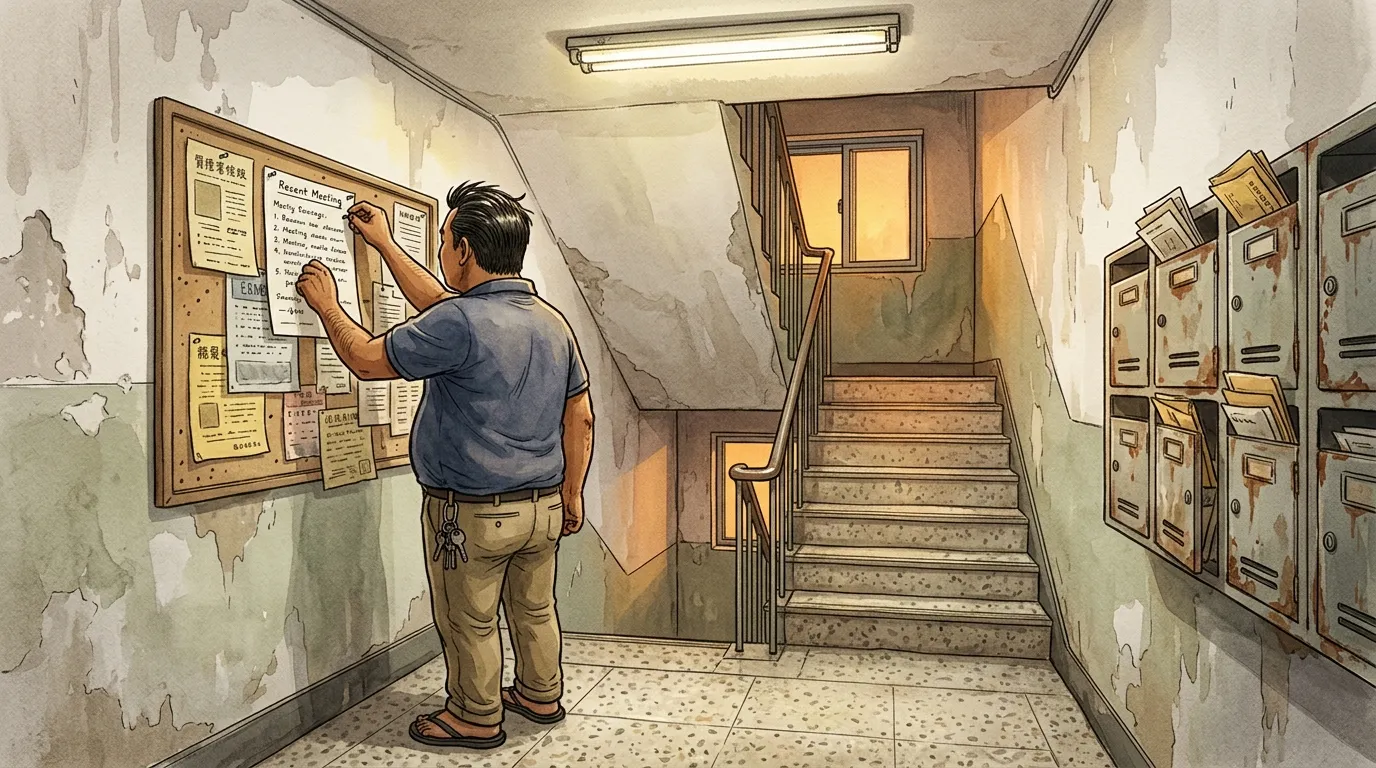
Six o’clock. The first-floor bulletin board.
Cai Yaoting pinned the meeting minutes to the corkboard with thumbtacks, pressing them down through three layers of old flyers underneath. His handwriting was large and forceful; the marker ink bled faintly at the edges into the cheap photocopy paper.
147 Yonghe Street — Residents’ Information Session: Summary — he pressed the residents’ committee stamp beside the title. The stamp landed crooked. But stamped was stamped.
He stepped back to look. It wasn’t just the stamp that was crooked — the whole sheet was on a slight angle. He pulled out the bottom-right thumbtack and re-pinned it, then decided the left side was too high.
Whatever.
The motion-sensor fluorescent light in the stairwell flickered on at the noise of his thumbtacking, then went dark again. The air outside was thick and sticky with summer evening, carrying traces of cooking oil drifting down from the upper floors. He could hear someone on the fifth floor bringing in laundry, the metal hangers knocking together with a faint jingle.
His gaze moved from the bulletin board to the mailboxes beside it. Ten slots embedded in the wall. Most of the locks had failed — the boxes hung half-open, stuffed with utility bills and advertising flyers.
Chen Sulan’s slot was easy to pick out. Her lock still worked, but the box itself was jammed so full it could barely close. Cai Yaoting touched the edge; his fingertip caught a corner of yellowed paper. He thought back to the last time he’d collected management fees, when Chen Sulan had handed him an envelope at her door with flour still on her hands. When was that? Last month, maybe.
Then it occurred to him.
He pulled out his phone and scrolled up in the group chat to the meeting notice. Everyone had responded with “noted” or a thumbs-up sticker. Chen Sulan’s message showed no read receipt — but that wasn’t unusual. Her son had set up her phone for her, and her leaving things unread was standard operating procedure.
But she hadn’t come today.
The entire meeting, start to finish — Chen Sulan had not appeared.
Cai Yaoting stood at the mailboxes for a moment, then turned for the stairs. His slippers slapped against the terrazzo steps; his keys kept up their rhythm. First floor, second floor, third floor — he passed his own door without stopping — fourth floor, fifth floor.
The stairwell between the fifth floor and the top floor was narrower than the rest. At the top was a pale-green metal door, paint flaking, like a very old person doing their best to remain upright.
He knocked three times.
No answer.
He knocked again, three more times, a little harder.
“Mrs. Chen? It’s Cai Yaoting. We had the residents’ meeting today — I printed a copy of the minutes, thought I’d bring one up for you—”
Silence from behind the door. But Cai Yaoting’s nose twitched.
Braised pork.
Unmistakably, wafting through the gap under the door — the slow simmer of soy sauce and rock sugar, the under-note of star anise coming through. Chen Sulan’s braised pork was known to the whole building; she used to send portions around in containers via Mrs. Cai every Lunar New Year — but that was before. Before things changed.
She was home.
Cai Yaoting lowered his hand. He stood at the pale-green door and listened. Under the silence, faintly, a radio. He looked down at the rolled-up meeting minutes he’d been holding; the paper had gone soft with sweat.
He almost knocked again. His hand stopped mid-air.
A line of dim yellow light showed at the bottom of the door.
Cai Yaoting rolled the minutes into a tighter cylinder and tucked them into the old wooden mailbox fixed to the wall beside the door — a handmade thing, the wood gone gray and weathered. He slid the paper in, turned, and headed back down the stairs.
The sound of the keys travelled through the empty stairwell for a long time after he was gone, each floor taking it a little farther away.