Chapter 2
For Two
Chapter 2: For Two
Chen Sulan woke at six fifteen. Same as yesterday. Same as the day before.
The refrigerator compressor hummed inside the corrugated tin walls, churning the sound into a low blur. The radio had been running all night; the station had cycled from late-night music to morning news. The announcer was giving a typhoon update — still far from Taiwan, but speaking with enough gravity to suggest it might arrive by tomorrow. She turned the volume down one notch and sat up, lowering her feet into the plastic slippers beside the bed.
The floor was cool. That was the only good thing about a tin-roofed shack in the early morning — before the sun came to bake it through, the concrete held onto a little of the night’s coolness. By noon it would be another matter entirely.
She stood, and passed the pillow on the other side of the bed. It sat neatly where it always did, the crease down the center of the pillowcase still visible from when she’d changed it two days ago — nothing had touched it since. She didn’t look at it. But as she passed, her fingers caught the edge of the pillow.
Cool.
She washed her face. Rubbed on a thin layer of Vaseline. Combed her graying hair with the sandalwood comb — the one Qishan had carved for her fiftieth birthday, the wood much darker now than when he’d first made it. A few strokes, then she set the comb back in its place beside the mirror.
Then she went to the kitchen and started the rice.
Two cups, measured with the rice cooker’s cup. Water up to the second line. Her hands moved between the cup and the cooker with a fluid economy, like stitching along a straight seam — no need to look; her hands knew where to stop.
Two cups.
She pressed the switch down.
She filled the kettle and lit the gas burner. The flame was blue at the center, with a ring of orange at the base — the burner was old, overdue for replacing, but she hadn’t replaced it. While she waited for the water to boil, she took out two cups. Her white porcelain one, and Qishan’s — dark moss-green, with a ring of tea stain at the bottom that she’d scrubbed many times but never quite removed. It had grown into the glaze, that stain.
Tea leaves. A pinch in each cup.
She carried both cups to the sitting room. Qishan’s recliner sat by the window, the leather worn through in long splits along the seat — lines of use, the shape of them like rivers pressed flat. She set the moss-green cup on the low stool beside the recliner, in the spot where his hand could reach it without effort.
The tea’s steam rose in the morning light.
Chen Sulan settled into the chair opposite and took a sip from her own cup. On the radio, a different announcer had taken over to read the agricultural prices.
At nine ten, she picked up her market basket and went downstairs.
At the iron door, she saw a roll of paper stuffed into the mailbox. It was sticking out halfway, its edges softened by the night’s damp. She knew what it was — someone had knocked yesterday evening; she hadn’t answered.
She pulled the paper out. It was rolled unevenly, the cylinder slightly lopsided. She didn’t open it. She folded it twice and tucked it under the other things in her basket.
As she drew her hand back, her fingers grazed the wooden frame of the mailbox. The grain had been worn rough by weather; she could feel the texture against her fingertips — deep grooves and shallow ones, like rings of a tree brought to the outside. Her hand paused for a moment, then she withdrew it and went downstairs.
Ten minutes on foot to Dongxing Market. Her route hadn’t changed in thirty years: out to the lane, left turn, past Azhu’s breakfast shop to buy soy milk, then straight down Minsheng Road to the market entrance. Azhu had it ready the moment she saw her — warm, lightly sweetened, tied up in a plastic bag.
“Morning, Grandma.”
“Morning.”
The same exchange every day. She liked that it was the same.
Under the market awnings it was hot and loud. Chen Sulan walked to the pork stall, where Huang-laoban was cleaving ribs against the block — a steady thock-thock-thock, each blow landing on the beat.
“Mrs. Chen! Good trotters today, want some?”
“Just ribs. Half a catty.”
“Half a catty’s not enough, with just you—” Huang-laoban’s cleaver paused for half a count. “Old Wu’s not with you today?”
“He went to exercise.”
The cleaver came down again, but the rhythm had shifted — a little slower than before, not quite matching what it had been. He didn’t look up. “Right. Half a catty of ribs. Want some daikon? Good price today.”
“All right. One piece.”
“One piece is nothing, I’ll give you two for the price of one.”
“Two, then.”
She moved to the vegetable stall and bought a bunch of water spinach and a few scallions. The vendor, Axia, slipped two chili peppers into the bag as she packed things up.
“A gift.”
“You do this every time.”
“You come every time.”
Chen Sulan smiled — small, just a shift at the corner of the mouth, but enough.
She made her circuit through the market and came out with a full basket, heavy enough that she shifted it in front of her and held it with both hands. The same amount as before. Before, it fed two people; whatever Qishan didn’t finish, he’d pack for his lunch the next day. Now she still bought the same amount. What didn’t get eaten went into the refrigerator, and what was still there on the third day went into the bin.
She knew. But her hands didn’t know how to buy half as much.
At two in the afternoon, someone knocked.
Chen Sulan had just finished the dishes, her hands still wet. Her first reaction to the knock was to check the clock — Cai Yaoting usually came in the evenings; this was the wrong time.
Three more knocks.
“Auntie Chen? It’s Cai Yaoting.”
She dried her hands on her apron and walked to the door.
“Yaoting, is it.” She said it through the door.
“Auntie, I wanted to talk to you about the residents’ meeting the other day—”
She opened the door. Cai Yaoting stood in the doorway, his belt-loop keys still swaying. He was in khaki shorts and a POLO shirt with a collar that had gone soft from too many washes; in his hands was a container with a lid.
“Mrs. Cai made too much chilled sweet cake,” he said, pushing the container forward. “She said we’d never get through it all.”
“That’s very kind of you. Come in, sit down.” She took the container and stepped back to let him pass.
He followed her inside. The tin-roofed sitting room was small but kept very clean. Photographs stood on the old wooden cabinet; a fan turned in the corner; only one of the ceiling light’s bulbs was on. He noticed a cup of tea on the low stool beside the recliner, the color in it deep and dark, as though it had been sitting there a long time.
Chen Sulan was already in the kitchen, pouring tea.
“Auntie, you don’t have to—”
“Sit down.”
She came out with a cup, then went back for a plate of peanut candy. The pieces were arranged in even rows.
Cai Yaoting sat in the plastic chair and accepted the tea. He wasn’t thirsty, but Chen Sulan had already settled into the seat across from him with the plate of peanut candy between them. He felt himself pinned to his chair by something invisible — getting up to state his business would be too abrupt; staying seated, the candy sat there like a very small shield.
He drank some tea. It was fragrant.
“Auntie, you know about the residents’ meeting the other day, right?”
“I know.”
“The developer came to explain the whole proposal—”
“Have some peanut candy.”
He picked up a piece and bit into it. Peanut powder fell on his shorts. He brushed it off while continuing: “It’s the urban renewal program, government-subsidized, the terms aren’t bad—”
“How’s your son doing with school these days?”
”…Fine, mid-terms just finished.” He’d been redirected, but tried to circle back. “Auntie, about that proposal—”
“We can talk about that later.” She lifted her own teacup and sipped, her tone as level as a weather report. “How are you and Mrs. Cai? Is her breakfast shop busy?”
Cai Yaoting opened his mouth, then closed it. He looked down at the peanut powder on his shorts and had the sudden sense that it was a kind of marker — you’ve been looked after, that’s enough.
He finished the second piece of candy. He finished his tea.
“Well, I’ll head back down. Auntie, do take a look at the documents when you get a chance — the ones in the mailbox.”
“Of course.”
“I’ll come back up and talk it through with you another time.”
“Of course. Take the peanut candy home.”
She tipped the whole plate into a plastic bag, tied the top, and handed it to him. As Cai Yaoting took it, he felt a force that was gentle and unexpectedly difficult to argue with. He had been welcomed, he had been thanked, he had been sent off with a bag of peanut candy. And from start to finish, she had not said a single no.
The keys jangled their way down the stairs.
Chen Sulan stood at the door and listened, waiting until the sound was completely gone before she eased the door shut.
At half past four in the afternoon, there was another knock.
No keys this time. The rhythm was different — three knocks, evenly spaced, measured force. Not the knock of a neighbor.
“Good afternoon. Is this Ms. Chen?”
She didn’t recognize the voice. Young, Mandarin, polite in a way that had a certain firmness to it. She looked through the peephole — a young man in a POLO shirt, a paper bag in hand.
She opened the door halfway.
“Hello. I’m Fang Dingyuan, from Dingfeng Construction.” He gave a slight bow and held out the paper bag with both hands. “This is a small token — Irwin mangoes from Pingtung, from a friend’s orchard.”
“Mangoes?” Chen Sulan took the bag and gauged the weight. Heavy. She looked at him. “And you are?”
“I’m handling the preliminary communications for this building’s redevelopment.” Fang Dingyuan’s pace was half a beat slower than standard sales-pitch speed. “I was also at the residents’ meeting the other day.”
“Oh.” She opened the door a little wider. “Come in, sit down.”
Fang Dingyuan stepped inside. His eyes made a quick circuit — the wooden furniture, the framed photographs, the cushion on the recliner. His gaze landed on the cold cup of tea beside the recliner and stayed there for less than a second.
“Is Mr. Wu not home?” His voice was easy.
Chen Sulan was in the kitchen, pouring tea. Her hand hesitated — the kettle tilted, and a small splash landed on the counter. She didn’t turn around.
“He’s out.”
She came out with the tea, her face already back to what it had been before. She set the cup in front of Fang Dingyuan, then went back for the cutting board and a fruit knife and started cutting the mangoes.
“Ms. Chen, the main reason I came today was to talk about the redevelopment—”
“First time visiting?” She cut without looking up, slicing along both sides of the pit, the blade steady. “These are good mangoes. You can smell them from here.”
“They’re especially sweet this year—”
“Where did you come from?”
“I rode over.”
“In this heat. Have your tea.”
Fang Dingyuan drank a sip. Then another. He waited for the pause between knife strokes to step in, but Chen Sulan finished cutting and began arranging the pieces in the plate one by one, unhurried, the way someone might smooth the creases from a length of cloth.
“Go ahead and eat.” She pushed the plate toward him.
He took a piece. Sweet, very juicy.
“Ms. Chen, about the redevelopment—”
“How old are you?”
“Thirty-six.”
“Married?”
“Not yet.”
“You should get on with it.” She finally looked up at him, a kind of benevolent appraisal in her eyes. “Thirty-six is a good age. Don’t wait too long.”
Fang Dingyuan smiled. She noticed his eyes move across the photographs on the shelf — several of them the same man, young in work clothes, older standing on a balcony. His gaze returned to the cup of tea by the recliner that no one had touched, and rested there briefly.
“Ms. Chen, I was really hoping to speak with you and Mr. Wu together—”
“He’ll be back later.” Her tone was the same as if she’d said the weather’s been warm. “Come again another day.”
“Of course. I’ll—”
“Have another cup of tea.”
She got up to pour it. Fang Dingyuan sat looking at the mango slices remaining on the plate and had the feeling he’d fallen into something — not a trap exactly, more like a very soft net; you could tell it was time to go, but every time you tried to stand, a cup of tea or a plate of fruit pressed you gently back down.
By the third cup, Fang Dingyuan gave up.
“Ms. Chen, thank you for the tea. I should be going.” He stood and fished a card from his pocket, presenting it with both hands. “My contact information. If you or Mr. Wu have any questions, please don’t hesitate to call.”
Chen Sulan took the card and read it: Dingfeng Construction — Community Development Manager — Fang Dingyuan, phone and email below. She set it on the tea table.
“Of course. You’ve been very kind.”
Fang Dingyuan heard a period in the words. As he left, his footsteps rang across the corrugated walkway.
Chen Sulan stood at the door until the footsteps had turned the stairwell corner. Then she closed the door and came back to the sitting room. She picked up the card from the tea table — Dingfeng Construction. She looked at it for a moment, pulled open the drawer beside the television cabinet, and dropped it in.
The drawer held a stack of receipts, a few expired payment notices, and Qishan’s health insurance card.
She slid the drawer shut.
Five twenty in the evening.
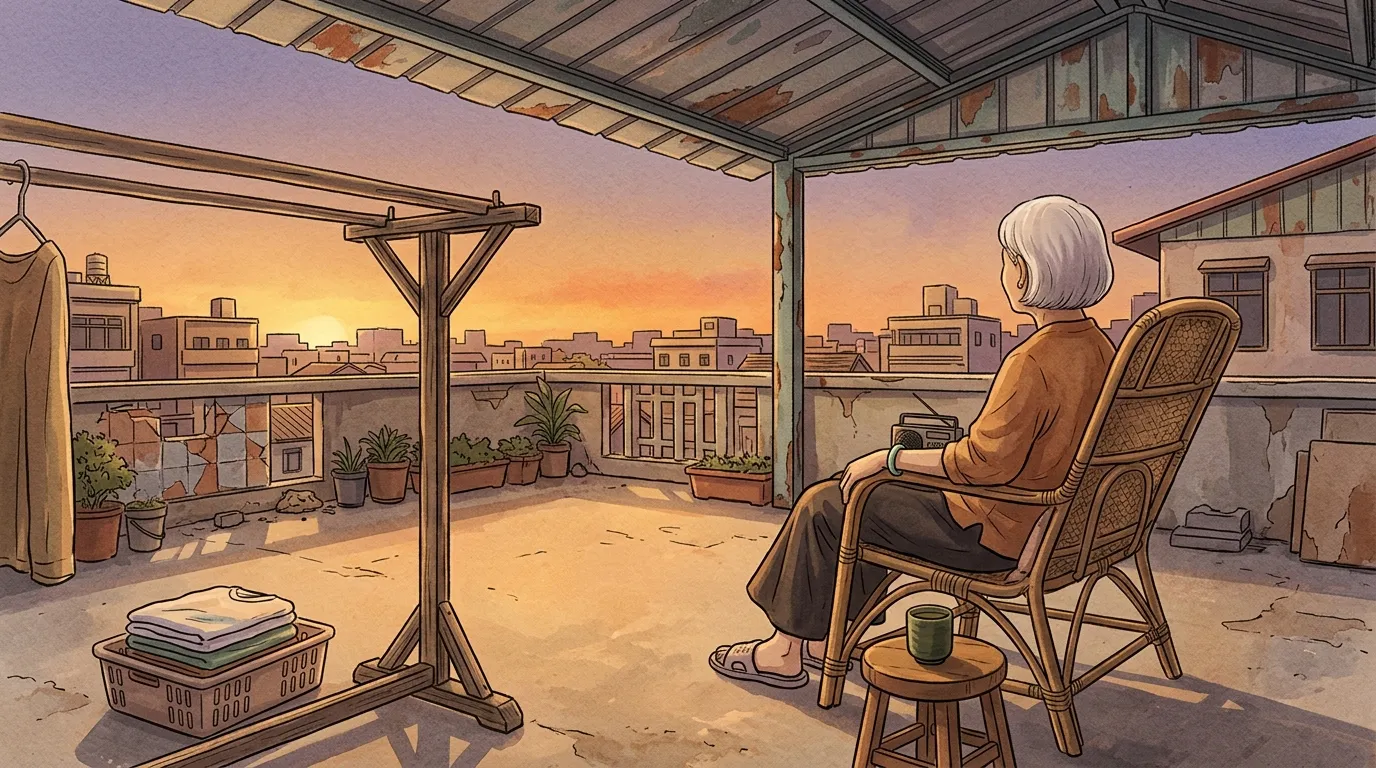
Chen Sulan brought the laundry in from the rooftop terrace. Everything had been in full sun all day — the clothes were warm to the touch, stiff, carrying the smell of dried sunlight. She took each piece down from the bamboo pole, folded it, laid it in the plastic basin. She’d done this for decades; her hands worked on their own and her mind was elsewhere.
The last light came in low from the west, pulling the tin-roof’s shadow long across the terrace. The wind had turned cool, but the floor was still warm — the heat the concrete had stored through the day wouldn’t be done leaving until the middle of the night. Somewhere in the distance, traffic. Below, someone frying something in a wok, the clang of a spatula against iron. The evening news played on several televisions at once, the announcers’ voices layered into a strange accidental chord.
She finished bringing in the laundry and sat down beside Qishan’s recliner. She tuned the radio to the oldies station, the volume low enough that you could only hear it if you were sitting close.
Wind passed through the metal clothesline frame out on the terrace, making it knock and ring at irregular intervals, like someone idly tapping whatever was nearby.
She rested her hands on the armrests. The jade bracelet on her left wrist caught no light in the evening sun, its color washed out to a dull gray-green.
The radio was playing “望春風.”
She thought about the young man from that afternoon. Fang Dingyuan. Thirty-six. Not married. Neatly dressed. When he’d asked is Mr. Wu not home, her hand had trembled slightly — but she was in the kitchen; he couldn’t have seen.
He’s out, she’d said.
She had been saying he’s out for eight months. She’d said it to the people at the market, to Cai Yaoting when he came to collect the management fee, to her son on the phone. Every time she said it, it was like re-stitching a hem that had already come loose — you sewed it back and it held for now, it looked all right, but she knew the thread could give at any moment.
The wind cooled a little. She stood and went inside.
The drawer beside the television cabinet.
She didn’t know what had brought her back to it. This afternoon, when she’d tossed the card in, she had seen Qishan’s health insurance card — the photo was from when he was young, his hair still black.
She opened the drawer.
Receipts, payment notices, his insurance card. Fang Dingyuan’s card was on top. She picked it up.
And underneath — a small rectangle of paper. Another card.
Chen Sulan lifted it out.
Dingfeng Construction. The same company name as Fang Dingyuan’s, but a different person. A small coffee stain in one corner.
She turned it over.
Pencil writing on the back. Qishan’s hand.
She knew that handwriting — the same strokes he used when he sketched out letters in pencil before carving them into wood, uneven and slanting, the pressure heavy, each line thick as though he’d been afraid the words might run away.
Her fingers touched the grooves the pencil had pressed into the card. He had pushed hard when he wrote this.
She turned the card face-up and laid it over the writing. Then she placed it back in the drawer, beneath the stack of receipts.
She shut the drawer.
She stood at the television cabinet, her hand still on the drawer pull. The room was quiet. The radio had stopped at some point — the station was changing programs, and in the gap, only the faint white noise of static.
Qishan’s recliner sat by the window. The moss-green cup on the low stool beside it had gone completely cold, its surface holding a still reflection of the ceiling light above.
Chen Sulan moved her hand from the drawer pull and went to the kitchen and opened the rice cooker.
The rice was still warm. Two cups’ worth.
She took a bowl and filled it.