Chapter 3
No Reply
Chapter 3: No Reply
When Lin Jing’en dragged her suitcase into 147 Yonghe Street, her first thought was: this alley shrank.
She remembered it being wide as a kid — wide enough to ride a bike in circles. But that was a sixteen-year-old memory, and memories weren’t reliable. Now both sides were packed with scooters, leaving barely enough of a gap in the middle for a person and a half. Her suitcase wheels caught on a drain cover and let out a sound like nails on a chalkboard.
The corner shop on the ground floor was still there. The metal shutter pulled halfway up, the fluorescent light inside burning white as an emergency room. A woman in a floral blouse leaned out from the entrance — not leaned, exactly. She had her entire body propped against the door frame at the angle of someone who had arrived at ringside early and intended to enjoy the show.
“You’re the Lin lady’s daughter, aren’t you?”
Lin Jing’en stopped walking. She looked down at herself — plain oversized T-shirt, wide-leg trousers, canvas shoes. Nothing that would identify her as anyone in particular.
”…Yes.”
“Look how big you’ve gotten.” Hong Xiuzhi swept her with the kind of full-body scan that doubled as a greeting, then nodded — the satisfied nod of someone completing a verification process. “I’m Hong-auntie from the first floor. You used to come buy popsicles when you were little. Remember?”
“I think so.” She had no memory of this whatsoever.
“How’s your mom doing?”
“Fine. She’s up in Taipei.”
“Oh, Taipei.” Hong Xiuzhi rolled the words around in her mouth, tasting them the way you’d taste a candy that had flavor but not quite enough sweetness. “So you’re back this time to—”
“Sign something.” Lin Jing’en stood her suitcase upright. “Sign and go.”
Hong Xiuzhi smiled but said nothing. There was a layer in that smile Lin Jing’en couldn’t read, and she had no intention of trying.
She dragged her suitcase toward the stairs. Terrazzo steps. The motion-sensor fluorescent light flickered twice before catching. Every floor was hotter than the last, the air trapped under some invisible lid. Second floor, left side — her mother’s unit. The key had arrived from Taipei by post before she left, wrapped in three layers of bubble wrap, as though it might shatter on arrival.
The door swung open.
She stood in the doorway, suitcase still behind her.
The living room was much smaller than she remembered. The things inside hadn’t changed — nothing had changed: the walls were the same off-white (now closer to yellow), the cracks in the terrazzo floor sat exactly where she remembered them. No air conditioning. The windows were open. A dead moth was pressed against the screen.
Small. Just small. When she’d moved away at twelve she’d thought the living room was enormous; standing in the same spot now, two steps and she’d hit the opposite wall.
She kicked off her canvas shoes and walked barefoot on the terrazzo. Cool. She remembered that sensation — the cool of coming home from school in summer and stepping onto this floor. Every summer of her childhood compressed into the soles of her feet.
She pushed her suitcase into the bedroom, opened the windows, sat down on the floor, and pulled out her phone.
Forty-seven unread messages.
The Line group was called “147 Yonghe Street Residents,” with a cartoon apartment building for the icon — no idea who had set that up. Her mother had left the group two years ago, citing “those people arguing every single day.” This morning Cai Yaoting had added Lin Jing’en back in, with a welcome message: “Welcome, Ms. Lin! Let’s all look out for each other~” followed by three clapping-hands stickers.
She started from the oldest.
The first message was Cai Yaoting’s announcement from three days ago: “Hello everyone, great news — we’ve now had 7 units complete the signing, progress is going well! For any residents who haven’t signed yet, please contact Mr. Fang to arrange a time. Make sure to take advantage of the bonus terms while they’re still available. Feel free to ask questions in the group anytime.”
Lu Zhensheng had responded in seconds: “Chairman working hard! Everyone let’s go 💪💪💪”
Then a stretch of nothing.
Then Guo Boyan: “Can someone tell me which units still haven’t signed?”
Cai Yaoting replied: “That involves personal privacy — can’t share in the group.”
Guo Boyan: “Then what exactly is going well about the progress you mentioned?”
Cai Yaoting: “I was speaking in terms of the ratio of signed units.”
Guo Boyan: ”?”
Read by 9.
Lin Jing’en scrolled down.
Lu Zhensheng had sent an image the next morning at seven — one of those glittering “Good Morning, Have a Nice Day” animations with a coffee cup and a rose.
No one responded.
Twenty minutes later, Lu Zhensheng again: “Has anyone thought about this — if it doesn’t pass this time, next time the floor area bonus is smaller, and the unit conversion works out less favorably. I’m seriously saying everyone should grab this opportunity while they can.”
Cai Yaoting replied: “Lu-ge makes a good point 👍”
Then Zhao Peiyun shared a link, headline reading: “Urban Renewal Scams on the Rise! Residents Must Know These 3 Warning Signs.” She added a note: “Sharing for reference — not saying this applies to our developer, just good to be informed.”
Read by 8. No replies.
Lin Jing’en scrolled on. Next came another announcement from Cai Yaoting: “Friendly reminder: please make sure recycling is properly sorted and bagged before leaving in the shared area. We’ve had cockroach activity on the first floor lately — let’s not give them a reason to start picking their own units 🙏”
Lu Zhensheng replied: “Could it be coming from the second floor? That unit’s been empty a while, I walked past the other day and—”
Cai Yaoting replied: “Let’s not name names. I’ll handle it.”
Lin Jing’en glanced down at the terrazzo floor she was sitting on.
Second floor. This place.
She kept scrolling. The message volume picked up as the days went on. When the signed count moved from seven to eight, Lu Zhensheng sent a chain of firecracker stickers. Cai Yaoting posted something more formal than a press release — “we are grateful for the trust and support of our fellow residents” — and Lu Zhensheng replied with a thumbs-up and three hearts, Zhao Peiyun hit like, and Guo Boyan left it unread.
Guo Boyan’s only voluntary contribution to the entire group chat had been that one question mark. Everything since had been read receipts and silence. Lin Jing’en decided this was performance art.
One message caught her attention. Lu Zhensheng had forwarded a YouTube video titled “Don’t Let One Person Destroy Everyone’s Rights!” He added: “Watched this. Felt a lot.”
Cai Yaoting replied: “Let’s keep the discussion rational. No need to get heated.”
Then, out of nowhere, Guo Boyan: “Lu-ge, why don’t you just go knock on her door?”
Lu Zhensheng: “Don’t put words in my mouth”
Guo Boyan went quiet again. Read by 9.
Lin Jing’en set her phone face-down on the floor and rubbed her eyes. The metal frames of her glasses had left two red indentations on her nose.
She tried to sort out the situation the way she would approach a brief. Ten units. Nine had signed. One hadn’t. Thirty-day deadline. Unanimous consent required. The core problem was a nine-to-one ratio — structurally very simple—
But nothing in the group chat was actually engaging with the problem. Cai Yaoting was running meetings, Lu Zhensheng was being enthusiastic, Zhao Peiyun was doing research, Guo Boyan was lobbing quiet provocations — everyone doing what they thought was useful, and nobody was actually talking to the one.
Or rather: the one wasn’t even in the group.
Chen Sulan. The woman up top. Lin Jing’en scrolled through the member list and didn’t find the name. Her mother had mentioned her before — “the old woman on the roof” — in the same tone you’d use for the weather.
She picked up her phone, backed out of Line, and opened her work email. Three clients chasing her on a deadline. She replied to two. The third was a wedding logo that had been through four rounds of revisions. The client’s feedback was just a phrase: “make it more lively.” She flipped the phone face-down again.
She ran into Fang Dingyuan that evening on the ground floor.
She’d come down to get dinner from the convenience store. He was walking in from the alley, a bag in hand, and when he saw her he did a brief double-take before his face arranged itself into a standard-issue professional smile.
“Ms. Lin?”
“You’re…”
“Fang Dingyuan, from Dingfeng Construction.” He switched the bag to his left hand and extended his right. “Chairman Cai mentioned you’d be back today to handle the signing.”
Lin Jing’en shook his hand. His palm was dry, his grip calibrated — not too firm, not too light. The kind of pressure someone had measured.
“Right, my mom asked me to come.” She said. “Sign and go.”
“Of course, of course.” Fang Dingyuan’s voice was steady, like someone reading from a script they’d memorized carefully enough that it didn’t sound like one. “I actually have the consent form with me — if it’s convenient, we could—”
“Sure.”
Fang Dingyuan clearly hadn’t expected her to be so quick about it. He retrieved the paperwork from his briefcase, and Lin Jing’en spread it across the top of the mailboxes by the entrance and signed. The six square meters of concrete in front of the building, the streetlights just coming on, her shadow slanting against the wall.
“Done.” She handed the documents back.
Fang Dingyuan folded them away and smiled. “Senior.”
“What?”
“You’ve signed now — technically you’re ahead of me in the program.”
“Don’t call me that.”
“Right, right.” He latched his briefcase but didn’t move to leave. He leaned against a scooter in a conversational posture and looked at her. “Ms. Lin, can I ask you something?”
She knew what he was about to ask.
“Mrs. Chen upstairs,” Fang Dingyuan said, his tone dropping slightly, as if handling something that required care. “I’ve been up to visit twice, but I haven’t had a chance to really speak with her. I understand everyone has their own considerations. But nine units have now signed — she’s the only one left—”
“So?”
He looked at her. “You’re closer in age to her. It might feel less — pressured — for her if it came from you. If you happen to get a chance, would you be willing to go up and chat with her? Nothing about the renewal. Just a conversation. Get a sense of where her head is at.”
Lin Jing’en adjusted her canvas tote, which had slid from her shoulder to her elbow. She pushed the strap back up.
“I don’t really know her.”
“But you grew up here.” Fang Dingyuan had done his homework.
“That was a long time ago.”
She said it without thinking much about it. But something shifted in Fang Dingyuan’s expression — not disappointment, something more like recalculation.
“I’ll think about it.” She added this herself, unsure whether it was a brush-off or an actual concession.
Fang Dingyuan nodded and held out a card. “Reach out anytime.”
She took it without looking and pushed it into her trouser pocket.
After he’d gone, she didn’t head for the convenience store. She stood on the ground floor and listened. Somewhere on one of the floors above her, a TV was running the evening news. Further away, someone was calling a child to dinner. Further still — the rooftop — what sounded like a radio, the signal muffled and indistinct by the time it filtered through several floors and a layer of corrugated tin, nothing left but the shape of a sound.
She started up the stairs.
She told herself she was going back to the second floor for her wallet. Her canvas shoes were soft-soled and almost silent on the terrazzo steps. Second floor, third floor — the stairwell light snapped on. Then the stretch between the third and fourth floor went dark; the light there wasn’t responding. She felt her way through half a landing without it. Fourth floor. Fifth floor.
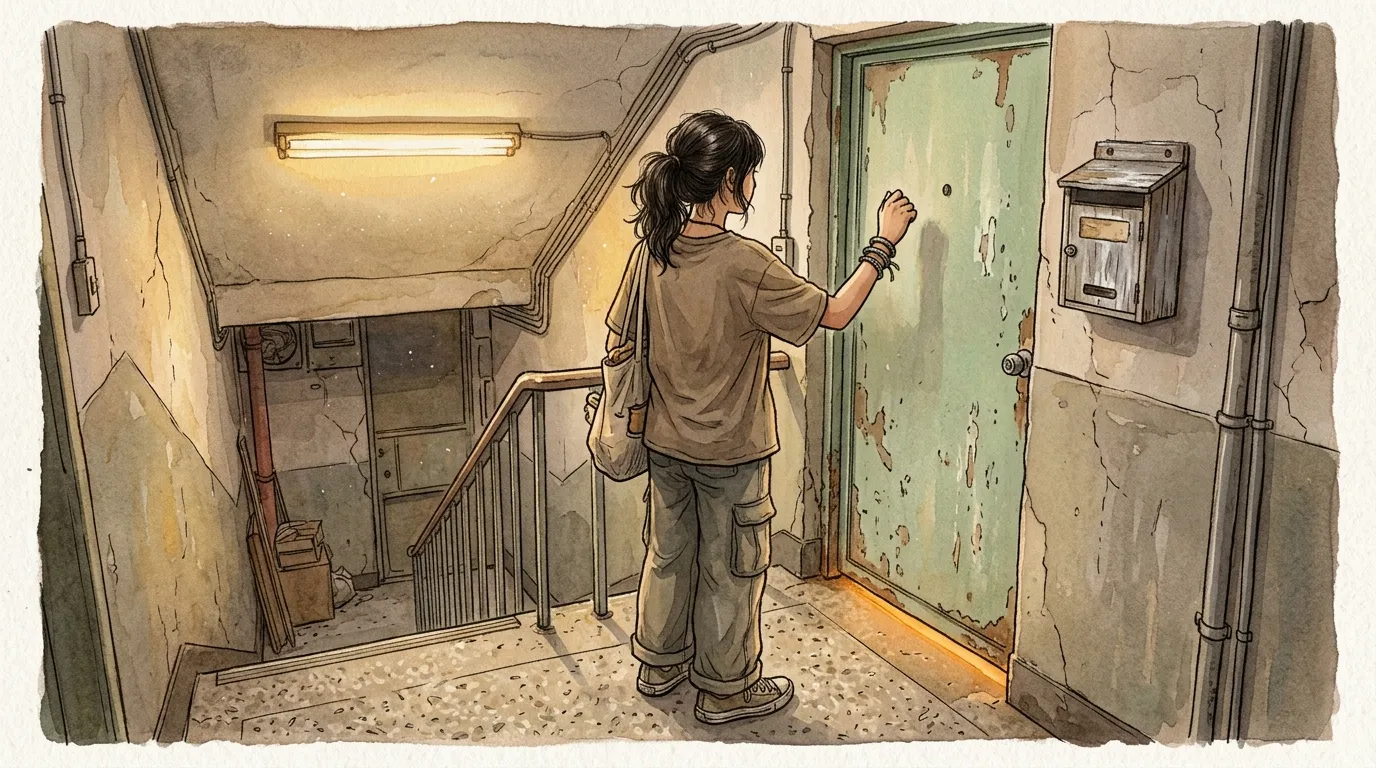
The stairs between the fifth floor and the rooftop were narrower. She wasn’t going up there, but her feet carried her to the landing.
A pale-green iron door. The paint had flaked badly. Beside the door, fixed to the wall, was a small wooden mailbox. Her eyes stopped on it. The surface had weathered to a dull gray, the corners worn smooth, but the shape was intact. Solid work. Someone had spent real time on this.
From behind the door came the faint sound of a radio, a voice wrapped in something soft, like cloth.
She stood at the landing, one hand on the railing.
Something surfaced.
Very young — six, maybe seven — coming home from school, book bag still on, and there would be a bowl of red bean soup waiting in the stairwell, on the second-floor landing. A white ceramic bowl, a small plate set on top, a sheet of tissue paper tucked under the rim. She hadn’t known who left it at the time. Later she found out it was the old woman from the roof.
She could still remember exactly how sweet that soup was. Very sweet. Simmered until every single bean had split open.
She lifted her hand from the railing and turned to go back down.
Two steps. Then she stopped.
She turned around, climbed the last half-flight, and stood in front of the pale-green iron door.
Her hand came up.
She wanted to knock. The logic was sound — Fang Dingyuan’s suggestion, the nine-to-one math, the clean efficiency of getting this done and leaving. But her hand hovered in the space between the door and the air.
Red bean soup. White ceramic bowl. Tissue paper pressed against the rim.
The radio kept flowing through the door, steady and thin, like a very small stream.
Lin Jing’en lowered her hand, turned, and walked back down the stairs. Her canvas soles landed on the terrazzo without making a sound.