Chapter 6
Blackout
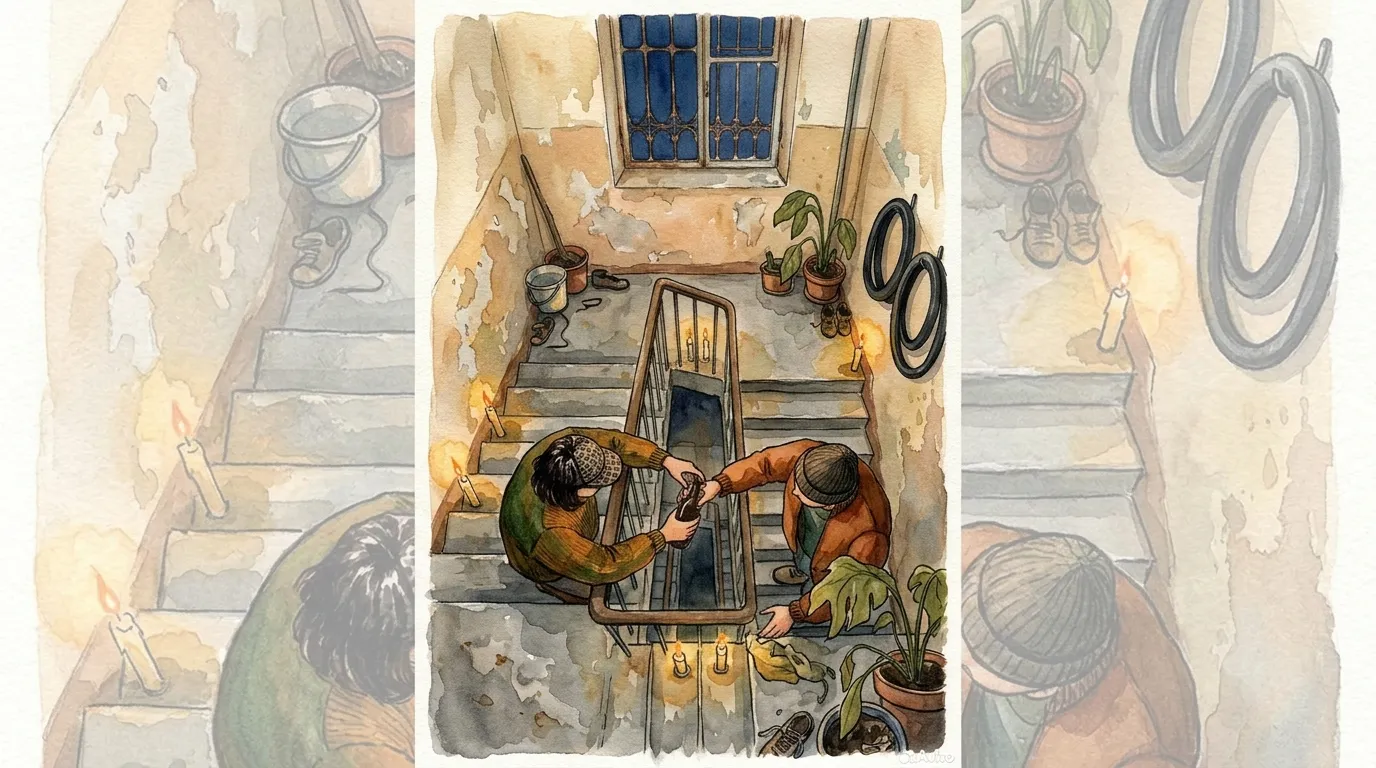
Chapter 6: Blackout
Cai Yaoting was standing at the first-floor bulletin board, pressing a sheet of A4 paper into the corkboard with thumbtacks.
Six in the evening. For the past three days he’d been rebuilding his Excel file — all ten units re-catalogued, eight tabs, background colors tiered by priority in red, yellow, green. Wall-to-wall red. But today he wasn’t here to post a spreadsheet.
The notice was simple: 147 Yonghe Street would be terminating its arrangement with Dingfeng Construction; the residents’ committee would negotiate with other developers; all units were asked to submit their views by Friday. Signed, Cai Yaoting. Four thumbtacks, one in each corner.
“What are you doing?”
Guo Boyan came out of the stairwell carrying a convenience-store bag. He stood in front of the bulletin board and read it for three seconds.
“So Fang Dingyuan made a mess of things, and you’re stepping in to clean it up.”
“I’m here to propose—”
“You’re proposing.” One corner of Guo Boyan’s mouth pulled up. “You brought in the developer, who offered different terms to different units, and you came out with the most. Now the developer’s the problem, and you’re proposing to take over the restructuring yourself. Chairman Cai — what does that sound like to you?”
“You just want to be the hero.”
It wasn’t Guo Boyan who said it. Lu Zhensheng was standing at the second-floor landing, one hand on the railing. No one knew when he’d come downstairs, but he’d clearly been listening for a while.
“Fang Dingyuan made a hash of it, so you come in to save the day, and everyone’s supposed to thank you.” Lu Zhensheng came down the last few steps. “I’ve had passengers in my cab tell me that story a hundred times.”
Cai Yaoting let his hand fall. The keys at his hip made a sound; he reached down and gripped them.
“Lu-ge, I just want to help—”
“You always just want to help.” Lu Zhensheng’s tone wasn’t angry. It was tired. “Everything wrapped up in your hands. And what’s actually wrapped up? A developer who quoted different prices to different floors. A plan where your unit came out the biggest.”
Lu Zhensheng turned and went back upstairs. Guo Boyan picked up his bag and walked around him. The entryway was empty.
Cai Yaoting stood there for a moment. Then he pulled out all four thumbtacks, folded the paper, and put it in his pocket.
The blackout came at seven forty-three in the evening.
Cai Yaoting remembered the exact time because he’d been looking at his phone — he had set a seven forty-five reminder to post an apology in the group chat. He’d written over four hundred words, revised it six times, stripped out every “I’ll handle it.”
Then every light went out at once.
The air conditioner stopped. The electric fan stopped. The refrigerator’s low hum stopped — you only noticed that sound existed when it didn’t.
“Another trip.” Mrs. Cai walked out from the kitchen. June in an old apartment building, the wiring cracking under the load — it was always going to happen.
Cai Yaoting rummaged out the flashlight. Dead batteries. Found fresh batteries, loaded them backwards, reloaded. Light. When he opened the door, Guo Boyan’s door across the hall opened at the same moment, and two beams of light crossed in the corridor. Guo Boyan’s face was unreadable; he turned and went downstairs without a word.
From below, Lu Zhensheng was shouting: “Did the power company cut us off because someone didn’t pay the building fund?”
Hong Xiuzhi: “Did a door hit you on the head? What does the building fund have to do with the power company?”
A thump — someone walking into something — and then a burst of Taiwanese that didn’t bear repeating.
Cai Yaoting headed down. On the second floor he met Lin Jing’en. “Big Brother Cai — where’s the main breaker?”
“Electrical panel, first floor.” He didn’t have to think about it. Every switch in this building, every pipe — he knew where they all were. Seven years as chairman, and at least those things hadn’t turned against him.
First floor. Hong Xiuzhi was standing in the doorway of her shop with a cardboard box. “Candles. Leftover from the altar.”
Cai Yaoting opened the electrical panel, clamped the flashlight between his teeth, and used both hands to work the residual current breaker. Reset it — it tripped. Reset again — tripped again. Three times.
“Old.” He took the flashlight out of his mouth. He wasn’t sure whether he meant the breaker or the wiring. “Can’t fix it tonight. Earliest would be tomorrow.”
After the candles were lit, the stairwell changed.
Under fluorescent light it was gray-white, narrow. Under candlelight it was orange, soft — like an old photograph where the edges have gone blurry.
One by one the residents came out. The heat of the blackout drove them into the open — a June night, no air conditioning, and the inside of an apartment became an oven; the stairwell, by contrast, had a cross-draft. Xu Guanghui came down from the fourth floor with a folding fan, his back a little more curved than the last time anyone had seen him. Zhou Mingda and Zhao Peiyun came down from the fifth. Lu Zhensheng appeared last, with a bottle of Paolyta-B in his hand. Guo Boyan came down to collect a couple of candles, didn’t light either of them, and went straight back up. The door of the right-side unit on the third floor closed with a heavy, muffled thud.
“Come on, everyone have a sip.” Lu Zhensheng passed the bottle to Xu Guanghui. “More useful than a candle.”
Cai Yaoting sat on the third-floor step. His keys were at his hip — this time he didn’t reach for them. He let them hang.
For a while nobody spoke. The Paolyta-B went around. A draft moved through the stairwell and the candle flames tilted.
“Do you all remember.” Hong Xiuzhi spoke first, her voice floating upward. “That typhoon, year ninety-two.”
“Ninety-two? Sure it wasn’t ninety-four?” Lu Zhensheng said.
“Ninety-two. Nari. Water came up to my shop doorstep.”
“Nari was year ninety,” Xu Guanghui said from higher up. Retired math teacher — occupational hazard.
“Right, ninety, whichever — that typhoon.” Hong Xiuzhi waved a hand. “Water flooded in, I lost the whole stock. Canned goods survived, but the biscuits were done for. And Cai Yaoting’s father—”
Cai Yaoting’s back straightened fractionally.
“—brought three pallets down from the third floor. Hardware-shop pallets, the plastic kind. Water was still rising and he was still hauling them, trouser legs rolled up to his knees. Then he helped the Lin family move their refrigerator. Slipped, his mouth hit the door handle. Chipped a front tooth.”
Lu Zhensheng laughed — the kind that comes from somewhere in the belly. “That cap was whiter than the teeth on either side. You could always pick him out in a crowd when he smiled.”
“The cap fell out eventually.” Cai Yaoting said. His voice was quieter than usual. “He said he was going to get it seen to anyway — hitting the door just saved him the registration fee.”
Someone laughed. More than one person.
“That typhoon—” Hong Xiuzhi pointed up toward the fourth floor “—Lu-ge, didn’t your younger kid take a tumble on the stairs?”
“That wasn’t the typhoon.” Lu Zhensheng shook his head. “That was Teacher Xu’s grandson, Xiao Hu — smacked his head and bled. Mrs. Chen came charging down from the rooftop and pressed the wound shut.”
“Not gauze.” Xu Guanghui said. His voice had gone soft in the candlelight. “It was leftover cotton from when she was cutting patterns. She held Xiao Hu in her lap and kept the cloth pressed down, humming a lullaby. The boy stopped crying.”
“What happened to the cloth?” Lin Jing’en asked from somewhere in the dark.
“We washed it and gave it back. My wife insisted on washing it properly before returning it. Cotton — blood doesn’t wash out easily. She soaked it in hydrogen peroxide…” He paused. The folding fan turned a half-circle in his hand; the tips of his fingers trembled faintly. “She still remembered how to use hydrogen peroxide, back then.”
No one said anything.
In the dark, Zhao Peiyun drew a long breath. Very quietly — but in a stairwell that still, everyone heard it.
“We’ve only been here a little over a year.” Her voice came out with a slight catch. “I thought this was just an old apartment building.”
“It is just an old apartment building.” Lu Zhensheng took a pull of Paolyta-B. “Falling apart. Leaking. Now no power.”
“But you all have typhoon stories.” Her voice was wet. “Mingda and I lived in a new tower for three years. Never found out who lived next door.”
Hong Xiuzhi steadied a candle that the draft had started leaning. “They used to host New Year banquets here. Two round tables in the space out front, everyone brought a dish. Cai’s father made braised pork rice every year. The pot was bigger than any of his kids’ heads.”
“Quite a bit bigger than mine,” Cai Yaoting said.
Several people laughed at the same time. The laughter went up the stairwell, hit the ceiling, and scattered. Cai Yaoting laughed too. He hadn’t laughed in three days — the muscles at the corners of his mouth felt stiff when they moved, like something being pried open after too long, but once they had moved, they loosened.
The Paolyta-B made its way to him. Lu Zhensheng was one step above him, watching. There was no trace of the afternoon’s tiredness in that look, and no forgiveness either — just a confirmation: you’re here too.
Cai Yaoting drank. Bittersweet, medicinal.
Then there was a sound from above.
The sound was slippers, moving very slowly across the terrazzo. Everyone went quiet.
Chen Sulan appeared at the landing between the fourth and fifth floors.
A plain cotton-linen top, dark wide trousers. Left hand on the wall, right hand holding nothing. No flashlight, no candle — she had felt her way down from the rooftop in the dark.
Cai Yaoting thought about standing up. His leg moved. He stayed sitting. He had the sense that if he stood up right now and said be careful, Auntie, something would shatter.
She kept coming down. Past the fourth floor, past the third. On the step between the second and third floors she sat down against the wall. The jade bracelet on her wrist caught the candlelight and looked a shade greener than it did in daylight. She said nothing to anyone; no one said anything to her. It wasn’t coldness — every person in that stairwell was operating from the same instinct: don’t break the quiet.
Hong Xiuzhi lit a fresh candle and set it beside her. Chen Sulan gave the smallest nod.
The conversation continued. Lu Zhensheng told the story of the time he’d reversed his car into the Chinese perfume tree by the entrance. Hong Xiuzhi said that tree had already been there before she moved in — she only found out later that one of the original residents had planted it.
“Mr. Wu planted it,” Xu Guanghui said.
Cai Yaoting turned to look at Chen Sulan. The candlelight didn’t show her expression clearly, but her body hadn’t gone rigid, hadn’t contracted. She was just sitting there. Listening.
He looked at the people around him. Lu Zhensheng leaning against the railing. Xu Guanghui’s folding fan resting across his knee. Lin Jing’en cross-legged on the floor, phone turned face-down beside her. Zhou Mingda and Zhao Peiyun, shoulders touching.
The keys at his hip hung loose, occasionally tapping against his trousers with a small, clear sound.
He thought about the Excel file. Eight tabs, red everywhere. Those numbers still mattered, but in this light the red didn’t feel quite so sharp.
What he wanted to save wasn’t his position as chairman.
It was this. These people, still willing to sit together in the same stairwell.
How would you put that in a spreadsheet?
Close to ten o’clock, people started to drift away. Xu Guanghui went first — Biyun was alone upstairs. Lu Zhensheng paused next to Cai Yaoting on his way by.
“That notice — the idea wasn’t wrong. But not now.”
Chen Sulan got up too, one hand on the wall, making her way slowly upward. The slippers on the steps, one after another, the sound gradually fading.
Cai Yaoting stayed to collect the candles. He worked his way down from the third floor: one at the second-floor landing, two on the first. He was about to blow out the last candles on the first floor when he heard something from above.
Someone coming back down. Slippers. Slow.
He raised a candle to light the way up.
Chen Sulan was standing on the stairs between the second and third floors, her back to him. Her palm lay flat on the plaster, fingers moving slowly, as if reading something.
Cai Yaoting didn’t make a sound.
Her fingers stopped at one spot. In the candlelight he couldn’t make out what was there. Her thumb moved back and forth across that small section of wall.
Then the power came back.
The stairwell’s fluorescent light sputtered on. White light fell from the ceiling like an axe-stroke, and the candle’s orange glow was gone in an instant.
Cai Yaoting blinked a few times. In the fluorescent light, he could see where her fingers had stopped — there was a small mark on the wall. Made with a permanent marker, a crooked circle with something smaller written inside it. Impossible to read anymore. Forty years of paint over it, and under the light it had nearly merged with the plaster.
If someone hadn’t placed their fingers precisely there, you would never know there was anything at all.
Chen Sulan lowered her hand. Without turning around, she continued upward. The slippers on the steps, slow but steady.
Cai Yaoting stood on the first floor and watched her silhouette climb — past the third floor, into the dark patch where the fourth-floor light was blown, then gone into the upper dark. The keys at his hip gave a single soft sound.
He waited until the slippers were completely silent. Then he went up, walked to the wall between the second and third floors, and touched the mark with his hand. His fingertip found a faint raise in the plaster — the slight thickness left by permanent marker ink after it has dried.
He didn’t know what it was. But he held his hand there for two seconds.
Then he went back downstairs, blew out the candles, and went home.