Chapter 7
Past Due
Chapter 7: Past Due
Xu Guanghui woke at five fifty-eight. His alarm was set for six, but he always beat it by two minutes — forty years of teaching had wound a clock inside him that retirement couldn’t unwind. He reached over and silenced it before it had the chance to ring.
Biyun was still asleep. On her side, facing the wall, breathing shallow. He watched her for three seconds, confirming the rise and fall of her chest, then got out of bed.
Bathroom. Toothpaste, toothbrush. The face in the mirror was older than he remembered — the bags under his eyes had deepened into two parentheses that bracketed his eyes inside them. He splashed water on his face. Cold; in old apartment buildings, the pipes always ran cooler in the early morning.
Six ten. He walked into the kitchen. A sheet of A4 paper was taped to the counter above the sink, written in his own marker:
6:00 | Rise, wash up
6:30 | Breakfast (congee + egg + greens)
7:00 | Medication (round white + long yellow)
8:00 | Walk (park, 30 min)
9:00 | Cognitive exercises (picture cards)
The schedule went on to ten at night. Each line had a small box at the beginning — for checkmarks. He took a pen from the holder and put a checkmark next to Rise, wash up.
The congee had been set to cook the night before on the timer. He lifted the lid; steam rose into his glasses. He took them off and wiped the lenses — the metal frames had two wraps of clear tape at the hinge, right at the ear, a repair he’d made so long ago that the taped version felt right and the untaped version felt loose.
Six twenty-five. Biyun still hadn’t stirred. He went to the bedroom.
“Biyun.” The same tone he’d always used to call her for meals. Not loud. No coaxing.
She shifted. Eyes opened, looking at the ceiling.
“Biyun, time to eat.”
She turned her head toward him. There was a brief blankness in her eyes — two seconds, perhaps — and then she smiled.
“Oh, Guanghui.”
She recognized him today. He put a checkmark next to it in his mind.
When he was brushing her teeth, she bit down on the toothbrush.
She didn’t mean to. Her jaw’s reflexes had gotten faster; when he reached the back molars her mouth closed, and the handle got caught in her teeth. He didn’t pull. He waited five seconds. She released it herself.
“Biyun, open.”
She opened. Foam from the toothpaste clung to the corner of her mouth. He wiped it away with a towel, gently. His hand was steady — the same steadiness he’d had drawing coordinate axes on the blackboard, clean lines from one end to the other without a tremor.
Breakfast. He ladled out the congee and cut the egg into small pieces. Biyun picked up the spoon herself and got a mouthful, but a little spilled onto the table. He wiped it up without comment. She scooped again; this time it made it in.
“Good,” she said.
“Mm.”
Medication. One round white tablet, half a long yellow one. He placed them in her palm and handed her the water. She stared at her palm for a long moment.
“What’s this?”
“Medicine. Swallow it.”
She did. He put a third checkmark on the A4 sheet.
The light outside was already bright. June sun didn’t wait — not yet seven o’clock and the balcony was baking. He settled Biyun in the living room, set the electric fan to the second speed, aimed it at her. The remote control was hidden — last week she had set it in a mug of tea, and it had taken him two days of careful drying before it worked again.
He stood in the middle of the living room and looked at her. Biyun sat in the chair, head tilted slightly, watching the blades of the fan go around. Her expression was quiet — like a student sitting by the classroom window, not really looking at anything.
Xu Guanghui went to wash the dishes.
When he turned on the tap, he heard Biyun humming in the living room. Broken, a little off-pitch, but a song he knew — “Longing for Spring Breeze.” When she was young she had a good ear, never off-key; she had sung it once at a school Teachers’ Day ceremony and the whole audience had gone quiet to listen.
Now the melody wandered and the rhythm drifted. But she was singing.
He turned the tap down a little, so the water wouldn’t drown her out. He washed the bowls twice over.
Eight thirty. Biyun had fallen asleep in the chair, leaning to one side, the fan turning near her face, her hair moving. He angled the fan away slightly and laid a thin blanket over her legs — if she woke up and found a blanket there, she’d know she was home. Blanket in its place, cup in its place, the family portrait on the wall in its place. He had arranged the apartment into a set of problems that didn’t need solving — the answers were always the same, and she only needed to see them.
He changed his shoes at the door. Dark brown leather, polished every day, though nobody looked at his shoes anymore. Shirt tucked into his dress trousers, belt buckled to the third hole — he’d used the second once.
He stood at the entrance for a moment, hand on the doorknob. He looked back at Biyun. Still asleep. Blanket on, fan turning.
He went out, locked the door, turned the key twice to be sure. Then headed up.
A hundred steps. At least two trips every day. His knees began to ache after the thirtieth step — a dull resistance, like working through a long division problem knowing the answer is still far off.
He caught his breath on the fifth floor, then continued upward.
The iron door to the rooftop addition was unlatched. Light came through the screen door, and a radio was playing inside.
Xu Guanghui didn’t knock. He stood in the corridor and cleared his throat.
“Sulan-jie.”
A sound from behind the screen door. The shuffle of slippers, and then the door opened.
Chen Sulan stood in the doorway in a plain cotton-linen shirt. The faded jade bracelet on her left wrist caught the morning light like a ring of pale green shadow.
“Guanghui.”
“I’m going to the market.” His pace was steady, like reading from a schedule. “Would you like to come?”
She looked at him. The invitation was unusual — she went to the market on her own, she didn’t need company. But Xu Guanghui was standing there, his back slightly stooped, hands in his trouser pockets, the bags under his eyes very deep. He didn’t look like a man issuing an invitation. He looked like a man announcing an itinerary that happened to have one empty slot in it.
“All right,” she said.
She went inside for her shopping basket. Xu Guanghui waited in the corridor, not going in. He looked at the clothes drying on the rooftop terrace — a cotton-linen shirt, a pair of wide dark trousers. The washing of one person.
Chen Sulan came out with the basket and locked the door behind her. The two of them started slowly down.
A hundred steps. He walked in front, she behind. His pace was unhurried; hers fit without effort. Neither of them made any deliberate adjustment — the rhythm of people who have climbed these stairs many years without thinking about it.
When they passed the fourth floor, his door was closed. Old apartment buildings carry sound poorly and keep it well; you could just make out the fan running inside.
Chen Sulan didn’t ask.
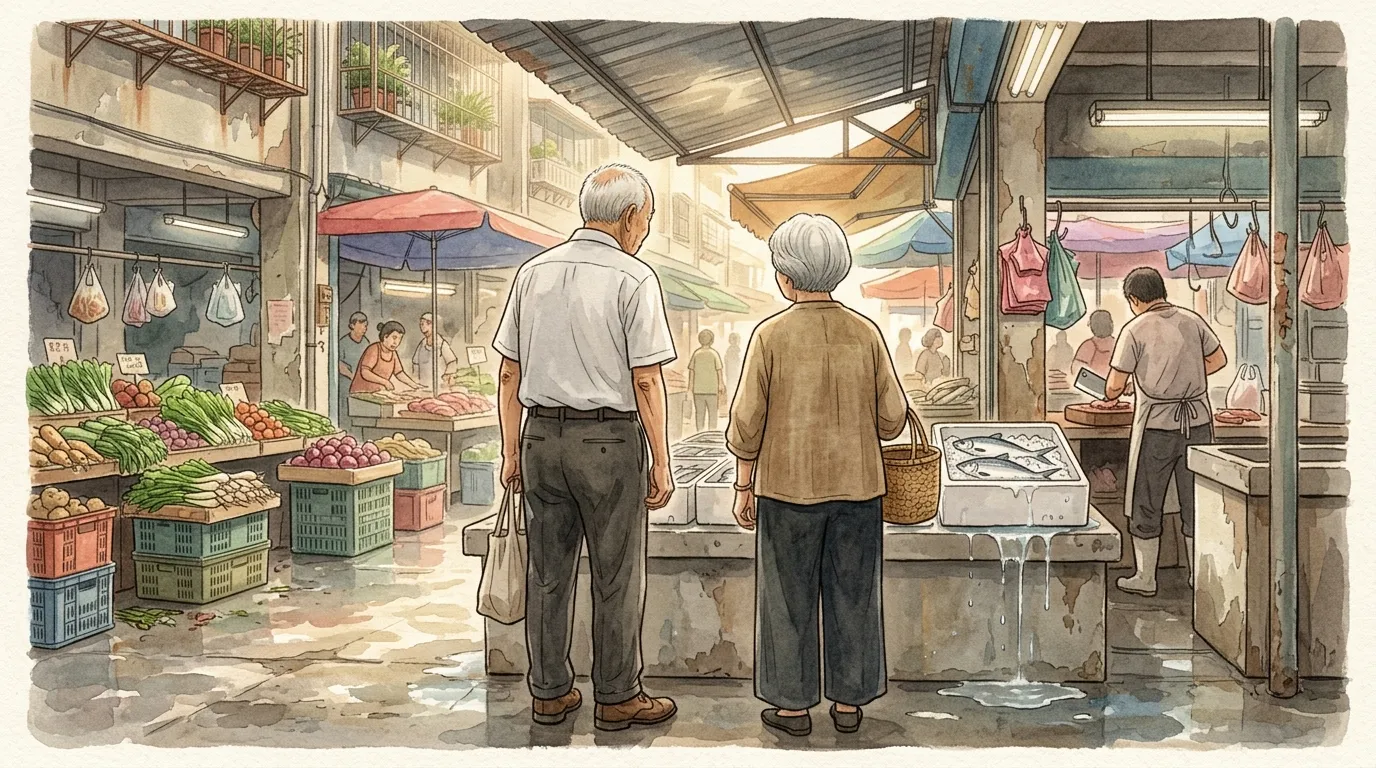
Dongxing Market at nine o’clock. Two rows of stalls under a corrugated metal awning, the aisles squeezed to a meter wide by carts and plastic crates. The floor was wet, smelling of fish and vegetable juice and someone’s braised pork drippings that had spilled and dried.
Xu Guanghui moved through the market the same way he moved through a school corridor — back a little straighter, step a little more regular. It was a hundred times louder than any school hallway, but his approach was the same: if someone called his name, he’d respond; if no one did, he kept to his route.
“Teacher Xu! Early today!” Old Huang called from behind the pork stall, waving his cleaver once. On the chopping block, a row of ribs had been cut to even lengths, the spacing near-identical.
“Morning.”
“Where’s Mrs. Xu?”
“Home.”
Huang’s cleaver paused, then continued. He didn’t ask more. Everyone in the market knew about Mrs. Xu, but nobody would say a word. That was the unspoken rule in a market like this: the more you know, the quieter you keep your mouth.
“Good milkfish today.” Huang used the back of the cleaver to point at the styrofoam box beside him. A few milkfish lay on ice, their eyes still bright. “Two for a deal.”
“Good. Two.”
“Mrs. Chen’s here too!” Huang spotted Chen Sulan behind them, and his voice lifted half a pitch. “Nice ribs today — want some?”
“Let me see.” Chen Sulan stepped up to the stall and leaned down to look at the ribs. “Half a jin.”
“Half a jin.” Huang’s knife came down — thunk. He put the cut on the scale. “Little over, I’ll call it half a jin.”
“Always a little over,” Chen Sulan said.
“Always half a jin.”
Xu Guanghui stood to one side watching Huang bag the milkfish — two fish stacked together, meltwater dripping from the corner of the bag. He took the bag and held it. Lighter than he remembered — the fish were the same size they had always been; he’d simply never noticed the weight before, because Biyun had always been the one carrying it.
They moved on. At the vegetable stall, A-Xia spotted them and waved.
“Teacher Xu, you brought the older sister out today?”
“She wanted to come herself.”
“I walk just fine,” Chen Sulan said.
A-Xia laughed. “You two, still better shoppers than me at your age. Here — the water spinach is beautiful today.”
Chen Sulan picked through a bunch of water spinach, turning the leaves over. A-Xia, as always, tucked two extra chili peppers in with it.
“A gift.”
“You give one every time.”
“You come every time.”
The exchange had the same rhythm as every other visit to the market. The same was good.
Xu Guanghui stood waiting while Chen Sulan finished, the milkfish hanging from his hand. The water from the ice was slowly melting, dripping onto his leather shoes. He didn’t move out of the way.
They passed the braised-goods stall, the star anise smell thick enough to cover the fish from the stall ahead. Xu Guanghui paused in front of a tofu vendor.
“Biyun used to make the best egg flower tofu soup,” he said. His voice was low, aimed somewhere between himself and Chen Sulan — quiet enough to be talking to nobody, loud enough for her to hear. “Tofu soup with egg, green onions sliced very thin. Her knife work was better than mine.”
Chen Sulan didn’t answer. She glanced at him, then at the tofu on the stall.
“Should we get a block?” she asked.
“No need. She can’t tell the difference anymore, whoever makes it.”
He kept walking. Chen Sulan walked beside him, the shopping basket swinging from her arm.
At the far end of the market was another fish stall — one selling fresh-caught fish. Xu Guanghui stopped there. He stood in front of it and looked at the fish arranged on the ice.
“Sulan-jie.”
“Mm.”
He wasn’t looking at her. His eyes stayed on the fish. His voice dropped and slowed — the way he used to read through a long proof problem, each step deliberate, nothing skipped.
“Biyun’s long-term care insurance only covers the basic amount. Day care runs thirty-six thousand a month.” He stopped. “My pension, after health insurance and labor insurance deductions, comes to forty-two thousand. Thirty-six thousand, plus her medication, her follow-up appointments, transport — the monthly shortfall is around fifteen thousand. I’ve been eating into savings.”
Chen Sulan’s basket went still.
“The savings will last — maybe two years.” He reached up with his left hand to adjust his glasses; the tape on the hinge had softened with sweat and gone a little loose. “If she needs residential care after that, the starting cost is sixty thousand a month. That number — I’ve run the calculation every way I know how, and it doesn’t work out.”
He paused. At the stall, someone was sorting through cuttlefish, the plastic bag rustling. The vendor was calling out, fresh-caught, fresh-caught. The noise of the market rose around them like a thick wall.
“My daughter calls every time and says she wants to help. I tell her no need, we’re fine. She stops asking.” The corner of his mouth moved — not a smile, just a reflex of the muscles. “Math teacher’s habit — I have to calculate everything. And when I calculate, I see that this apartment is the only asset I have left to work with. After redevelopment — new unit plus compensation — Biyun’s years ahead have somewhere to land.”
He finally turned and looked at Chen Sulan — just one glance, and then his eyes went back to the fish.
“I know your situation. I didn’t come to convince you.” His voice was quieter than before. “But some things, if you leave them sitting — they expire.”
Xu Guanghui took a tissue from his pocket and wiped his hands. His hands were dry; there was nothing to wipe. But he needed something to do.
Chen Sulan stood beside him, the basket held in front of her. She said nothing. She looked at the fish on the stall — round, bright eyes, the ice melting, water dripping off the edge of the platform onto the wet floor.
She looked for a long time.
Then she said: “The milkfish you bought — can Biyun taste that it’s milkfish?”
Xu Guanghui went still for a moment.
“She…” He lifted the bag of milkfish and looked at it, then lowered it again. “She can’t taste much of anything anymore.”
He said it without any change in his voice. He had rehearsed this sentence too many times inside his own head; by the time it came out, it felt like reading a number aloud. But this time was different — because Chen Sulan had asked. She actually wanted to know.
“And you still bought two,” Chen Sulan said.
Xu Guanghui didn’t answer.
Someone pushed a cart through the market, the wheels squeaking on the wet floor. The smell of star anise drifted past again.
Two old people standing in front of a fish stall, each carrying their own things. Neither of them making any move to go.
On the way back they didn’t speak.
Passing the lane entrance, Xu Guanghui’s pace slowed slightly — his body easing into thought: whether Biyun had woken up, whether she might not be able to find the blanket, whether not finding it would frighten her. These thoughts came one after another, each pulling the next behind it.
“Guanghui.” Chen Sulan’s voice came from behind him.
He stopped.
“When your daughter calls next time, don’t say everything’s fine.”
He turned around. Chen Sulan stood in the shadow of the lane entrance, the basket in her right hand, the jade bracelet at the edge of the light.
Her face was without any particular expression. Just a seventy-two-year-old woman standing in a lane, saying something to you.
Xu Guanghui looked at her, his mouth moving slightly. ”…All right.”
He turned and kept walking. After a few steps, one side of his mouth pulled up. “That sounded like something I used to say to my students.”
“You teachers love lecturing people.”
“Retired and still getting lectured.” He shook his head. “Very poor treatment.”
The two of them walked into the first floor of the building. He went first, she followed. A hundred steps. His knees began to ache after the thirtieth step, but he didn’t slow down, because he wanted to get back to Biyun.
Fourth floor. He stood at his own door.
“Sulan-jie.”
She had already passed him, heading up to the fifth floor. She turned back.
”…Thank you.”
Chen Sulan said nothing. She kept going up. The sound of her slippers on the terrazzo steps was very steady.
That afternoon.
Xu Guanghui was doing cognitive exercises with Biyun when his phone buzzed. A message in the group chat. He set the picture cards down on the table — today was the animal set; Biyun had just identified the cat and the dog, and called the elephant a hippopotamus — and waited until she’d looked at the last one before he picked up the phone.
Fang Dingyuan had posted a long message to the group.
Hello, everyone. This is Fang Dingyuan. The way I’ve been communicating has created doubts and a lack of trust, and I sincerely apologize. After an internal review at the company, we’ve decided to make all terms fully transparent: one uniform standard for all ten units, calculated by registered area, floor coefficient, and aspect adjustments — the formula and all numbers are on the table. The attachment is a complete allocation table, and every unit can see every other unit’s figures. If anyone has questions, I’m available to walk through them one by one.
The attachment was a screenshot of a spreadsheet. Ten rows, one unit per row. Registered area, floor, aspect, formula, result. Xu Guanghui zoomed in — every number visible, no blurring, no “details to be discussed individually.”
Cai Yaoting was first to reply: “I’ve looked it over — it’s different from the earlier version. Mr. Fang and I went through it again; my unit’s figures have been adjusted. Everyone can check.”
Lu Zhensheng: “So the same standard for everyone now?”
Fang Dingyuan: “One formula, not adjusted through individual negotiations. All numbers public. Verification is welcome.”
Lu Zhensheng didn’t reply again. Three minutes later he sent: OK.
Zhou Mingda: “Thank you, Mr. Fang, for the good faith. I’ll go through the numbers tonight.”
Zhao Peiyun sent a smiling sticker.
The group went quiet for a dozen minutes.
Then Guo Zeng Wanru appeared: “Boyan and I have looked it over. We’re willing to re-sign.”
Xu Guanghui stared at his phone. He did the calculation — Lu Zhensheng had threatened to withdraw, but had never actually submitted a withdrawal form, so legally he’d never truly pulled out. Now Guo Boyan had re-signed.
Nine units in agreement. One remaining.
He put down the phone. Biyun, beside him, was stacking the animal cards into a pile — the order was wrong, but she stacked them very neatly.
No more messages came through the group chat.
No one tagged Chen Sulan. No one said her name. No one said one unit left.
This silence was different from before. The earlier silence had been a who’s going to say it silence. This was a we’re not going to say it silence.
Xu Guanghui turned his phone face-down on the table. Biyun looked up at him, holding an elephant card in her hand.
“What’s this?” She pointed at the elephant.
“Elephant.”
“Elephant.” She repeated it and nodded. Then she looked at the card again. ”…Elephant.”
As if making sure she’d remember.
Evening. Chen Sulan sat in the plastic chair on the rooftop and watched the sky for a while. Then she went inside and walked to the television cabinet.
She opened the drawer.
Receipts, utility notices, health insurance card. Wu Qishan’s health insurance card, with a photo from when his hair was still black. Fang Dingyuan’s business card sitting on top of the receipts.
She picked up Fang Dingyuan’s card. The one underneath — the one Qishan had placed there — she took it out with two fingers.
Business card face-up. A coffee stain in the corner. Dingfeng Construction.
She turned it over.
Qishan’s pencil handwriting, crooked and unsteady, the strokes thick as if he’d been afraid the words might run away.
This time she didn’t cover it back up.
She sat in Qishan’s recliner, set the card on her knee, and ran her thumb over the indentations the pencil had pressed into the card. The cracked leather of the chair held her back; the seat had been shaped by twenty years of Qishan sitting in it.
The radio was on, the evening weather forecast. Tomorrow, thirty-six degrees.
She didn’t turn the card back over.