Chapter 8
His Handwriting
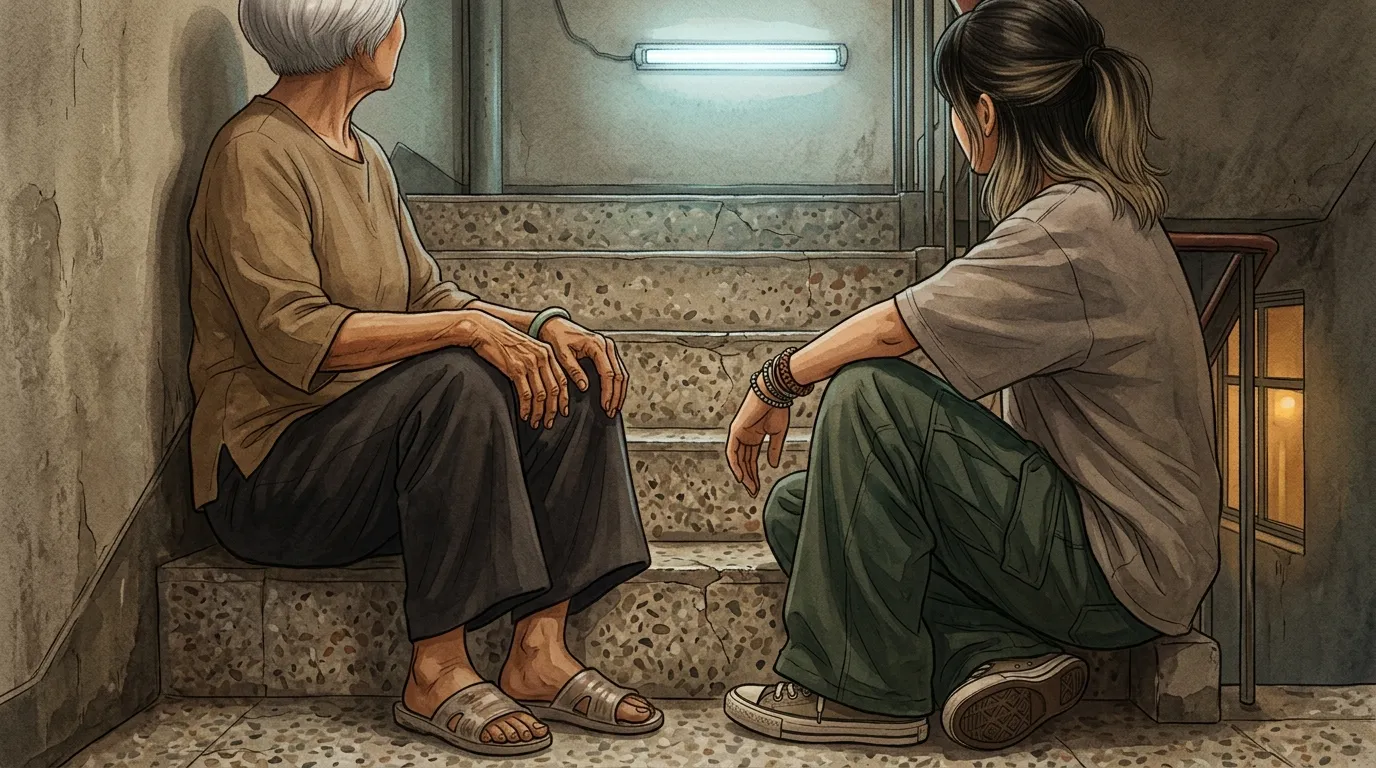
Chapter 8: His Handwriting
Four days.
The business card sat on the nightstand, face down so the back — his handwriting — faced up. Every morning Chen Sulan woke to it. Every night before she closed her eyes, she looked at it one more time. But she hadn’t picked it up again.
She knew there were words on it. She knew Wu Qishan had written them. She knew the pencil strokes were uneven, pressed heavy into the paper the way a man who held a pencil like a chisel would press. But she hadn’t read them.
Not because she couldn’t see them. Because she wouldn’t let herself.
It was like lining up a cut in fabric — you’ve measured, the scissors are positioned, everything is ready. But you don’t bring the blades together. Because once you do, the cloth can’t go back.
The four days passed the way days had been passing for months. She cooked enough for two, brewed two cups of tea, sat on the balcony in the evening with the radio on. The refrigerator compressor hummed. The tin roof had been absorbing heat all day and now, in the cooling evening, it breathed the warmth back out in slow exhales. She sat alone in the rattan chair. Qishan’s recliner stood empty beside her, its cracked leather catching the last of the light — the surface worn into the exact shape of someone who was no longer there.
She knew what the group chat was saying. Nine units had signed. Only her unit remained. Hong Xiuzhi had come up once with some mangoes, stood in the doorway, said a few things, said nothing about the redevelopment. The numbers Xu Guanghui had mentioned at the market — she remembered all of them. She remembered them clearly.
But remembering wasn’t the same as being able to move.
The fourth evening. An old song on the radio, she couldn’t have named it. The sky shifted from gold to ash-orange; the tin roof finally began to cool.
She went inside. Walked to the nightstand.
The card was there. A coffee stain on one corner. Dingfeng Construction. She turned it over — Qishan’s pencil handwriting on the back.
She picked it up.
This time she held the card up to the window, where the last of the daylight still clung to the surface. Old eyes need light to read small print. The body knows these things.
The first character.
Su.
The pencil line was deep, pressed down into the cardstock. She ran her thumb across it; the groove was deeper than she remembered. He must have pressed hard while writing — Qishan held a pencil the same way he held a chisel. No lightness in it.
Lan.
Two characters. Her name. He had written her name.
Her hand went wrong. A small tremor finer than shaking, starting in her fingertips and traveling up through the bone toward her wrist. She pressed her other hand over the one holding the card. It didn’t help.
She kept reading.
If anyone downstairs comes asking about the redevelopment—
Her eyes stopped. She could read it too clearly. The words were bright in the last of the daylight, the pencil’s gray still carrying a faint silver.
You decide for yourself. It’s yours to decide.
She set the card down on her knee.
Then her breathing broke — a single missed beat.
Something was pulled out of her chest, the way thread is pulled from cloth — you hear the sound of it, fine and continuous, and then the whole piece of fabric starts to pucker and pull.
She sat on the edge of the bed. The card didn’t fall; her fingers held it without being told to.
You decide for yourself. It’s yours to decide.
A handful of words. The longest sentence Wu Qishan had written in his life.
Her tears didn’t fall — they rose. No sound. No sobbing. The water filled her eyes until it overflowed from the corners, finding the channels of her face, traveling slowly through the deep lines. The creases in her face were old. The tears moved slowly through them, following the bends.
She didn’t wipe them away.
Because she understood, all at once.
He had known.
He had known he was going to leave. He had known the developer would come. He had known she would be trapped. The redevelopment was only the occasion; the real trap was that she had no idea how to make a decision without him. He had known she’d spent her whole life letting him handle the big things, because from the time she was small, she had never been allowed to handle them herself.
So he hadn’t written sign. He hadn’t written don’t sign.
What he had written was: you can.
You decide for yourself. It’s yours to decide. I trust you, the words meant. You always could.
Chen Sulan sat on the edge of the bed, the card held between her fingers, tears moving slowly down the forty years of lines on her face. In the next room, the radio finished the song and went to an advertisement. The refrigerator hummed. The tin roof let go of its warmth, degree by degree.
She didn’t know how long she sat there. The sky went from ash-orange to gray-blue, and from gray-blue to dark. The city outside began to light up — the glow of signs on Minsheng Road in the distance, the red aviation warning light on the rooftop across the lane blinking in its slow rhythm.
She turned the card over and wiped at the coffee stain with the corner of her shirt. It didn’t come off. She turned it back to his handwriting and read it again.
Sulan, if anyone downstairs comes asking about the redevelopment, you decide for yourself. It’s yours to decide.
She set the card on the nightstand. Handwriting facing up. Same as before. But different now.
She stood. When her feet found the floor she swayed slightly — she’d been sitting too long; the blood was still finding its way back to her legs. She steadied herself against the wall, walked to the bathroom. Turned the cross-handled faucet to the right position — the position that was always right, no more, no less. Cold water on her face; she closed her eyes. Behind her eyelids, the heat remained.
She looked at herself in the mirror. A seventy-two-year-old woman, eyes red, hair slightly loose. On the wall beside the mirror hung Qishan’s square-framed reading glasses. A thin film of dust on the lenses.
She reached up and took the glasses down. Cleaned the lenses with the corner of her shirt. Put them back.
She went downstairs at nearly eight in the evening.
Plastic sandals on, footsteps soft on the terrazzo steps. The stairwell light was motion-sensor; she didn’t want to clap her hands. She kept one hand on the wall — rough cement paint dragging against her palm. She had walked this staircase for forty years. She didn’t need to see where the steps were.
Between the fifth floor and the fourth, the broken fluorescent panel made that stretch darker than the rest. She slowed a little.
At the third-floor landing she couldn’t see the marker on the wall — too dark. But she knew where it was. As she passed, her fingers brushed the wall and found it: the old felt-tip mark, rougher than the paint around it. Forty years, and it hadn’t faded.
She kept going. Second floor.
A strip of light under Lin Jing’en’s door.
Chen Sulan stood at the door. She didn’t know what she was going to say. She hadn’t thought about what she would say when she started down the stairs. It was her feet that had brought her here — the same way her body had walked to the rooftop every evening for forty years, knowing where to go before her mind caught up.
She raised her hand and knocked twice.
Footsteps inside. The door opened.
Lin Jing’en stood in the doorway in an oversized gray t-shirt, hair pulled into a loose knot at the nape of her neck, wire-frame glasses pushed up on her head. One hand held her phone; the screen’s light fell on her face.
“Mrs. Chen?”
Chen Sulan stood in the corridor, the dark stairwell at her back. She looked at Lin Jing’en — twenty-eight, thin, with the particular pallor of a face too often lit by a screen.
“Jing’en,” she said.
Lin Jing’en looked at her. The old woman’s eyes were red, but her face was dry. The expression was very still. Too still.
“Would you — do you want to come in and sit down?”
“No need.” Chen Sulan paused. “Outside is fine.”
She gestured toward the staircase steps.
Lin Jing’en tucked her phone into her pocket and followed her out. The door closed behind them; the corridor went dark. Lin Jing’en clapped once. The motion-sensor light flickered twice before it caught. White fluorescent light made them both blink.
Chen Sulan was already sitting — the third step between the second and third floors, back against the wall. Her plastic sandals were set neatly on the terrazzo. Her ankles showed beneath her trouser hem, the bones prominent, the legs thin as bamboo.
Lin Jing’en sat down beside her. One step away.
Neither of them spoke first. The white light became ordinary. The stairwell air smelled of cement dust and, from somewhere on the second floor, something cooking — garlic, strong.
“When you were small.” Chen Sulan was the one who spoke. Slow. “Did you like living here?”
Lin Jing’en blinked.
That wasn’t the question she’d expected. She’d expected have you eaten or it’s so hot out, isn’t it or silence, just the two of them sitting. Not this.
“When I was small…” She started, then stopped. Habit reached for a lighter answer — that was a long time ago or kids are happy anywhere. But those words stalled somewhere before her mouth. Maybe because Chen Sulan’s eyes were still red. Maybe because the question was so quiet — it wasn’t a challenge, it was a genuine question.
”…I liked it,” she said.
The motion-sensor light went dark. In the dimness, only the yellow of the streetlight through the second-floor window remained, dividing the stairwell into a lit half and a dark half. Lin Jing’en clapped once. The light came back.
“When I got home from school,” she said, “the moment my foot hit the first step I knew I was home. Terrazzo — cool against the soles. Summer, no shoes, walking up barefoot, and the cold would travel all the way up through your feet.”
Chen Sulan listened.
“And…” Lin Jing’en’s eyes moved to some point on the wall, tracing the cracks, the damp stains, the places where the paint had lifted. Her eyes were running their fingers along a memory from a long way back. “On the second floor. After school. There’d be a bowl of red bean soup.”
“White bowl,” Chen Sulan said.
“A plate on top. Napkin to keep it from sliding.”
A half-second of quiet between them.
“Sweet,” Lin Jing’en said. Her voice was softer now. “Red beans cooked until every one of them had burst. That kind of sweet.”
“He liked sweet things, your grandfather’s grandfather.” Chen Sulan’s voice was easy. “I’d make a pot; he’d eat most of it. Whatever was left I’d bring down and leave out. Didn’t think about who might eat it.”
“It was me.” A flicker of muscle memory at the corner of Lin Jing’en’s mouth. “Every time, it was me. I wouldn’t even put my bag down first — I’d just crouch there and eat the whole thing.”
The light went dark again. This time Lin Jing’en didn’t clap. They sat in the dimness. The streetlight traced a thin line along the edge of each step.
“Mrs. Chen.”
“Mm.”
“What was he like? My — what kind of man was he?”
The question surprised Lin Jing’en as much as it surprised Chen Sulan. She hadn’t planned to ask this — she didn’t know what she’d planned to ask — but this was what came out.
Chen Sulan didn’t answer right away. In the dark her hand found the jade bracelet on her wrist, and went around it once.
“Him.”
A long pause.
“Very slow.”
Her voice in the darkness was barely above a murmur, as if she were speaking to herself.
“You’d ask him to fix something and he’d study it for three days before he touched it. At the market he’d stand in front of a vegetable stall for ten minutes, just looking. I used to get after him about it — are you making friends with the vegetables? He never got annoyed. Next time, same thing, ten more minutes.”
In the darkness, Lin Jing’en let out a breath through her nose — the sound you make when something reaches you before you decide to let it.
“But what he made was always good.” Chen Sulan’s hand left the bracelet and found the terrazzo step. “That mailbox at the front door — he spent a full month on it. One mailbox. He measured and sawed and if it wasn’t right he’d start again. I told him, just nail something together, it doesn’t matter. He said a mailbox is the face of a home. You can’t do it carelessly.”
The rhythm of her speech had settled. It was no longer the stop-and-start of earlier — it was the steadiness of thread that has found its way through, smoothed out, moving.
“In the last few months before he went. I could tell he was getting things in order. He didn’t say so, but I could see — the drawers had been sorted, the tools were all back in their places, even the refrigerator he’d rearranged.” Her voice wavered very slightly but didn’t break. “That was his way. Leaving without saying he was leaving, and doing everything properly first.”
Lin Jing’en sat in the dark, eyes fixed on some point in front of her, not moving. She had nothing to say. The man she was learning about was still taking shape. The grandfather she’d had as a child was: quiet, crouching to look, a candy from his pocket. Now that outline was being filled in, and she needed a moment to take it in.
“He left something for me,” Chen Sulan said. Her voice had gone quieter still. “A line of writing.”
She didn’t say what it said.
“What it meant was… that I could do it myself.”
The stairwell was quiet enough that they could hear someone washing dishes in the building next door.
“But I don’t know how.” Chen Sulan’s hand returned to the jade bracelet and closed around it. “Forty years. The big things were always his. My part was keeping the days running. Groceries, cooking, laundry, bills. Small things, mine. Big things, his. That was our arrangement.”
“And then he left,” Lin Jing’en said.
Quiet and simple. Just the fact, lifted from Chen Sulan’s chest and set down between them where they could both see it.
“And then he left,” Chen Sulan said again.
The light went dark. Then came on. Someone opened a door on the third floor — footsteps, then the door closed again. Probably someone taking out the trash.
“My mom didn’t really make the big decisions either.” Lin Jing’en’s voice came from the dimness — she hadn’t planned to say this. “It was always my dad. After they divorced, she was alone in Taipei. Everything fell to her. She said the first year she thought she was going to die.”
Chen Sulan turned to look at her. In the dark it was hard to read her expression, but you could feel the turn.
“And then?”
“And then… she came through.” Lin Jing’en reached up and put her glasses on, though there wasn’t enough light to see clearly anyway. Her hands needed something to do. “She said the first year was the hardest. Get through the first year and the rest becomes possible.”
“It’s been eight months since your grandfather went,” Chen Sulan said. As if doing the arithmetic.
“Almost,” Lin Jing’en said. Then caught herself — almost sounded like she was pushing. But Chen Sulan didn’t take it that way. From the darkness came a very quiet exhalation — the sound of letting extra air out of a chest that had been holding too much.
“I used to sit here,” Lin Jing’en said, her hand touching the edge of the step. “Right here, doing homework. The apartment was noisy — my parents were… talking inside. So I’d drag a little stool out and sit in the stairwell. Cool in summer.”
“I know,” Chen Sulan said. “I saw you, coming down the stairs.”
“You saw me?”
“Many times. Your school bag was huge and you were so thin. You’d sit there and your feet couldn’t reach the next step down.”
Lin Jing’en drew a breath. The streetlight through the window fell on her wrist. Among the bracelets there was a woven one — she’d bought it at a night market when she was small. She didn’t remember it, but her wrist did.
“I didn’t know you’d seen me,” she said.
“I saw you.” Chen Sulan’s voice was matter-of-fact. “Forty years in one place. Upstairs, downstairs — you know what’s happening in every household without having to ask. When your family moved out, I was up on the roof watching the moving truck. Qishan said, the Lin girl won’t be coming for red bean soup anymore.”
The light went dark.
This time it stayed dark for a while.
Lin Jing’en stared into the dimness. She didn’t clap. Her eyes had gone warm. Something was returning from a long way off, walking back toward her, standing in front of her now, and she recognized it but couldn’t name it.
“Mrs. Chen.”
“Mm.”
“This place… is a good place.”
She didn’t entirely know what she meant by good. Maybe she meant the building. Maybe she meant sitting here. Maybe she’d run out of more accurate words — in moments like this her vocabulary failed, and only the simplest ones remained.
Chen Sulan didn’t answer. She lowered her hand from the bracelet. The two of them sat in the darkness and listened to the stairwell’s draft moving up from the ground floor, carrying with it a trace of exhaust from the lane outside and someone’s laundry detergent drifting down from above.
After a while, Chen Sulan pressed her hand to the wall and stood. Her knee made a dull sound.
“I’ll head up.”
“All right.”
“You—” Chen Sulan paused. “Have you eaten?”
“I have.”
“Liar.”
Lin Jing’en laughed. A real laugh — brief, through the nose.
”…I had instant noodles.”
“That doesn’t count.”
Chen Sulan’s sandals found the stairs and she started up. Even steps, one at a time, the same rhythm she’d kept for forty years. Lin Jing’en sat in the darkness and listened to the sound of it climbing away — growing distant, growing quieter, until it disappeared somewhere above the fifth floor.
The rooftop.
Chen Sulan pushed open the iron door. Click. She didn’t go inside; she walked to the open terrace.
Night wind. The tin roof had been holding warmth all day — near the door the tiles were still hot underfoot; out at the edge the temperature dropped to merely mild. No stars visible — the city’s light had washed the sky a flat amber-orange. But at the far edge of the skyline, faintly, a darker line ran along the horizon. Mountains, or perhaps the sea.
She walked to the clothesline. The laundry she’d hung this afternoon was still there — a cotton-linen shirt, a pair of dark trousers. She touched them. Dry. She took them down from the line, folded them, held them to her chest.
One person’s worth.
She stood for a moment.
Then she went back inside. The radio was still on, playing a talk program, the host’s voice slow and unhurried. She walked to it — on the nightstand, beside the card.
She turned the radio off.
A click, and the sound was gone. The room was suddenly only the refrigerator’s hum and the faraway rush of traffic from outside.
Forty years. The radio had never been switched off at night. Qishan had kept it on — he liked to fall asleep to voices. After he went, she’d kept it on too, because when she turned it off it went too quiet, and the quiet meant only one person.
Tonight she turned it off.
She stood at the nightstand, looking at the card. His pencil handwriting was still in the lamplight.
She opened the drawer of the TV cabinet and took out a tin box. Inside was their wedding photograph — black and white, both of them standing very straight, neither one smiling. She set the card inside the box, on top of the photograph.
She closed the lid.
She put the tin box back in the drawer and pushed the drawer shut.
Then she went to bathe. The cross-handled faucet to the right position; the water temperature right. She stayed in longer than usual.
When she came out she lay down on the bed. The left side. The right pillow was still there.
She closed her eyes.
The room was quiet. No radio. No voices. Only the refrigerator, and the wind, and her own breathing.
She listened for a little while.
Then she slept.
The twenty-ninth morning. Just past six.
Chen Sulan was woken by a sound outside the iron door. Soft — something being set down.
She put on her sandals and went out. The iron door opened. Click.
On the floor outside the door was a bowl of red bean soup.
White ceramic bowl. A plate on top. A napkin tucked against the rim.
She crouched down. The bowl was warm — made not long ago. The smell of red beans drifted through the gap between bowl and plate. Faint and sweet.
No note.
She looked at it for a long moment.
Then she picked it up and stood. The morning light had already come over the edge of the tin roof, falling across the bougainvillea on the open terrace, burning it red.
She carried the bowl inside and set it on the round wooden table. She pulled out one of the two chairs — the one that faced Qishan’s recliner — no. She pushed that one back. She pulled out the other one. Sat down.
She lifted the plate. Red beans cooked until every one had burst. Very sweet.
She ate.