Chapter 9
Ours
Chapter 9: Ours
Cai Yaoting was downstairs moving tables by himself.
Half past five in the evening, the sun still up but no longer sharp. He’d hauled a folding table down from his place on the third floor, keys jingling five flights the whole way down. The table legs caught on the corner of the first-floor vestibule; he used his knee to shove them free.
The concrete apron in front of the building was maybe six pings of space. On one side, a branch of the Chinese perfume tree reached in from the lane, its leaves going a bright, vivid green in the late-afternoon light. Cai Yaoting unfolded the table in the middle of the apron, stepped back to look, decided it was crooked, and gave it one more push.
Then he went back up for the second table. Passing the second floor, Lin Jing’en’s door opened.
“Need a hand?”
“No, no, I’ve got it—” He stopped. Drew a breath. ”…All right. Help me bring down some chairs.”
Lin Jing’en looked at him. His expression was the face of a man swallowing a very large pill — he wasn’t used to accepting help, but he was practicing.
By the time they’d pushed three folding tables together into one long surface, the heights didn’t match. The middle one sat lower than the two on either side — a slight downward arc, like a gentle smile. Cai Yaoting crouched to examine the legs, stood up, crouched again.
“Leave it.” Hong Xiuzhi’s voice came from the vestibule. She was carrying a large stainless-steel pot in both hands, steam escaping around the lid. Braised things. Enough braised food in that pot to feed the whole lane.
“Who told you?” Cai Yaoting asked.
“When Sulan came down to talk to you, I was on the second floor and heard it.” Hong Xiuzhi set the pot directly on the table; the surface dipped under the weight. “She said she wanted to eat with everyone. So I braised something. You think braised food takes ten minutes? I started it last night.”
Cai Yaoting thought this timeline didn’t quite add up, but Hong Xiuzhi had already turned around to go get the bowls.
Lu Zhensheng leaned out from the second floor. “I’ve still got a case of Taiwan Beer in the fridge — want it?”
“Bring it down.” Hong Xiuzhi didn’t look back.
Cai Yaoting suddenly realized he didn’t need to notify anyone. The news had grown its own legs, walked down from the rooftop to the first floor, and knocked on every door along the way. This building didn’t need a group chat — Hong Xiuzhi was the group chat.
When he went back upstairs to find things, he turned up a string of Christmas lights in the storage closet. He’d bought them three years ago, hung them once, then put them away because Guo Boyan had said Christmas lights were garish. He pulled them out and tested them. They still worked.
He ran an extension cord from inside and wound the lights around the branches of the Chinese perfume tree. The little bulbs were hard to see in the remaining daylight, but once it got a bit darker they’d look good.
Zhou Mingda and Zhao Peiyun came in from the lane with two large bags of takeaway sushi. The bags had a Japanese restaurant’s name printed on them — in the context of the braised food and folding tables out front, a small, dignified civilization gap.
“You brought sushi.” Cai Yaoting said this. Not a question.
“Peiyun said she’d bring something. I said okay. She ordered delivery.” Zhou Mingda set the bags on the table.
Zhao Peiyun added, from beside him: “I can’t cook.”
The honesty of it left no room for complaint.
Around seven, it got dark.
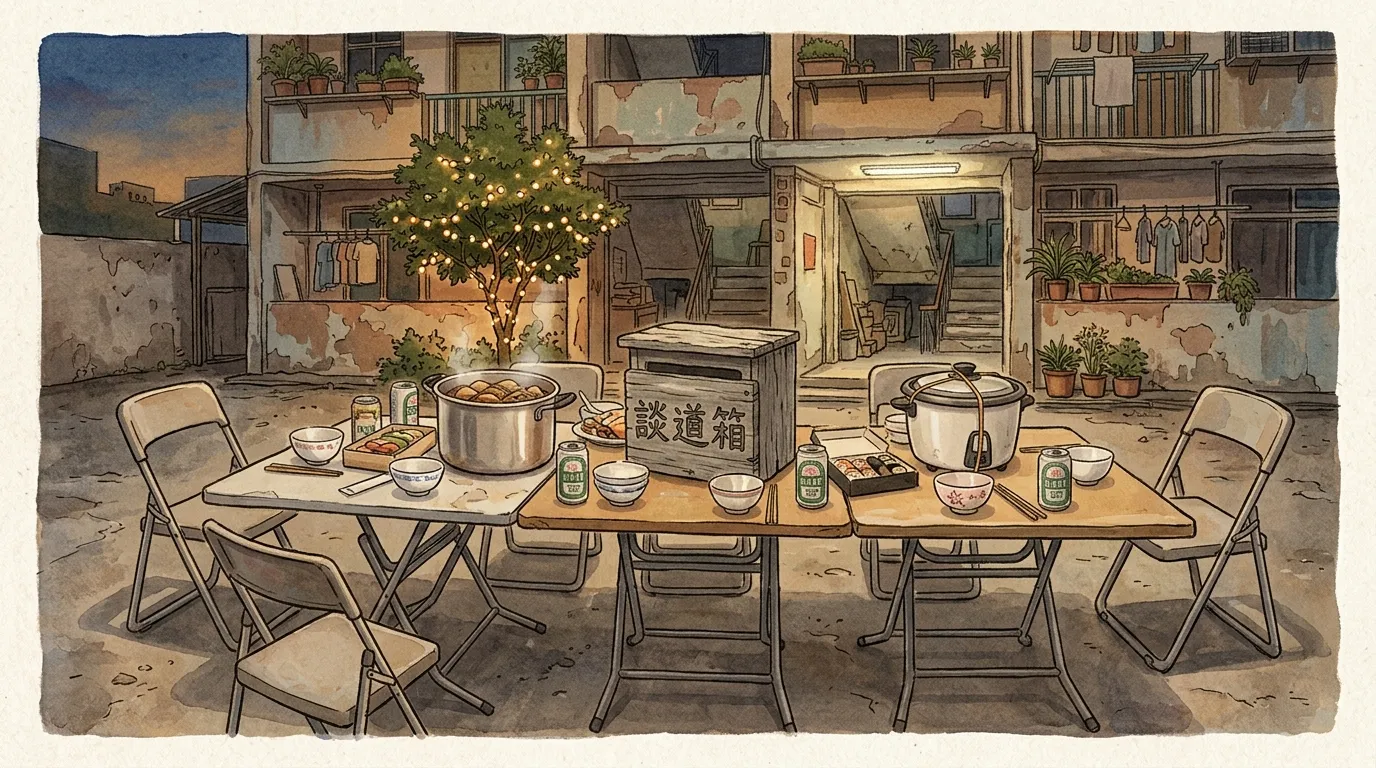
By the time the Christmas lights came on, there was a full table of people. Left to right along the folding tables: Hong Xiuzhi’s enormous braised pot; Mrs. Cai’s braised pork, carried out in the inner pot of the rice cooker, lid held on with a rubber band; the three boxes of takeaway sushi; the case of Taiwan Beer Lu Zhensheng had brought down; Xu Guanghui’s fried rice vermicelli packed in a food container — he said it was Biyun’s old recipe, he’d followed it himself, but he admitted the taste wasn’t quite right.
The bowls were pooled from every household. White ceramic from Cai Yaoting’s kitchen, melamine from Hong Xiuzhi’s, Japanese bowls that Lin Jing’en had turned up from the landlord’s leftover kitchen things — a small cherry blossom printed on each base, somewhat overdressed for the occasion. Chopsticks were also uncoordinated. Disposable ones, metal ones from various kitchens, and Lu Zhensheng had even brought down a pair of wooden ones he said he’d used for twenty years and they had the best weight.
Guo Boyan was the last to appear. He brought a plate of fried eggs — six sunny-side-up eggs stacked on the plate, edges crisped dark, yolks fully cooked through. He set the plate at the corner of the table and took a seat at the far end.
“You made those?” Lu Zhensheng looked at the plate.
“What about it.”
“Nothing. Very honest presentation.”
Xu Guanghui arrived close to half past seven. He came down from the second floor slowly, back a little rounded. Before sitting he gave Cai Yaoting a nod, then pulled a chair next to Guo Boyan.
“Where’s Biyun?” Hong Xiuzhi asked.
“Asleep.” Xu Guanghui took off his glasses and wiped them; the tape around the temple hinge caught the light. “She took her medication. Won’t be up before eight. I’ll sit a while and go back up.”
Nobody said take your time or we’ll check on her. Everyone just kept reaching for food. The kind of unspoken understanding that takes forty years of living alongside someone to grow.
When Chen Sulan came down, every pair of chopsticks at the table paused for a second.
She was wearing a dark cotton-linen top, her hair combed neat, her plastic sandals on her feet. The sound of her coming down the terrazzo steps carried up the stairwell one stair at a time — a hundred steps, a path she had walked for forty years. Her right hand held an aluminum pot, lid on. Her left hand trailed along the wall.
Lin Jing’en stood up and took the pot. When Chen Sulan passed it over, she glanced at her — briefly. Then she sat.
“Made a pot of soup,” she said. “Daikon and pork ribs.”
Hong Xiuzhi had already made room. When Chen Sulan sat down, the folding chair let out a small metallic protest. She looked around the table — braised things, braised pork, sushi, fried rice vermicelli, fried eggs.
“Who brought the sushi?”
“Us.” Zhao Peiyun raised her hand slightly.
Chen Sulan looked at the sushi, then at the braised pot, and said nothing — but the angle of her mouth said plenty.
Cai Yaoting picked up a can of Taiwan Beer, and when he pulled the tab he realized he had no idea what to say. He used to prepare an opening — residents, today we… But this wasn’t a meeting. There was no agenda, no projector, no A4 handout.
He raised his beer. Everyone else raised theirs — beer cans, tea cups, empty hands.
“Let’s eat,” he said.
Just that.
Halfway through dinner, Lu Zhensheng opened his phone and started playing music. Old Taiwanese songs leaked out of the phone speaker, the sound quality like something poured from a tin can, soft and blurred at the edges. But the melodies everyone knew.
“Do you remember—” Hong Xiuzhi pointed at Cai Yaoting with her chopsticks, “when your son fell down the staircase as a kid and chipped a front tooth?”
“That was the second floor to the first floor,” Cai Yaoting said.
“Third floor to second floor. I was there.”
“If you were there, how come you didn’t catch him?”
“I’m not a goalkeeper.”
Zhou Mingda sat beside them with his mouth half open. He and Zhao Peiyun had only moved in three years ago; these stories were archaeological finds for them.
“The year of Nari.” Xu Guanghui spoke up. His voice wasn’t loud, but the table went quiet. “Water flooded up to the first floor. Qishan and I were sandbagging the entrance. Couldn’t hold it. He was crouched down in the water, just kept stacking, clothes soaked through. I said that’s enough, he said let’s do one more row.”
Chen Sulan bent her head and picked up a piece of pork rib. Her hand was steady.
“After the water went down, the whole first floor was destroyed.” Xu Guanghui continued. “You know who came to sweep first?” He glanced at Guo Boyan.
Guo Boyan took a bite of his fried egg. No response. But he didn’t deny it.
“The dog on the third floor—” Lu Zhensheng picked up the thread, “back when it went after the postman—”
“It didn’t go after him, it chased him.” Guo Boyan finally spoke. “It just ran fast.”
“The postman’s trousers were ripped,” Hong Xiuzhi said.
“That was his trousers’ problem.”
Laughter moved around the table — the kind that comes out through your nose, carrying a little beer, the kind that requires no effort. The Christmas lights blinked in the branches of the Chinese perfume tree, throwing everyone’s shadows onto the concrete in slow, swaying shapes.
When Zhao Peiyun put the last piece of sushi on Zhou Mingda’s plate, she said very quietly: “We should have moved in sooner.”
Zhou Mingda looked at her. He didn’t say anything back. But he ate the sushi.
Cai Yaoting sat where he was, his beer can long empty, turning the tab in his fingers. He noticed he hadn’t stood up once all evening — no organizing, no allocating, no counting down. He’d just sat here. Listening to them talk. The table was crooked, the food was a patchwork, nobody had kept track of who brought what. A mess.
Just right.
Close to nine, Chen Sulan stood up.
“I’m going up to get something.”
Lin Jing’en started to follow. Chen Sulan waved her off. “No need. I’ll go myself.”
The sound of her sandals on the stairwell steps went up one at a time. A hundred steps. When she reached the stretch between the third and fourth floors where the light didn’t reach, she didn’t clap her hands to trigger the motion sensor — she felt her way along the wall. At the corner on the third floor, her fingertips grazed that spot on the wall — a thick marker line, still there.
Top floor. The iron door clicked open.
She stood in the doorway and looked in. The radio was quiet. She’d turned it off yesterday and hadn’t turned it back on. Qishan’s reading glasses sat on the windowsill where she’d left them — she hadn’t put them away, and she didn’t plan to.
She walked to the wall beside the iron door. The wooden mailbox.
Handmade. Qishan had spent a month on it. The wood had gone gray from forty years of wind and sun, the paint long since gone; the surface was rough under your hand, like driftwood. At the top, he had carved the word ours into the wood.
Forty years ago, the rooftop addition had no address number. Chen Sulan had said they should put up a nameplate; Qishan asked what kind of number they were supposed to put. She said just write Top Floor Unit One. He didn’t want that. He measured the wood, spent days sawing, a week carving, and when he finally brought it out, what he’d put on it wasn’t a number — it was ours.
Chen Sulan had scolded him for it at the time. What kind of nameplate was that? Would the postman understand? Qishan said the postman never came up anyway. The people who came up were all their own.
In the forty years after, the postman never did come up. The people who came up were all their own.
She reached up and lifted the mailbox from the wall. The nail had come loose; one pull and it was down. The wood was lighter than she remembered. She tucked it under her arm, pulled the iron door shut — the click of the latch — and walked back down.
A hundred steps.
By the time she came down, people had started clearing the table. Hong Xiuzhi was stacking bowls; Cai Yaoting was tipping the last drops from a beer can. Chen Sulan walked to the table and set the wooden mailbox down in the middle.
Everyone looked at it.
The wood was gray, the corners worn smooth, the front carved with a single word. The cuts were deep — Qishan had held his chisel like a man who meant it. Ours. The carving wasn’t beautiful, the strokes thick and a little uneven, but every line had stayed put in the wood for forty years without moving.
Chen Sulan stood at the table. The light from the Christmas lights fell across her face, alternating bright and dim.
“I can’t take this with me.” Her voice was quiet, but the apron was still and every word arrived. “Putting it in a new apartment wouldn’t be right.”
She paused.
“But I want you all to remember — that once, we lived here.”
Ours.
Nobody spoke.
Hong Xiuzhi’s bowl stopped midway to the stack. Lu Zhensheng turned off the music on his phone — maybe his finger found the button by accident, maybe not. Cai Yaoting gripped his empty beer can; the tab had snapped off in his fingers. Xu Guanghui bowed his head and pressed his thumb against the tape on his temple hinge. Guo Boyan sat at the far end of the table, looking at the mailbox, nothing on his face, but he didn’t look away.
Lin Jing’en stood beside Chen Sulan. She reached out and touched the carved word — one finger tracing each stroke of the first character, then the second. The cuts in the wood were rough, like reading a very long story by touch.
Zhao Peiyun drew a breath through her nose. Zhou Mingda reached over and held her hand without looking at her.
Then Chen Sulan said: “Where’s the consent form?”
Cai Yaoting blinked. His instinct said I’ll go get it, but his mouth hadn’t moved yet and his keys were already making noise — he’d stood up too fast.
He went home and came back down with the consent form. A single A4 sheet, stamped. Chen Sulan took the pen, stood at that uneven folding table, and signed her name on the resident’s signature line.
Steady strokes.
When Cai Yaoting folded the consent form away, his hands were shaking. Not Chen Sulan’s hands — his.
Moving day was a week later.
Three small trucks sat in front of 147 Yonghe Street. Movers ran up and down from the first floor to the fifth, their feet on the terrazzo steps like a drumroll. The motion-sensor light in the stairwell couldn’t keep up; it just stayed on.
Everything each household brought out was different, but there was one thing in common: everyone’s boxes had something in them that wasn’t theirs.
On top of Hong Xiuzhi’s boxes sat a jar of Mrs. Cai’s homemade pickled pineapple paste — take it, take it, I’ve got more. When Cai Yaoting went to move his things, he found a screwdriver in his box that belonged to Lu Zhensheng — they’d argued before about clutter in the stairwell, but the screwdriver had appeared. Tucked into the zipper pocket of Zhou Mingda and Zhao Peiyun’s luggage was a vacuum-packed portion of Hong Xiuzhi’s braised food with heat for ten minutes written on it in marker.
Xu Guanghui moved out slowest. He stood alone in the second-floor stairwell for a long time. Biyun’s things had to be handled carefully — her habits were fixed, where the cup went, where the slippers went; the new place had to be exactly the same. On one of the cardboard boxes he wrote a list: Biyun’s cup. Biyun’s pillow. Biyun’s slippers (don’t mix left and right). Biyun’s radio. When he finished writing he realized the marker had been handed to him by Guo Boyan.
Guo Boyan had been standing beside him, not saying anything. He handed over the marker and walked away.
Chen Sulan was the last to move.
She stood on the rooftop terrace and looked around once. The bougainvillea was still blooming; the planters were too heavy to take, so she left them. Nothing on the clothesline. A flake of pale-green paint had come away from the iron door in the sun. On the wall where the mailbox had hung for forty years, there was a faint rectangular patch — the wood had shielded that section of plaster, and it had stayed lighter than everything around it.
She walked down a hundred steps. The movers had already loaded her things onto the truck. There weren’t many. The things a seventy-two-year-old person needs to bring along are fewer than you’d expect.
Lin Jing’en was waiting at the first-floor entrance.
The last box belonged to Chen Sulan. When Lin Jing’en helped carry it up to the truck, she slipped the wooden mailbox inside — tucked between clothes and bedding, held still.
There was a note stuck to the mailbox.
Ama, this is ours.
Chen Sulan didn’t open the box. But she saw the corner of the note showing above the flap. She reached in and pressed it down so it wouldn’t fall out.
The moving trucks left one by one. When the front of 147 Yonghe Street went quiet again, the motorcycles at the end of the lane were still going past like they always had. The leaves of the Chinese perfume tree shook once in the exhaust, then went still.
The empty stairwell. Afternoon light came in at an angle through the second-floor window, falling across the terrazzo steps. The marker line on the wall was hard to make out in the light — but it was still there.