Chapter 3
Mimi
Saturday afternoon, Yifen was folding laundry in the living room.
The TV was on, playing some food travel show. The host was talking about scallion pancakes from Yilan. She wasn’t watching—she just let the noise fill the room. In her hands was Atuo’s school uniform shirt. She shook it out, folded it in half, tucked the sleeves in, flipped it over, smoothed the collar. The same motions repeated hundreds of times, no thinking required. Her hands moved on their own.
Atuo was sprawled over the folding table, doing homework. The mechanical pencil scratched against the workbook paper, occasionally stopping as he erased a few lines, then started again.
The living room was quiet, peaceful.
Yifen picked up the next piece of clothing—her own long-sleeved T-shirt, gray, the collar a little loose. She shook it out, aligned the shoulder seams, and was about to fold it when Atuo spoke.
“Mom.”
“Mm?”
“He says you had a cat when you were little. Her name was Mimi.”
Yifen’s hands froze midair. The T-shirt’s sleeves hung down, the left one longer than the right by a few inches.
“What?”
“Mimi.” Atuo looked up, still holding the pencil. “Black, with a white patch on her belly. She liked to sleep on your lap.”
She set the T-shirt on her knees.
“How do you know about Mimi?”
“He told me.” Atuo said it the same way he might say “Lunch today was chicken leg.” He looked back down and kept writing, the pencil moving across the paper again.
Yifen didn’t move. The T-shirt was still on her lap. She gripped the collar, her knuckles white.
Mimi was the cat she’d had in middle school. Found on the street, a little black kitten with a white patch on her belly, like a apron stained with cream. She’d had her for six years. Then Mimi got sick and died. Yifen had cried for days. She’d never told anyone about it—not Atuo’s father, not any of her friends. It was her own thing, a long time ago, something she’d almost forgotten.
“Atuo.”
“Mm?”
“You… don’t talk nonsense.”
“I’m not talking nonsense.” Atuo looked at her, his expression serious. “Mimi liked to sleep on your lap, right? Every time you did homework, she’d jump up, circle around twice, then curl up on your thighs. Purring loud, real loud.”
Yifen’s throat tightened.
“Enough.”
“But he said—”
“I said enough.”
Her voice came out louder than she meant. Atuo blinked, the pencil stopped, the tip leaving a small ink blot on the paper.
The living room was silent for three seconds. On TV, the host was still talking about how good the scallion pancakes were, the oil sizzling in the pan.
Yifen stood up, folded the T-shirt, and placed it on the arm of the sofa. She walked into the kitchen, turned on the faucet, and water rushed out in a loud stream. She wasn’t washing anything—she just let the water run, reached her hand under it, the cold water streaming over her fingers.
She watched the water swirl in the sink and disappear down the drain.
Mimi.
Twenty years ago. A cat, six years, then dead. She’d never mentioned it to anyone. Not even her own mother—Atuo’s grandmother—probably didn’t remember.
That thing in the closet knew about it.
Not a guess. Not observation. No one could deduce from everyday observation that she’d had a cat named Mimi twenty years ago. No one knew that cat liked to sleep on her lap. No one knew the white patch on her belly. No one knew her purr was loud.
Unless that thing really was there. Really watching her.
Not yesterday. Not today. Twenty years ago.
Yifen turned off the faucet. The water stopped, and the kitchen fell silent. She gripped the edge of the counter, staring down at her fingers. Nails cut short, no polish, knuckles white from the pressure.
She took a few deep breaths.
Okay. It’s fine, she told herself. I have work tomorrow. The after-school program fee hasn’t been paid yet. There are only three eggs left in the fridge.
She dried her hands and walked out of the kitchen.
Atuo was still doing homework, the pencil moving across the paper with a soft scratching sound. He didn’t look up, didn’t say anything else.
Yifen sat back down on the sofa, picked up another piece of clothing—Atuo’s gym shirt, blue, with a ballpoint pen ink stain on the sleeve. She shook it out, folded it, pressed it flat, and set it aside.
“Atuo.”
“Mm?”
“You… that ‘he’… did he say anything else?”
Atuo looked up at her.
“He said you’re tired. He said you shouldn’t overthink.”
Yifen didn’t answer. She picked up the next piece of clothing and kept folding.
At three in the afternoon, she went out to the supermarket to buy groceries. Before she left, she told Atuo, “I’m going out. Stay home, don’t open the door for strangers.” Atuo said okay, not looking up from his comic book.
The supermarket was about a ten-minute walk from the apartment. Yifen pushed a shopping cart, weaving between the aisles. She grabbed milk, eggs, toast, a pack of pork slices, a bunch of water spinach, two onions. When she passed the pet supplies aisle, she caught a glimpse of a woman in a puffer jacket carrying an orange cat. The cat’s tail hung down, swinging back and forth. She froze for a second, then her gaze shifted to the shelves next to her—cat food. She didn’t know why she stopped. She didn’t have a cat.
She pushed the cart past and got in line to check out.
In front of her was the neighbor lady from the third floor. Short hair, in her fifties, wearing a floral print top, her cart full of toilet paper and instant noodles.
“Yifen, out grocery shopping?”
“Yeah, Mrs. Lin.”
“How’s Atuo doing lately?”
“Fine. Why?”
“Oh, nothing. I got up to use the bathroom last night and heard some noise coming from your place. Sounded like someone talking.” The neighbor lowered her voice, leaning in. “I thought maybe Atuo was still awake, on the phone with someone or something.”
Yifen smiled.
“Maybe he was talking in his sleep.”
“Oh, I see. I just wanted to check. Kids—if they stay up late, they can’t get up the next day.”
“Yeah, I’ll keep an eye on it. Thanks, Mrs. Lin.”
The neighbor smiled and turned back to pay. Her cart wheel got stuck in a crack in the floor, and she had to give it a hard shove to get it moving.
Yifen stood behind her, gripping the handle of her cart. A single mom who couldn’t even keep her closet organized, and now she had to worry about her son chatting with something in it—she might as well sign up for a “parenting consultant” service.
Last night.
Atuo’s room didn’t have a phone. He didn’t have a cell phone. No computer, no tablet in his room.
Talking to someone in the middle of the night?
She swiped her card, paid, and walked home carrying two bags. The sky was darkening, streetlights glowing yellow, stretching her shadow long behind her. As she passed the convenience store, the man in the suit was standing at the entrance, smoking. As she passed the park, a few kids were screaming on the slide. She didn’t stop. She walked straight back to the apartment, climbed to the third floor, pulled out her keys, and unlocked the iron door.
Atuo was sitting in the living room watching TV. Cartoon channel—a yellow sponge bouncing around on the screen.
“Mom, you’re back.”
“Mm.”
She put the grocery bags in the kitchen and started putting things away. Milk on the top shelf, eggs on the door, pork slices in the freezer. She washed the water spinach, cut it into sections, and put it in a colander. Peeled the onions, sliced them, and put them in a container.
While she did all that, Atuo watched TV in the living room. Cartoon sound effects, exaggerated laughter, and commercial music alternated. She listened to these sounds, chopping the onions, her eyes stinging a little.
For dinner, she cooked a pot of noodle soup. The two of them sat at the table and ate. Atuo ate quietly, picking up noodles with his chopsticks, blowing on them, then slurping them in. Yifen didn’t have much appetite. She drank a few sips of soup and set her bowl down.
“Mom, you’re not eating?”
“Not really hungry.”
“Oh.”
Atuo continued eating his noodles. He ate the egg first, then the meat slices, then the noodles. He always ate in a specific order, ever since he was little.
“Atuo.”
“Mm?”
“He… when did he start being in your room?”
Atuo paused, his chopsticks in midair, and thought for a moment.
“About… last month.”
“Last month?”
“Yeah. One night I was sleeping and I heard a noise from the closet. A soft sound, like tapping on wood. I asked who was there, and he started talking to me.”
“What did he say?”
“He said, ‘Don’t be afraid, I’m just here.’” Atuo shrugged. “Then he asked me how my day at school was.”
Yifen tightened her grip on her chopsticks.
“And you just talked to him?”
“Yeah. What else?”
“Weren’t you scared?”
Atuo looked at her, his eyes serious.
“Why would I be? He hasn’t hurt me.”
Yifen opened her mouth, wanting to say something, but didn’t know what.
Atuo looked down and continued eating his noodles.
“And he cares more about how my day at school went than you do,” he murmured.
The words were like a needle—thin, sharp, piercing into Yifen’s chest.
She didn’t answer. She stood up, took her bowl into the kitchen, turned on the faucet, and started washing the dishes.
The water ran loudly. She scrubbed the bowl hard, making it squeak.
At nine in the evening, Atuo took a shower, put on his pajamas, and walked into his room. Yifen stood at the doorway, watching him climb into bed and pull the blanket up to his chest.
“Time to turn off the light.”
“Okay.”
She reached in and switched off the light. The room went dark. A yellow strip of light from the streetlamp came through the curtain gap, landing on the closet door.
“Mom.”
“Mm?”
“He says goodnight.”
Yifen stood at the doorway, her fingers still on the switch. She didn’t know why she said what she did next—as if she was confirming something.
”…Say goodnight to him too.”
She closed the door and walked back to the living room.
The TV was on, some talk show where guests were discussing recent weather changes. She sat on the sofa, staring at the screen but not really watching.
She remembered Atuo when he was little. Around three or four, there was a period when he’d also talk to the air. She thought it was an imaginary friend back then, didn’t think much of it. Eventually he stopped on his own, and she forgot about it.
But this was different. Atuo was ten now, in fifth grade. He wasn’t at the age where he made up imaginary friends. And the things he knew—those weren’t things a fifth-grade boy should know.
Mimi.
She closed her eyes, leaning back against the sofa. In her mind, a little black cat appeared, a white patch on its belly, curled up on her lap, purring loudly.
That was so long ago.
She opened her eyes, stood up, and walked to Atuo’s door.
A sliver of light showed under the door—not fluorescent, but the warm yellow of a nightlight. Atuo always kept a nightlight on when he slept, said he was afraid of the dark.
She pressed her ear against the door.
No voices. No tapping. Only Atuo’s steady breathing.
She stood there for a moment, then gently pushed open Atuo’s door. The room was dark except for the faint glow of the nightlight. She walked in and stopped in front of the closet.
A three-door sliding wooden closet. Old, one of the doors would stick. Inside, it was stuffed with blankets, off-season clothes, suitcases, paper bags.
She stood there, looking at the closet door.
“Who are you?”
Her voice was so soft it was almost inaudible. As if afraid to wake something, or afraid to be heard.
The closet didn’t answer.
Silent. Not even the sound of a mouse.
She stood there for thirty seconds.
Then she turned and walked out of the room, gently pulling the door shut behind her. She went into the master bedroom and closed the door.
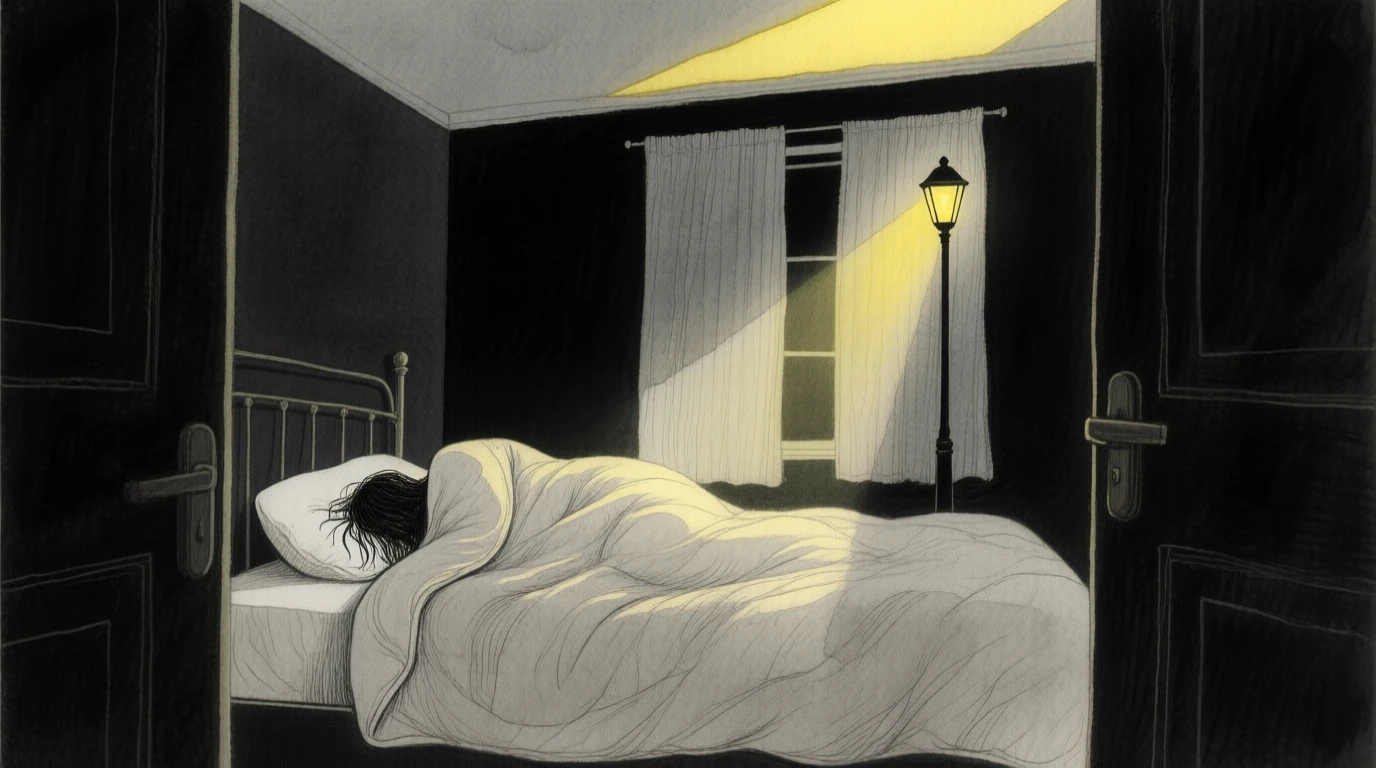
But she didn’t fall asleep. She lay in bed, staring at the ceiling, listening to her own heartbeat. The next room was quiet. The TV had automatically turned off. The streetlamp light came through the curtain gap, drawing a thin yellow line on the ceiling.
She remembered Atuo’s words.
“He says goodnight.”
She turned over and pulled the blanket over her head.
I have work tomorrow. The after-school program fee is due this week. There are two eggs left in the fridge—she could fry one for Atuo’s breakfast tomorrow.
She closed her eyes.
But for a long, long time, she didn’t fall asleep.
At two in the morning, she woke up.
Not because of an alarm. Not because she needed to pee. But because of a strange feeling—she felt like someone was watching her.
She opened her eyes. The room was dark. The yellow line from the curtain gap was painted on the ceiling. She listened for a moment. No sound. The next room was quiet. The living room was quiet. The whole house was quiet.
She lay there, not moving.
Maybe it was a dream. Maybe she was too tired. Maybe she was just scaring herself.
She closed her eyes, turned over, and pulled the blanket up to her chin.
And then she heard it.
Softly, coming from the direction of Atuo’s room—
Three short, one long.
Knock knock knock—knock.
She froze. Her fingers instinctively gripped the bedsheet, knuckles white, breathing shallow and fast.
Tapping. Clear rhythm, steady, like someone knocking on wood.
Knock knock knock—knock.
A few seconds pause, then it came again.
Knock knock knock—knock.
Yifen’s heartbeat thundered in her eardrums. She lay in bed, blanket pulled up to her nose, eyes wide open, staring at the dark ceiling.
She should get up and check. She should go to Atuo’s room, turn on the light, inspect the closet.
But she didn’t move.
She lay there, listening to the steady tapping. One, two, three, then a pause. Over and over.
She didn’t know what it was. She didn’t want to know.
She just needed to work tomorrow. The after-school program fee wasn’t paid yet. There were only two eggs left in the fridge.
She pulled the blanket over her head, curling up like a frightened cat.
Knock knock knock—knock.
The sound continued for a while, then stopped.
The house fell silent again.
Yifen lay under the blanket, eyes open, until dawn.