Chapter 5
The Neighbor's Knocking on the Wall
Friday evening, Yifen climbed the stairs to the third floor, a supermarket shopping bag in hand, and ran into the neighbor lady at the turn of the landing.
The neighbor lady was wearing a floral-print house dress, holding a stainless steel thermos, as if she were on her way down to take out the trash. When she saw Yifen, she stopped and put on that “I’ve been meaning to talk to you” expression.
“Hey, Atuo’s mom.”
”…Hi.”
Yifen took two more steps up and stopped on the same landing. The shopping bag was a bit heavy; she switched hands.
“Has your place been making any knocking sounds lately?” The neighbor lady lowered her voice, as if sharing a secret. “I’ve been hearing it these past few nights—knock, knock, knock—coming from the wall. I thought maybe Atuo was playing with something.”
Yifen’s heart skipped half a beat, but her face didn’t change.
“Oh, maybe he’s just messing around in his room.”
“Really?” The neighbor lady tilted her head, a slight frown forming. “But it didn’t sound like playing to me. The noise was really regular, like someone tapping out a rhythm. And it was always around eleven or twelve at night.”
“He sometimes bangs on his bed before he falls asleep.”
“I see.” The neighbor lady took a sip from her thermos, her eyes not leaving Yifen’s face. “At first I thought it might be your closet, because the sound seemed to come from the wall side. You know, the wall between our two apartments.”
Yifen’s fingers tightened on the handles of the shopping bag.
“The closet?” she repeated, her voice carefully flat.
“Yeah, it sounded like wood—knock, knock, knock. I told my husband about it, and he said it might be pipes expanding and contracting from heat, but I’ve lived here twenty years and never heard pipes make that kind of sound.”
The neighbor lady took another sip of tea, still watching Yifen.
(Oh right, pipes tapping out three shorts and a long—are pipes rock musicians now?) Yifen muttered to herself.
“No, it’s probably Atuo playing. I’ll tell him to keep it down.”
“Oh, I’m not complaining, just asking.” The neighbor lady waved a hand, her expression softening. “Kids will be kids. It’s just that the sound was so rhythmic, I wanted to check.”
“Okay, I’ll keep an eye on it.”
“Good, good. Well, I’ll head down now—the garbage truck will be here soon.”
The neighbor lady walked down the stairs, thermos in hand, her slippers making a flip-flop, flip-flop sound on the steps.
Yifen stood on the landing, listening as the sound faded, until the iron door on the first floor opened and closed.
She carried the shopping bag into the apartment, set it on the dining table, and didn’t rush to put things away. She stood in the middle of the living room, looking at Atuo’s closed door. No sound.
She walked over and knocked.
“Atuo?”
No response. She pushed the door open. Atuo was sitting at his desk, doing homework. The mechanical pencil scratched across the workbook; he didn’t turn around.
“Mom?”
“Just now, the neighbor lady said she heard knocking on the wall at night.”
Atuo’s pencil stopped, but he still didn’t turn.
“Oh.”
“She said it sounded like someone knocking on the closet.”
“Yeah, that’s Him playing with me.” Atuo’s tone was light, as if explaining something ordinary. “We’re tapping out a rhythm.”
Yifen stepped into the room and stood beside Atuo’s desk. She looked at his profile as he lowered his head and continued writing, the pencil drawing rows of Chinese characters on the page.
“What rhythm?”
Atuo put down the pencil and turned around. He raised his right hand and tapped a few times on the edge of the desk.
Knock. Knock. Knock.—Knock.
Three shorts and a long.
Yifen’s chest tightened.
”…What rhythm is that?”
“Just a rhythm. He taught me.” Atuo put his hand down and picked up the pencil again. “He said you’ve heard it before.”
Yifen didn’t speak. She thought: Is He an archaeologist? Digging up songs I listened to at twenty. She stood there, watching Atuo continue his homework. The sound of the pencil scraping across paper was clear in the quiet room. Outside the window, the sky had darkened; the only light in the room came from the desk lamp, casting a warm yellow circle on the wall.
”…I haven’t heard it.”
“Really? He said you have.”
“He’s wrong.”
“He said no.”
Yifen didn’t answer. She turned, walked out of the room, closed the door, and went into the kitchen.
She stood at the counter, turned on the tap, and started washing vegetables. The water rushed over the backs of her hands as she rubbed the bok choy leaves clean, rinsing off the dirt.
Three shorts and a long.
Where had she heard that rhythm?
She turned off the tap, shook the water from her hands, and stood there, staring at her own blurry reflection in the window glass.
A song.
She remembered—she’d already thought of it this morning while brushing her teeth. A song she and Chen Shijie used to love when they were dating. What was the title? She thought for a long time but couldn’t recall. Only the rhythm: three shorts and a long, repeated twice, then the melody came in.
But that was over ten years ago.
She bent down and continued washing the vegetables.
Dinner was simple: stir-fried bok choy, scallion eggs, and a bowl of meatball soup. Atuo sat at the dining table, ate quietly, then took his bowl and chopsticks to the sink.
“Finished your homework?”
“One page of math left.”
“Watch TV after you finish.”
“Okay.”
Atuo went back to his room, leaving the door open. Yifen washed the dishes in the kitchen, the water splashing loudly. The TV was on, broadcasting the weather forecast. As she scrubbed the pot, she listened to the weatherman say that tomorrow the weather would change, the northeast monsoon would strengthen, and the low would drop to eighteen degrees.
She finished washing, dried her hands, and walked out of the kitchen.
Atuo had already finished his homework and was sitting in the living room watching TV. He was hugging a cushion, sitting cross-legged on the sofa, watching a Japanese cartoon. A blue-haired boy on the screen shouted, then transformed, his hair turning golden.
Yifen sat down next to him.
“Atuo.”
“Mm?”
“When you tap that rhythm with Him at night, is it very loud?”
“Not really.” Atuo’s eyes didn’t leave the TV. “Just a light tap.”
“But the neighbor heard it.”
“Oh.”
“She said she’s heard it for several nights.”
Atuo didn’t answer. On TV, the golden-haired boy was fighting a monster, with boom boom boom sound effects filling the living room.
“Atuo.”
“Mm?”
“Don’t tap at night anymore.”
Atuo turned to look at her.
“Why?”
“Because it bothers the neighbors.”
“But He likes tapping.”
“Tell Him to play another way.”
Atuo was silent for a moment, then turned back to the TV.
“He says okay.”
Yifen let out a breath and leaned back into the sofa.
The living room was left with only the TV sound. The cartoon ended, and commercials came on—a shampoo ad, a girl flipping her long hair, the strands glittering in the sunlight.
“Mom.”
“Mm?”
“He says you really have heard that rhythm.”
Yifen didn’t answer. She watched the TV screen. The shampoo commercial ended, followed by a convenience store ad: a guy walks into a convenience store late at night, buys a drink and a tea egg.
“He says you really liked that song back then.”
”…When?”
“He didn’t say.”
Yifen tapped her fingers lightly on the armrest of the sofa twice.
“Tell Him not to keep talking about my stuff.”
“He said you didn’t forbid it.”
“I’m forbidding it now.”
Atuo glanced at her, said nothing, and turned back to the TV. The next show started—a food travel program, the host standing in front of a night market, holding a grilled squid skewer and talking to the camera.
“He says you weren’t like this before.”
Yifen froze.
“What do you mean, before?”
“He didn’t say.”
”…What was I like before?”
Atuo shrugged. “He didn’t say. He just said, ‘Your mom wasn’t like this before.’ That’s all.”
Yifen was silent.
She sat on the sofa, the TV light flickering on the wall, the aroma of food unable to escape the screen. She heard the low hum of the refrigerator, the sound of footsteps from upstairs, her own breathing.
”…I haven’t changed.”
She said it very softly, as if talking to herself.
Atuo didn’t answer.
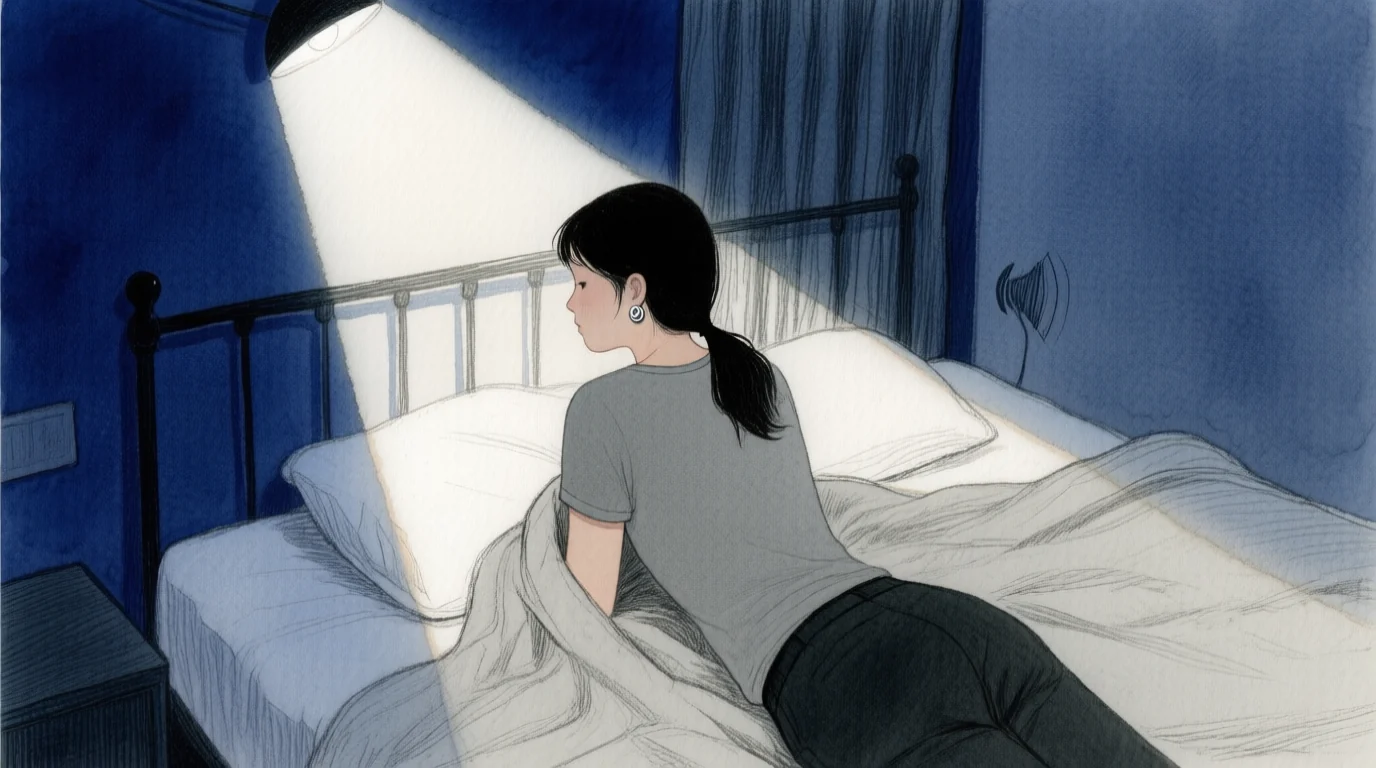
At eleven at night, Yifen lay in the master bedroom, not asleep.
She lay on her side, facing the wall, the blanket pulled up to her chin. The curtains weren’t fully drawn; a strip of streetlight came through the gap, painting a long bright line on the ceiling.
She closed her eyes.
No sound.
She turned over, changed positions.
Still no sound.
The neighbor lady said she’d heard it for several nights. But Yifen herself—except for that one time in the early morning with the three shorts and a long—hadn’t heard it again. Maybe she’d been asleep, maybe the sound was too quiet to wake her.
But tonight, she was listening.
She kept her eyes open in the dark, listening to every sound in the apartment. The refrigerator humming. Car noises outside. Someone walking upstairs, footsteps coming from the ceiling—thump thump thump, going one way, then coming back.
Then she heard it.
Knock. Knock. Knock.—Knock.
From the direction of the wall.
Very soft, like someone tapping lightly on wood with a knuckle. If she hadn’t been listening for it, she might have dismissed it as pipes expanding and contracting, or a mouse crawling inside the wall.
But she knew what it was.
She didn’t move. She lay in bed, staring at the strip of light on the ceiling, listening to the sound.
Knock. Knock. Knock.—Knock.
A second time.
She didn’t get up to check on Atuo in the next room. She didn’t call out to him. She just lay there, listening to the sound, her heartbeat steady in her chest.
Knock. Knock. Knock.—Knock.
A third time.
Then it stopped.
The apartment fell quiet again. Refrigerator humming. Car noises outside. Her own breathing.
She closed her eyes.
She remembered that song.
The melody suddenly surfaced from deep in her memory—the intro was that rhythm: three shorts and a long, twice, then the guitar came in. She remembered now: the song was called “Gentle Night,” by a band whose name she’d forgotten. She used to love that song, so much that she’d played the CD until it got scratched, skipped, and finally couldn’t be read at all.
That was when she was twenty.
Chen Shijie had burned that song onto a CD for her as a birthday gift. She accepted it, listened to it a lot, until she knew the lyrics by heart. Later they broke up; she threw away the CD and never listened to that song again.
She thought she’d forgotten.
But she hadn’t.
She opened her eyes in the dark, her eyes feeling a little warm.
She didn’t know why she wanted to cry.
She just lay there, listening to the quiet night, remembering a song from over ten years ago, remembering someone, remembering a version of herself she hadn’t thought about in a long time.
She turned over and buried her face in the pillow.
The next room was silent now.
Atuo must be asleep. He’d gone quiet too.
She closed her eyes, and slowly, her breathing steadied.
Just as she was about to fall asleep, she vaguely heard a sound. Very soft, very distant, as if coming from deep memory.
Not a tapping.
A melody.
Three shorts and a long, twice, then the guitar came in.
In her dream, she hummed it softly, thinking in a daze: Even in my dreams I can’t get any peace—but at least the melody isn’t bad.