Chapter 7
That Rhythm
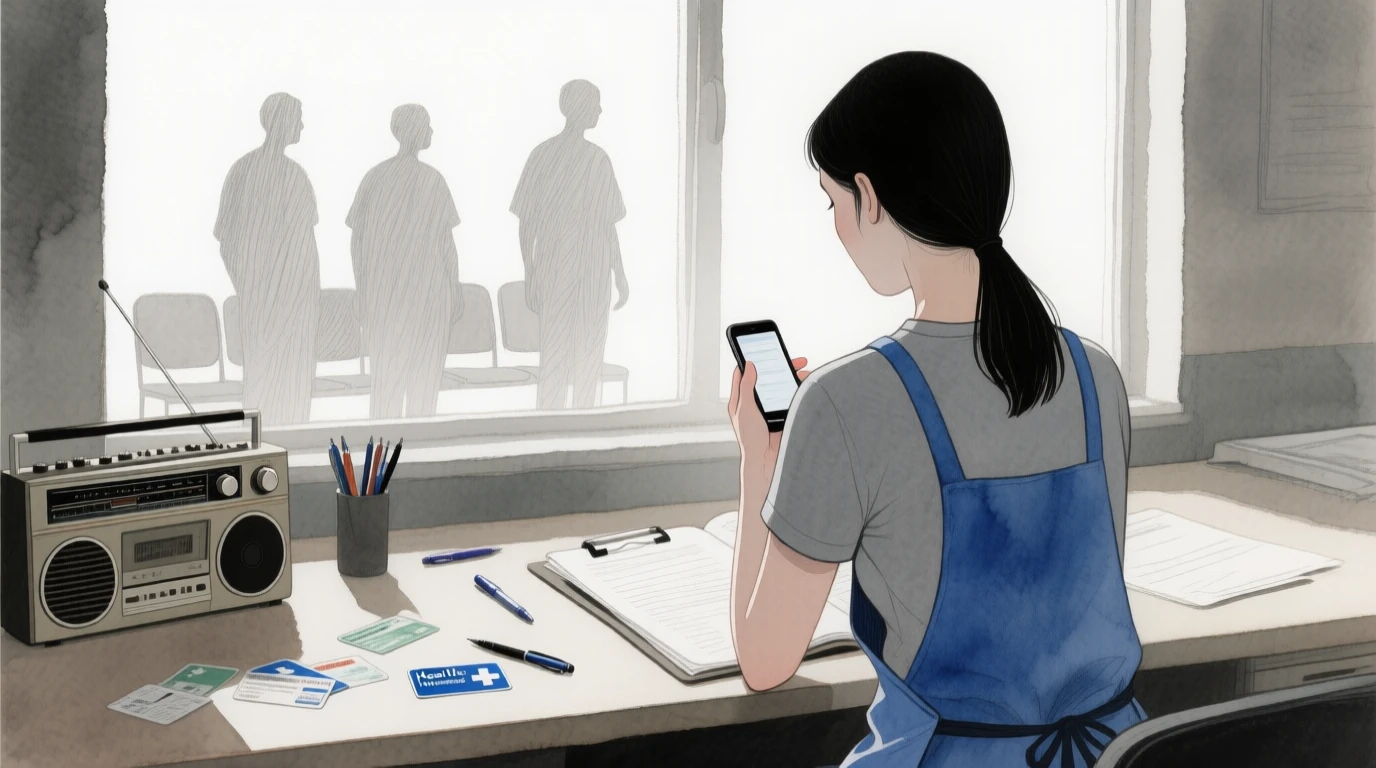
The phone rang while Yifen was checking in an elderly woman.
“Here, give me your health insurance card. What’s bothering you today?”
“It’s my… throat. Been coughing for days.”
Yifen took the card, swiped it into the system, and printed out the registration slip. The old woman took it and shuffled slowly into the consultation room. Yifen sat back down, reached for her cup on the desk—and then the phone rang.
“Zhongzheng Family Medicine, how can I help you?”
“Mom.”
It was Atuo. Calling from his cell.
“What’s wrong? You’re done with school?”
“Yeah, I’m home. I’m telling you, today It—”
“Hold on.” Yifen cut him off. “The first thing you do when you get home is call me to tell me what It did today?”
There was a pause on the other end.
”…You told me to call when I got home.”
“I told you to call and let me know you’re home, not to call and tell me about It.”
“Oh. I’m home.”
“Good. Got it.”
She was about to hang up when Atuo spoke again.
“But It did say something today.”
Yifen held the receiver, not hanging up. Three patients were waiting in the reception area—one on his phone, one coughing, one flipping through a magazine. The radio was on, playing a midday pop song.
“What did It say?”
“It said you’re going to hear a song today.”
Yifen froze.
”…What song?”
“It didn’t say. Just that you’ll hear a song.”
“And then?”
“No then. That’s it.”
Yifen opened her mouth, wanting to say something, but not knowing what. She heard the song on the radio nearing its end, about to transition into the next one.
“Okay, I got it. Stay home and do your homework. Don’t keep talking to It.”
“Oh.”
Atuo hung up.
Yifen placed the receiver back and stared at the medical charts on her desk, then at the clock. 11:47. Another ten minutes or so until noon. She’d go buy lunch soon.
The radio played the last line of the song, then a commercial break—and then the intro of the next song began.
The intro started—three short notes and one long one, an electronic keyboard melody.
Three short, one long.
Yifen’s fingers stopped on the medical chart.
It was an old song. Really old, from about a decade ago. The intro was a keyboard melody that started with three short notes and one long—like a knock, like a signal, like something calling out to her.
She knew this song.
A long time ago.
She sat behind the counter, listening to that melody, feeling something crawl up from her feet—cold, creeping from her ankles up to her calves, to her knees, to her chest.
She remembered this song.
Because it was the song Chen Shijie loved.
Chen Shijie. The guy she dated when she was twenty. Tall, wore glasses, liked plaid shirts, rode a beat-up secondhand Wild Wolf motorcycle. He’d take her out for soy milk in the middle of the night. They dated for about a year, then broke up—she couldn’t remember why, just that it hurt a lot at the time, but it passed. Over a decade later, she’d barely thought about him.
She’d never mentioned Chen Shijie to Atuo.
Not once.
But the “person” in the closet knew.
And It had told her through rhythm—three short, one long. The intro to that song, the one she and Chen Shijie had listened to countless times in their rented room. That radio hadn’t played that song in ages.
Yifen stared at the radio. The song continued, the lead vocal came in, singing lyrics she barely remembered anymore. Her hand still rested on the medical chart, unmoving.
“Excuse me, can I register?”
She looked up. A middle-aged man stood at the counter, holding his health insurance card.
“Oh, yes, sure.” She took the card and swiped it into the system. “What’s bothering you?”
“Runny nose, sore throat.”
“Okay, that’ll be one hundred fifty dollars for the registration fee.”
She took the money, gave change, printed the slip. The man took it and walked into the consultation room. Yifen sat back down and stared at the radio.
The song was still playing.
She remembered Chen Shijie’s Wild Wolf, remembered him taking her to the beach in Tamsui, remembered him playing this song on a cassette tape in her rented room and saying, “This is really good, you know?” She remembered the sound of his beat-up motorcycle’s exhaust, the colors of his plaid shirts, the way he smiled.
And then she remembered—she had never told Atuo any of this.
She had never told anyone any of this.
These things should have rotted away in her brain, known to no one else.
She picked up her phone and looked at the screen. The time was 11:52. She opened her contacts, found Atuo’s number, and hovered her finger over the screen.
She didn’t press it.
She put the phone back on the desk.
Then she picked it up again.
Pressed dial.
It rang twice, and Atuo picked up.
“Hello?”
“Atuo, did It—” Yifen paused. “Did It say anything else today?”
“No, just that you’d hear a song. Did you hear it?”
”…Yeah.”
“Oh. What song?”
“A song you wouldn’t know. A really old one.”
“Oh.”
Silence.
Yifen held the phone, staring at the medical charts on the counter. The patients in the waiting area had changed. Three new people sat there, none of them looking at her.
“Atuo.”
“Yeah?”
“You… you ask It something for me.”
“What?”
“Ask It—” She took a deep breath. “Ask It if It knows who Chen Shijie is.”
“Who?”
“Just ask, okay?”
There were a few seconds of silence on the line. She heard Atuo’s footsteps, heard him walk into his room, heard the closet door open—and then Atuo spoke, but not to her.
“It’s asking who Chen Shijie is.”
On her end of the line, she heard her own heartbeat.
Then Atuo’s voice came again, still speaking to her.
“It said, ‘I know.’”
Yifen didn’t speak.
She sat behind the counter, phone pressed to her ear, listening to those three words echo in her head.
I know.
Three words. Light and easy, like saying something trivial—like knowing what she had for lunch today, knowing she used to have a cat named Mimi, knowing what song she’d heard. It even knows what I eat—might as well be my nutritionist. It knew everything. It knew her life better than her son did, better than her own memory.
And It dismissed her with just three words.
”…Did It say anything else?”
“No, just ‘I know.’ That’s all.”
Yifen closed her eyes.
“Tell It—” She opened her mouth, then closed it. Then she said, “Tell It to stop talking.”
“Stop talking about what?”
”…Stop talking about me.”
There was a pause on the line.
“But you asked.”
“I asked for the last time. No more. Don’t tell It anything about me, and don’t tell me anything It says about me. Understand?”
”…Oh.”
Atuo’s voice sounded unhappy. But Yifen didn’t have the energy to care about whether he was happy or not. She hung up, placed the phone on the desk, and stared at it.
The song on the radio had ended. Now it was playing commercials—laundry detergent on sale, zero-interest motorcycle financing, some candidate asking for support. Normal sounds. Normal daily life. Normal Wednesday noon.
But her feet were still cold.
The intro of that old song—three short, one long—was still spinning in her head. The sound of a knock. The sound of a signal. The sound of something reminding her.
It knew Chen Shijie.
It knew that part of her past she’d never spoken about.
It knew that song.
And It used that song to tell her—I know. I’ve always known.
Yifen slumped onto the counter, burying her face in her arms.
“Miss, are you okay?”
She looked up. An old man stood at the counter, holding a medicine bag.
“Oh, I’m fine. Do you need to pick up your prescription?”
“Yeah, the doctor just prescribed it.”
“Okay, sure, give me your health insurance card.”
She took the card, swiped it into the system, and printed the prescription slip. The old man took it and gave her a look.
“Miss, you don’t look so good. Want to see a doctor yourself?”
“No, I’m fine.” Yifen forced a smile. “Just a little tired.”
“Then take a break, don’t push yourself.”
“Thanks, Uncle.”
The old man nodded and walked away. Yifen sat back down and stared at her phone.
She remembered Chen Shijie. Remembered riding on the back of his Wild Wolf, holding him from behind, the wind blowing, his shirt puffing up. Remembered listening to that song in their rented room, the one with the three-short-one-long intro, him playing it over and over, saying, “This is really good.” Remembered the day they broke up, him packing her things into a cardboard box, riding the Wild Wolf to take her to the station, not a single word.
Those memories had been fuzzy, like old photos—yellowed edges, unclear details. But now they were suddenly sharp—because something she couldn’t see knew all of it.
It knew Chen Shijie. Knew that song. Knew that rhythm.
It knew everything.
And she knew nothing.
All she knew was that It was in the closet, that It talked to Atuo, that It meant no harm—at least that’s what Atuo said. But she didn’t know who It was, where It came from, what It really wanted.
All she knew was that It knew things about her.
Better than she remembered them herself.
Lunch break arrived. Another colleague came to relieve her, and Yifen grabbed her bag and walked out of the clinic. The sun was huge, beating down on the asphalt, heat shimmering. She stood under the awning, watching the cars go by, not knowing where she wanted to go.
She took out her phone, then put it away.
She didn’t want to call Atuo.
She didn’t want to ask about It anymore.
She wanted to pretend she hadn’t heard that song today.
But she knew she couldn’t forget it.
Three short, one long.
Like a knock.
Like a signal.
Like saying—
I know.
She walked into the convenience store, bought an onigiri and a drink, and stood at the counter to pay. The clerk smiled and said, “That’ll be forty-five dollars.” She paid, walked out of the store, and sat down on a bench under the awning.
She unwrapped the onigiri and took a bite.
Tuna mayo. Cold. Soft.
She chewed a few times, swallowed.
Then she took another bite.
As she ate the onigiri, she watched the cars on the road. One after another—sedans, motorcycles, buses, bicycles. No one stopped to look at her. No one knew what she was thinking.
Only one “person” knew.
The one in the closet.
Did It know what she was thinking right now?
She tried to empty her mind. Don’t think. Don’t think about Chen Shijie. Don’t think about that song. Don’t think about three short, one long.
Eat. Just eat.
She took another bite of the onigiri.
But her brain wouldn’t listen. That melody—three short, one long—crept back up, like tinnitus, impossible to shake.
She finished the onigiri, crumpled the wrapper into a ball, and tossed it into the nearby trash can. Then she stood up and walked back to the clinic.
There were still piles of medical charts to organize in the afternoon.
More phone calls to answer.
More patients to check in.
She walked into the clinic, sat back down at the counter, and started working. Her colleague asked, “Did you eat lunch?” She said, “Yeah.” Her colleague asked again, “Are you okay? You look terrible.” She said, “I’m fine, just didn’t sleep well last night.”
She filed the medical charts into the cabinet, organized the registration slips, straightened the pens on the desk.
Then she picked up her phone and glanced at it.
No missed calls.
No messages.
She put the phone back on the desk and continued organizing the charts.
But those three words kept spinning in her head—
I know.
At least It didn’t tell me tomorrow’s lottery numbers.