Chapter 8
A Tuo's Answer
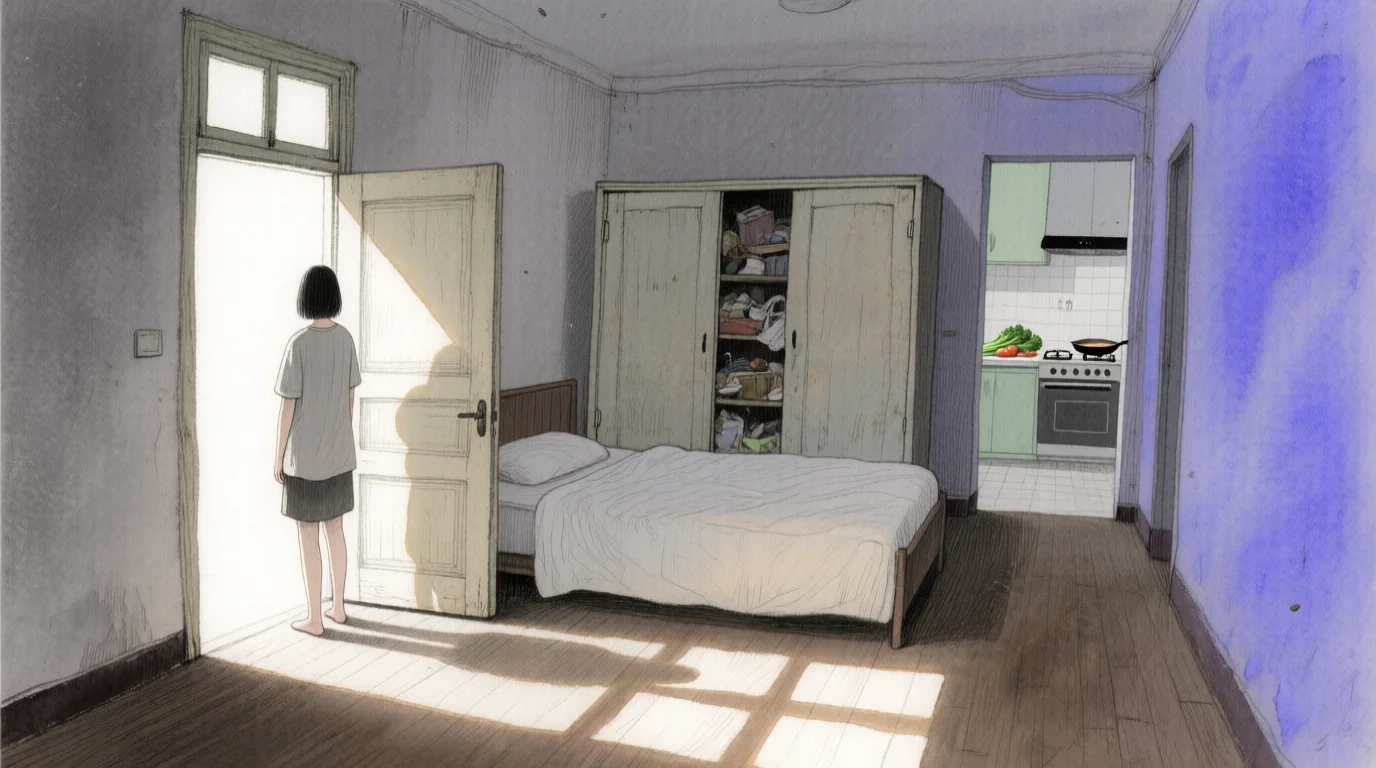
Saturday morning, Yifen was woken up by the sun.
Not the gentle kind of morning light that seeps through the cracks in the curtains—the kind that hits you right in the face, the kind that won’t quit until you’re up. She’d forgotten to close the curtains, and the window faced east. As soon as the sun came out, it lit up the whole room like an operating table.
She rolled over, covered her eyes with her arm, lay there for about half a minute, then resignedly sat up.
Her phone showed 7:23.
Saturday. 7:23. The one day she could sleep until eight, and the sun had ruined it.
She got out of bed, shuffled into her slippers, and walked out of the room. The living room fan was on. Atuo was already sitting on the sofa, still in his pajamas, a comic book spread open on his lap, a glass of milk beside him.
“What time did you get up?”
“Dunno. A little after six.”
“You got up at a little after six to read a comic?”
“Couldn’t sleep.”
Yifen didn’t ask why he couldn’t sleep. She walked into the kitchen, poured herself a glass of water, and leaned against the counter to drink it. Through the window came the sound of the neighbor lady hanging laundry on the balcony—the bamboo pole smacking against the metal rack, thwack, thwack, thwack, like it was keeping time.
Three short, one long. Three short, one long.
She set the glass down hard.
No. It was just a bamboo pole. Just hanging laundry. She wasn’t going to hear three short, one long in everything anymore.
She walked out of the kitchen and sat down in the single armchair in the living room. Atuo kept reading his comic, not looking up.
The living room was quiet. The fan hummed. Birds chirped outside. Occasionally a motorcycle engine revved from downstairs. An ordinary weekend morning, nothing out of place—except that inside her son’s closet there was something that knew who she’d dated when she was twenty.
“Atuo.”
“Hmm?”
“You—” Yifen paused. “What do you think It is?”
Atuo looked up at her, blinked. Like he hadn’t understood the question.
“Who?”
“The one in the closet. What do you think It is?”
Atuo thought for a moment, looked down at his comic, then looked up again.
“I don’t know.”
“You don’t know?”
“I just don’t know.” His tone was calm, like he was saying he didn’t know what was for lunch today. “It didn’t say who It was, and I didn’t ask.”
“Aren’t you curious?”
“Not really.” Atuo turned a page. “It’s my friend. That’s all that matters.”
Yifen watched him. He sat on the sofa, knees bent, comic resting on his knees, milk on the side table. A fifth-grade boy, hair a little long—needed a haircut—wearing an old T-shirt with a cartoon character he didn’t even watch anymore.
Suddenly the scene felt unfamiliar.
Not because Atuo had changed—but because she hadn’t sat down on a Saturday morning and really looked at him in a long time.
“Aren’t you scared?”
“Scared of what?”
“Scared that It—” Yifen opened her mouth. “You don’t know what It is, and It’s in your room, talking to you.”
Atuo put down his comic and looked at her.
“Why would I be scared?”
“Because you don’t know what It is.”
“I know who It is,” Atuo said. “It’s my friend.”
“But you don’t know if It’s really—”
“I do.”
Yifen shut her mouth.
Atuo looked at her, his eyes not dodging, not angry. He just looked at her calmly, like he was waiting for her to understand a simple truth.
“Mom, why are you so scared of It?”
“I’m not scared.”
“You are.”
Yifen didn’t answer.
“You’re scared of It, but It hasn’t done anything bad,” Atuo said. “It just stays here, talks to me, plays with me, listens to me tell It what happened at school today.”
“—”
“You don’t listen to me talk about that stuff.”
That sentence was like a needle—thin, sharp, piercing somewhere in her chest she didn’t want to touch.
“I do listen,” she said, but even she could hear how hollow her voice sounded.
“You don’t.” Atuo looked down, picking at the corner of a page with his finger. “You always say ‘in a minute,’ and then you go do something else. Or you say ‘tell me tomorrow,’ and then tomorrow never comes.”
Yifen opened her mouth, wanting to say something—that she was tired from work, that she had to pay rent, that raising him alone was already hard enough, that she didn’t mean to—but every sentence got stuck in her throat.
Because they were all excuses.
She knew it.
“—I’m sorry.”
She didn’t know why she said sorry. But she said it.
Atuo looked up at her, no trace of triumph or blame in his eyes. He just looked at her, like he was waiting for her to finish.
“I’m not saying I don’t listen to you,” Yifen said, her voice smaller than she’d intended. “I’m just—tired.”
“I know.”
“—”
“It knows too.”
Yifen dug her fingernails into her palm.
“You even tell It that?”
“No, It just knows,” Atuo said. “It said you’re tired, and told me not to bother you.”
Yifen sat in the armchair, feeling like the chair had suddenly become very small. She looked at Atuo, at his lowered head, at his finger picking at the page corner, at the comic on his knee—he’d read it yesterday too, and the day before, and she’d never asked him what it was about.
Even something in the closet is more considerate than me.
“It was right,” Atuo said again, his tone light, like he was stating something unimportant. “You really are tired. You come home from work and fall asleep on the sofa, and I can’t wake you up. I sign the communication book myself, I put it in my backpack myself, I take lunch money from your wallet myself.”
“—”
“It’s okay,” Atuo turned a page. “I’m used to it.”
Yifen didn’t say anything.
She sat in the armchair, looking at her son, feeling like he was far away. Not because he was on the other sofa—but because he didn’t need her anymore. He’d learned to sign his own communication book, take his own lunch money, handle his own things. And she hadn’t even noticed.
It was the “person” in the closet who noticed.
It was the one who talked with him.
Who listened to him.
Who told him not to bother his mom.
“Atuo.”
“Hmm?”
“You—” Yifen swallowed. “Do you think I’m not a good mom?”
Atuo looked up, frowned a little.
“No.”
“—”
“You’re my mom,” he said, like it was a fact that didn’t need explaining. “There’s no such thing as good or bad.”
Yifen’s eyes suddenly burned.
She quickly looked down, pretending to study her fingers. No rings, no nail polish, just some dry skin and a small cut from yesterday’s paper filing.
“Mom.”
“Yeah?”
“Don’t cry.”
“I’m not crying.”
“You are.”
Yifen took a breath, lifted her head, blinked hard a few times.
“Okay,” she said. “Are you done with your comic? We need to go grocery shopping—the fridge is empty.”
“Okay.”
Atuo closed his comic, stood up, and carried his glass into the kitchen. Yifen sat on the sofa, listening to the sound of the faucet running—he was washing his glass. She could have washed it herself. She hadn’t asked him to.
She sat on the sofa, looking at the closed comic on the side table. The cover showed a uniformed character holding a sword, with a giant monster behind him. She had no idea what comic it was. She’d never asked.
She remembered what Atuo said.
“It listens to me. You don’t.”
She tried to remember the last time she’d really listened to Atuo—sat down, looked at him, heard him out. She couldn’t.
Maybe last month. Maybe last semester. Maybe last year.
She didn’t know.
She only knew that the “person” in the closet remembered.
It knew what happened to Atuo at school today. It knew when he finished his homework. It knew what he liked to eat and what he didn’t. It knew what he needed—and she didn’t.
Yifen stood up and walked into the kitchen. Atuo had already washed the glass, put it on the drying rack, and was wiping his hands.
“Atuo.”
“Hmm?”
“Do you—do you think It treats you well?”
Atuo turned and looked at her, startled for a second.
“Yeah.”
“How?”
“Um—” Atuo thought. “It listens to me. When I get bullied at school, It says, ‘It’s okay, they’re just boring.’ When I do badly on a test, It says, ‘Do better next time.’ When I can’t sleep, It chats with me until I’m sleepy.”
Yifen leaned against the counter, listening.
“It doesn’t yell at me,” Atuo said. “And It never says ‘in a minute.’”
The last sentence was like a small knife, slicing lightly.
“—I won’t say ‘in a minute’ anymore,” Yifen said.
Atuo glanced at her, didn’t answer. That look wasn’t disbelief—it was uncertainty. Not sure if Mom would really follow through this time.
“I mean it.”
“Oh.”
“Do you believe me?”
Atuo thought for a moment, then said, “I don’t know.”
Yifen nodded. She couldn’t argue with that answer.
“That’s okay,” she said. “I’ll show you with my actions.”
Atuo didn’t respond. He turned and walked out of the kitchen. Yifen heard him go into his room, heard the closet door slide open—then his voice, low, like he was talking to someone.
She stood in the kitchen, listening.
She didn’t go over to eavesdrop. Didn’t knock and ask who he was talking to. She just stood there, smelling the lingering soy sauce and cooking oil in the kitchen, listening to the neighbor lady take in the laundry outside, listening to the fan turn.
Then she opened the fridge, took out eggs and greens, and started preparing lunch.
Slowly.
As she washed the greens, she thought about what Atuo had said.
“It said It doesn’t want anything. It’s just here.”
Just—here.
Not here to hurt anyone. Not here to take over. Not here to replace anyone.
Just here.
To talk to her son.
To listen to her son.
To do what she hadn’t done.
She turned off the faucet, set the washed greens on the cutting board, and picked up the knife. The blade hit the board—thump, thump, thump—a steady rhythm.
She remembered Atuo saying “It’s just here,” and wondered “why?”
She put down the knife, walked out of the kitchen, and stood at the door of Atuo’s room. The door wasn’t closed. Atuo sat on the edge of the bed, the closet door open, stuffed with clutter and blankets.
“Atuo.”
“Hmm?”
“It—” Yifen paused. “Did It say why It’s here?”
Atuo turned toward the closet, stayed quiet for a few seconds—like he was listening. Then he turned back.
“It said no reason. Just staying.”
“—”
“Just—here.”
Yifen stood at the door, looking at the closet. Three-panel sliding type, old wood, paint peeling in spots. Stuffed with things—winter blankets, out-of-season clothes, a few old magazines, a hot water bottle nobody used anymore, a packet of desiccant. Messy, like every ordinary family’s closet.
But among that clutter, there was a “person.”
It didn’t take up space. Didn’t cause trouble. Just existed.
“Ask It for me—” Yifen said. “What does It really want?”
Atuo turned to the closet again. This time the silence was longer.
Then he spoke.
“It said, It doesn’t want anything. It’s just here.”
Yifen stood at the door, not moving.
She looked at the closet, at the piled-up clutter, at the slightly crooked door. She remembered the night she first discovered this—Atuo said, “Mom, there’s someone in my closet,” and she opened the door and saw nothing. She thought he was talking nonsense and scolded him.
But Atuo had been telling the truth.
There really was a “person” in the closet.
She just couldn’t see It.
“—Okay,” she said. “I understand.”
She turned and walked back to the kitchen.
“Mom.”
She stopped.
“It said—” Atuo’s voice came from the room. “It said thank you for not opening the door again.”
Yifen stood in the hallway, her back to Atuo’s room, not turning around.
She stood still for three seconds.
Then she said, “Tell It, you’re welcome.”
She walked into the kitchen and continued chopping.
Thump, thump, thump, thump.
Steady rhythm.
Like a heartbeat.
Like the everyday.
Like a mother making lunch for her son on a Saturday morning.
Like a presence in the closet, doing nothing, just being there.
Like she was finally learning to share her son, her home, her life with something she couldn’t see.
She didn’t have answers. She didn’t know who It was. Where It came from. When It would leave.
But she knew one thing—
It was Atuo’s friend.
And Atuo said that was enough.
She put down the knife, slid the chopped greens into the pot, and turned on the stove.
The oil sizzled.
Through the window came the neighbor lady’s TV, someone ringing a doorbell downstairs, the distant sound of an ambulance.
An ordinary Saturday morning.
An ordinary old apartment.
An ordinary mom and son.
And a “person” in the closet.
She put the lid on the pot and let the greens steam. Then she leaned against the counter and looked out the window.
The sky was blue.
The clouds were white.
Life went on.
She wasn’t as scared anymore.
Not because she had the answer—but because she’d finally figured out one thing.
Some questions don’t need answers.
Some people don’t need explanations.
Some existences—are just here.
She remembered that intro with three short beats, one long beat. Remembered Chen Shijie. Remembered the Wild Wolf motorcycle. Remembered that she had once been a girl who got taken to the seaside in the early morning—back when she wasn’t a mom, wasn’t a tired registration clerk, just a twenty-year-old girl who cried for days after a breakup. It hadn’t made her remember those things just to scare her. It was to make her remember—before she became “Atuo’s mom,” she had another self.
“Mom, is it ready to eat?”
“In a minute.”
“You said ‘in a minute.’”
She turned and looked at Atuo. He stood in the kitchen doorway, his face expressionless, but the corner of his mouth lifted a little.
“—Okay, it’s ready.”
She smiled.
Not a big happy laugh, not a bitter grimace—just a smile that said, All right, so be it.
She scooped rice into bowls and carried them to the folding table in the living room. Atuo sat down and picked up his chopsticks.
“Should we ask It to eat with us?”
Atuo looked up at her, startled.
“—No need. It said It can just smell it.”
“Oh, really?” Yifen sat down and picked up her chopsticks too. “Then tell It, next time I’ll cook extra. Since It only smells and doesn’t eat, saves on groceries.”
Atuo looked at her, blinked.
Then he laughed.
“Okay, I’ll tell It.”
He lowered his head and started eating.
Yifen lowered her head and started eating too.
The only sounds in the living room were chopsticks clinking against bowls and the fan turning.
And a presence in the closet, quiet, doing nothing.
Just here.