Chapter 3
The Boss's 'You Know'
The break room smelled like single-origin beans.
I breathed in—burnt and bitter, like the only place on the floor still making sense. The blood-and-thunder of that conference room, HR’s gray briefcase, the CEO’s voice listing names with the calm of someone reading off a menu—all of it was too insane. Only the coffee smell here made things feel briefly real.
As I carried my cold Americano toward the break room, something had been turning over in my head.
Cold Americano: failure.
But cold attitude—what’s that?
I pushed the door open. Mark was standing by the coffee machine.
He had on that gray polo, sleeves rolled up—same outfit from the termination meeting where he sat center stage, face blank the whole time. I remember standing in the back row wondering if he’d seen me.
Now I know the answer.
He had. But it didn’t matter.
“Lin Yuan, sit.”
He didn’t turn around. Just pulled a folding chair out from under the counter and slid it toward me.
I slapped the severance agreement on the table.
“Boss, I’ve got a question about the layoffs.”
“Mm.” He lifted his coffee cup. “Ask.”
“Three years. I did three years of dirty work for this company. Why am I on the list?”
He finally turned around. Looked at me.
“Lin Yuan, how much do you think the company valuation went up these three years?”
”…It didn’t.”
“Numbers looked good, that was enough. Investors want stories, not technical documents.” He took a sip. “Everybody in this space does it. You think those million users are actually real?”
I stood there, feeling something slowly collapse inside me.
Three years ago, when he handed me that first Redmi, he’d had the exact same expression. Relaxed. Natural. Like we were discussing what to eat for lunch. He’d said: “I need someone who can handle things.”
Now here he was, holding a hand-pour, talking about how deep these waters run—same tone as discussing a ball game.
“Boss, about the severance—”
“Go talk to HR.”
“HR says it needs your approval.”
He looked at me again. This time the gaze was different. Like he was looking at an intern who didn’t know how things worked.
“Lin Yuan, the stuff you’ve got on your hands—if it comes out, you’re not exactly clean either.”
He tapped the table with his finger.
“Everybody in this space does it. Investors aren’t idiots. They know those accounts can’t all be real, but as long as the numbers look good and the story holds, the money flows in. You think those million users are actually organic traffic?”
I froze.
“So you’re admitting it?”
“I didn’t say anything.” He lifted his cup. “You know what I mean.”
Those three words.
You know what I mean.
It hit me then—three years ago he’d said it the same way. “I’m personally overseeing this project, you know what I mean.”
Now here he stood, same tone, packaging three years of dirty work as “industry standard,” then wiping the responsibility clean with three words.
“Boss.” I took a breath. “The severance isn’t fair.”
“Go talk to HR.”
“HR says—”
“HR’s right.” He put down his cup, finally looked me dead in the eye. “Numbers don’t look good, you think investors would still be putting in money?”
“But the numbers are—”
“Lin Yuan.” He cut me off. “Do you know why you’re being let go?”
I shook my head.
“Because the project is wrapping up. You know what I mean.”
He stood, walked over to where I was. Patted my shoulder.
In that moment, I thought about what my personal trainer always said—“just hold on a little longer.” Every time he’d say it, I’d feel like I could break through my limits. It was only later I realized—the limits broke, all right. What opened up beyond them was just a bigger hole.
“Kid, these waters run deep. Don’t go talking out there.”
As he walked toward the door, he stopped.
“That Redmi of yours… still got it?”
I blinked. ”…Yeah.”
He nodded. Said nothing. Pushed through the door and was gone.
The door closed. The coffee machine beeped softly, switching to warm mode.
I looked down at the severance agreement. The number on it wasn’t laughing—but it wasn’t crying either.
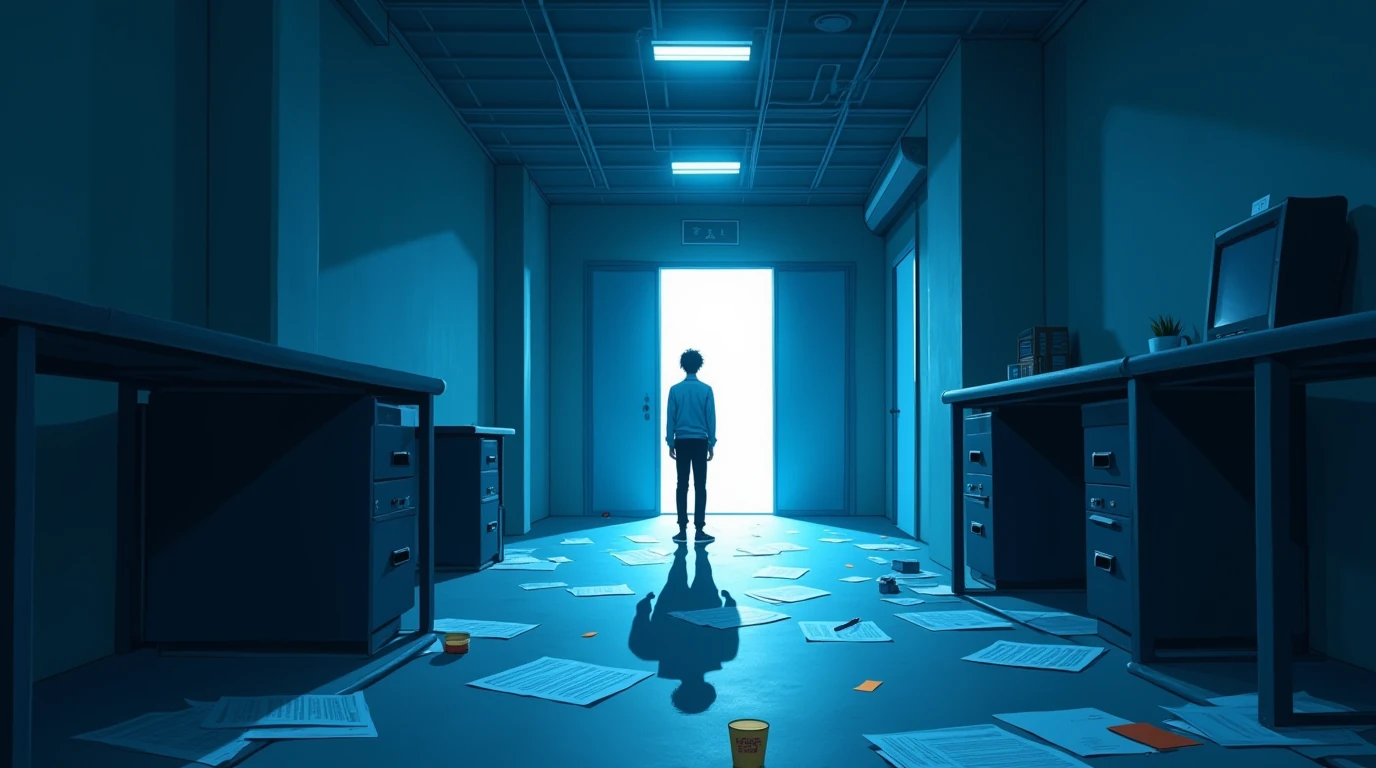
Walking out of the break room, I passed through the tech department. Every light on the floor was off. Only Xu Chengze’s office was still lit.
His door was half-open. I stood at the threshold for a second.
Then knocked.
“Come in.”
He was sitting behind his desk, computer screen glowing with dense rows of backend data.
I walked in. He looked up, frowned slightly. Then glanced at his phone.
“Lin Yuan?”
“Boss.” I set the severance agreement on his desk. “HR said this number needs your sign-off.”
He picked it up, read it, set it down.
“Sit.”
“Thanks, boss.” I sat.
Silence. The only sound was the server fans humming in the office.
“Lin Yuan.” He finally spoke. “Do you know why I cut you?”
I thought he’d say the project was wrapping up, or blame HR, or say it was the boss’s call.
“The project wrapped up.” I said.
“No.” He shook his head. “It’s because you know too much.”
He looked at me, face perfectly calm.
“I know what you’ve done these three years. You know who Ah Zhi is. You know about the twelve phones. You know how the whole traffic matrix propped up the valuation.”
“Then why—”
“Because this system needs an exit point.” He stood, walked to the window. “Someone who knows too much is a liability to this system.”
I stood there, feeling something slowly assemble inside me.
When the CEO read out the termination list, he hadn’t looked at me once. When HR handed me the severance, her hand was shaking. Zhang Yutong set the effective date for three days after the site went dark. Now Xu Chengze stood in front of me, saying “because you know too much.”
“Boss.” I stood up. “The severance—”
“That number’s actually pretty good.” He slid the severance agreement back toward me. “Take it, walk away, forget these three years.”
A thought suddenly bubbled up: Fine. This is how adult friendships work—I pull late nights for you, you show me the door.
“This is a win-win,” he said.
Win-win.
That word made me think of Ah Zhi.
Think of all the gatherings I skipped. First-year reunion with college friends, I said I had to work. Second year, my cousin’s wedding, I said I was on a business trip. Third year, a blind date’s second meeting, I said the boss needed me last-minute.
Think of all those phones that were always lit up.
Think of my mom calling to ask if I was busy, I said nah, just pushing through a deadline.
Think of Ah Zhi.
The 35-year-old from Taipei, who loved camping and coffee. In three years, I’d raised someone more real than myself.
“Alright.” I stood. “I’ll take it and walk.”
I picked up the severance agreement, headed for the door. As I passed his desk, I stopped.
“Boss.”
“Yeah.”
“Thanks for at least telling me the truth.”
He didn’t say anything. Just nodded.
Walking out of the tech department, the whole floor was dark. Only the emergency lights at either end of the hallway glowed, like two rows of silent eyes.
I stopped in the middle of the corridor.
One million users.
Whether those accounts were real or fake—it didn’t matter anymore. What mattered was they existed.
And I would remember.