Chapter 2
Twelve Phones
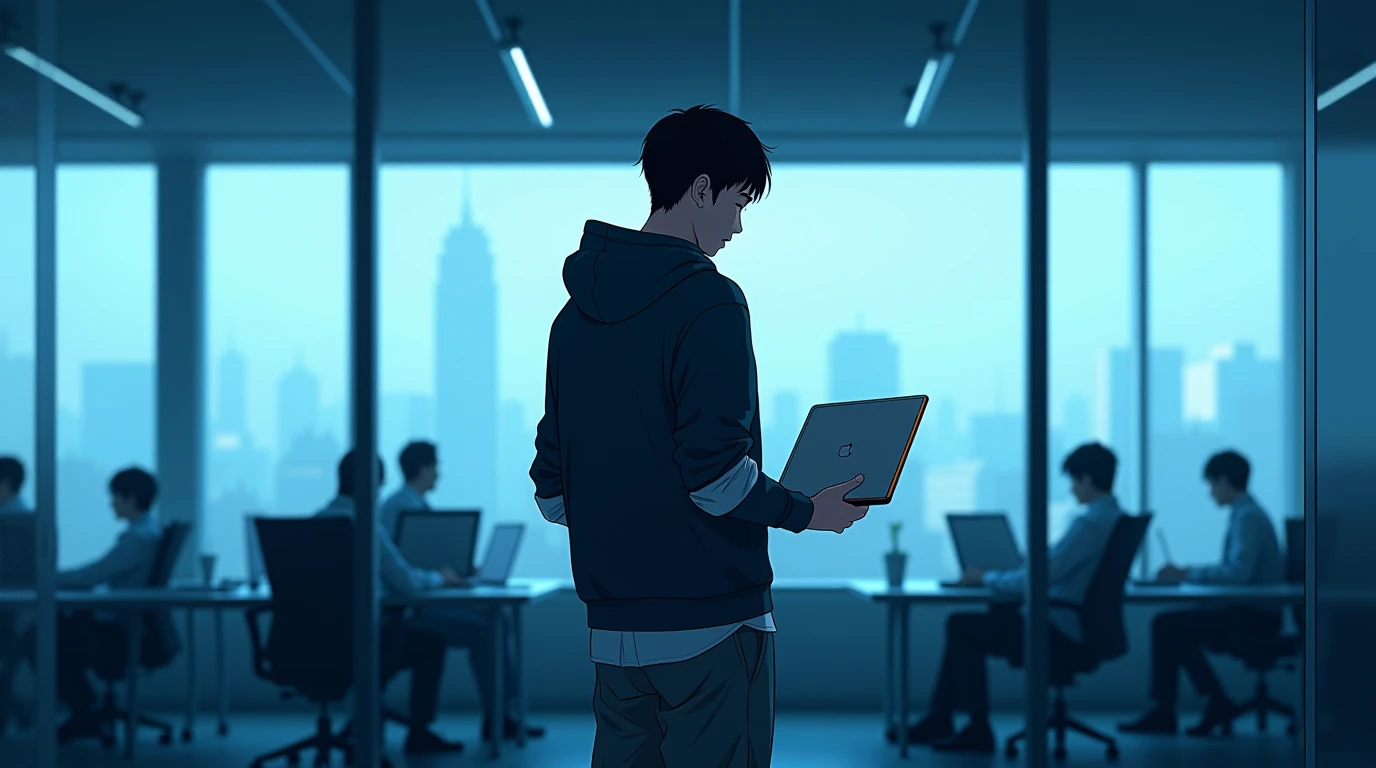
That day I came back from a meeting and sling-bagged my backpack onto the table. All twelve phones went off at once.
Not metaphorically. Twelve phones, one after another, a whole wave of vibrations rippling across the desk.
It had been three years and I still wasn’t used to that sight.
Three years ago the sight had been something else entirely.
When the boss called me into his office, I thought we were going to talk quarterly content strategy. I arrived on time. He was making coffee.
You know the type—the tech-bro who emerged from third-wave coffee culture. Hand-grinding beans, water temperature checked with a thermometer. He tamped the grounds while he talked to me, like he was delivering a sermon.
“Lin Yuan, I’ve been watching you for a while now.” He said. “You do solid work. You don’t grandstand. The company takes care of people who do solid work.”
At that time I didn’t understand what he meant. I thought he was praising me.
“Right now the company has a… project in a transitional phase. We need someone who can carry the weight.” He finally looked up at me. “You understand, it’s a bit unusual. Can’t go through the normal document process.”
I said I understood.
I didn’t. But every new hire answers that way.
The boss smiled. A satisfied smile. “I’m giving you a work phone. Go ahead, test the waters.”
He pulled a Redmi from his desk drawer. I thought he was joking.
A brand-new one, the plastic case still gleaming with factory-fresh sheen.
“Your task is this: make this account look like a real person.” He said. “Posts, interactions, friends. The platform’s risk controls will scan you. You just need to make sure they don’t catch anything.”
“Just one account?” I asked.
The boss smiled again. This time with a hint of “rookie” in it. “Start with one. We’ll talk about more later.”
What I named that first account, I’ve long forgotten. But it was supposed to be a twenty-six-year-old woman from Taipei. The persona: “office worker who loves food and life’s little moments.”
I followed an Auto.js tutorial to write the first version of the script. When I ran a test at 3 AM, it liked ten posts in a row—each like precisely 0.3 seconds apart. Like someone sitting next to it with a stopwatch. So exact even a robot wouldn’t be that clinical.
The next day the account got action-restricted.
I remember spending that night on the forums, flipping through proxies, searching for answers. The problem, I discovered, was “too regular an interval.” Humans aren’t machines. When humans like posts, they get distracted, they hesitate, they suddenly stop to reply to their boss’s message.
So I added random delays. Between 0.3 and 1.7 seconds. Fully randomized.
The second week, the account came back to life.
The boss sent me a LINE message. Just two words: “acceptable.”
That was the most sincere praise I received in three years.
By the third month I had a second phone.
By the sixth month, six phones.
By the twelfth month, my room didn’t look like a bedroom anymore. It looked like a server room. The kind you’d pass by in a building’s mechanical floor and catch a whiff of that plastic-and-ozone smell.
Twelve phones lined up on the desk, twelve charging cables snaking into the power strip, screens permanently lit. At 3 AM I sat beside them like a miniature lighthouse keeper—except instead of guiding ships, I was tending bots.
Ah Zhi was the account on the sixth phone. Thirty-five, Taipei local, into camping and coffee.
He was the first account that made me think: this isn’t just a job.
Because I spent too much time building his backstory. What did he do for work? What café did he hit on weekends? Under which posts would he leave comments? What topics would make him say, “That really hit home for me.”
Every word Ah Zhi said, I designed. But whenever he got a reply from someone, I felt something strange—like I was pulling the strings of a puppet, but the puppet’s audience was real. Sometimes I even wondered if that stranger, receiving Ah Zhi’s “hang in there” on a sleepless night, had any idea that on the other side of the screen was another person on the edge of unemployment, trading fake concern for real gratitude.
It was a sick feeling. I know.
But aside from that sick feeling, I didn’t have anything else.
First year, I missed my college class reunion. The excuse was “working overtime.”
Second year, I missed my cousin’s wedding. The excuse was “feeling unwell.”
Third year, I turned down a second date with a blind-date match. The excuse was “work is really busy.”
Every time I turned someone down, I counted in my head: how many times was this now. Twelfth missed gathering, first failed blind date, second Chinese New Year without going back south.
My mom always called during mealtimes. Always the same lines: “Have you eaten?” “Don’t push yourself too hard.” “Your colleagues say the economy’s been bad lately—is your company doing okay?”
Every time I said everything was fine.
She didn’t know there were twelve phones in my room. Didn’t know I wasn’t awake at 3 AM because of insomnia but because I was “putting out fires”—the platform had updated its risk control algorithm, my scripts needed parameter adjustments, some core sock puppet got reported and needed emergency handling.
She didn’t know how that platform’s claimed “million users” had been assembled. On my twelve phones, the core personas I actually nurtured with care numbered just over a hundred—Ah Zhi-type accounts, with flesh and blood, capable of drawing real human responses. But under each core, the scripts automatically spawned hundreds and thousands of sub-accounts: registration, idle farming, mutual likes. One person, twelve phones, plus scripts that never slept—and that was how the registered user count climbed all the way to seven digits. What the investors wanted wasn’t real people. It was that upward-trending curve.
But none of this would ever reach her. In my mom’s world, there was no “risk control algorithm,” no “platform fabrication,” no “sock puppet accounts.” There was only me.
And the things I hid from her outnumbered everything else in the world combined.
One day, in the third year, the boss called me into his office again.
This time he wasn’t making coffee. He was sitting there, looking out the window, fingers drumming on the desk.
“Lin Yuan, this project is wrapping up.” He said.
I stood there, suddenly unsure how to respond.
“You understand.” He said it again.
I understood.
Of course I understood.
“Wrapping up” could mean one of two things. Either this “secret mission” was complete and the company no longer needed me to maintain accounts. Or this project and the people attached to it were being wrapped up together—like those posts on the forums that got censored, their traces of existence simply erased.
The boss didn’t look at me. His gaze drifted out the window into the distance, like he was looking at something very important.
But I knew he was waiting for my reaction.
I said: “I understand.”
Walking out of the office, I glanced back. His phone was sitting right there on the desk, screen lit, reflecting a rectangle of white ceiling tiles.
Just like all the phones in my room.
Always lit.
Never knowing if the next second would be the last one before someone pulls the plug.
That night I sat facing the twelve phones for three hours. Ah Zhi was on the sixth phone, screen glowing, having just replied “hang in there” to a stranger. The stranger had posted about being unemployed. Ah Zhi said: “I’ve been there too. Just keep pushing through.”
I had designed that line.
But in the moment I wrote it, I suddenly couldn’t tell if it was meant for that stranger or for myself.
I didn’t reply to the stranger’s follow-up comment. I sat there, staring at the dialogue box on the screen, not knowing what to say.
Three years ago the boss asked if I understood, and I said I did.
Three years later the boss said it again, and I said I did.
But what exactly did I understand?
What I understood was: I was the one who made this world look lively—and my own room was quieter than a morgue.
Across the window, the neon signs on the building opposite lit up. Right. I remembered. I was sitting by the window now. Across the street was that hotpot restaurant with the sign that never went dark.
I hadn’t eaten dinner yet.
I stood up, took two steps, then looked back at the twelve phones.
They were still glowing.
Like twelve small, never-going-to-burn-out miracles—miracles that also didn’t know if someone might yank their cords tomorrow.