Chapter 7
To Delete, or Not to Delete
2:45 PM.
I stood at the door of the company’s IT department, the external hard drive clutched in my hand. Two terabytes. Enough to hold a lot of things — or nothing at all.
Old Zhou from IT looked up at me, something flickering in his eyes. “Lin Yuan? Weren’t you already—”
He didn’t finish the sentence. We’d joined the company in the same cohort, he’d simply arrived a week earlier. He’d probably be on next month’s optimization list too. He glanced down the corridor in both directions. Empty. Then his eyes flicked to the hard drive in my hand, like he was swallowing back every question he wanted to ask. In the end, he just sighed.
“The laptop.” I said. “The asset tag needs crossed out.”
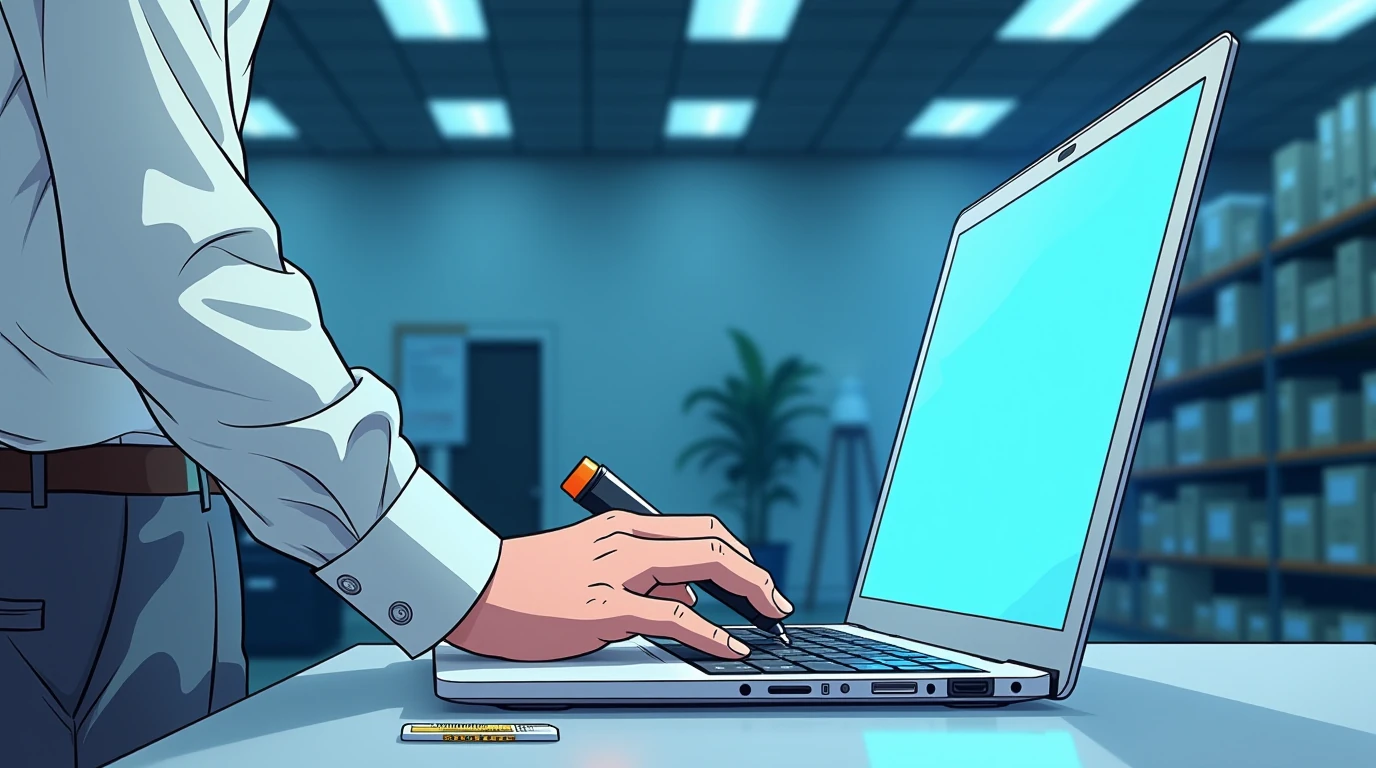
He nodded, pulled open a drawer and rifled through it, locating my machine. Silver aluminum casing, the asset tag still clinging to the top-left corner — the one I’d stuck on three years ago, its corners now curling even more aggressively. He grabbed a permanent marker, ready to strike through the tag, and I said wait.
“Something else?”
“Let me look at it one more time.”
He shrugged and handed it over.
I opened the lid, pressed my fingerprint. The desktop lit up the moment it unlocked — every folder I’d spent three years building: “Twelve Account Names,” “Ah Zhi Fan List,” “Script Update Log v2.3.1,” “3 AM Backups” — all still there. I didn’t have time to examine them closely, but I knew they were all there.
I plugged in the hard drive and began backing up the final batch of data. Nothing critical. Just some screenshots, some numbers, some proof that any of this had existed.
“System shuts down at four.” Old Zhou reminded me. “Just over an hour left.”
“I know.”
I disconnected the hard drive and slipped it into my pocket. The drive had some weight to it. Felt like all the choices I’d made over three years.
Then I opened the browser and typed in the backend login URL.
The password was still the same.
Three years ago, when the CEO gave me this assignment, he’d said, “Use your phone, use scripts, use everything you can think of.” I asked him what I was supposed to use for calculations, and he said use your phone, use scripts, use everything you can think of. Never in my wildest dreams did I imagine I’d actually pull it off with twelve phones.
The backend page loaded on screen. The number in the top-left corner was still there.
Registered Users: 1,032,417
One million, thirty-two thousand, four hundred and seventeen.
I stared at that number for a long time. It was so large, and yet so hollow. How hollow can something that large be? The answer: one million, thirty-two thousand, four hundred and seventeen hollow.
A line of smaller text sat beside it: “Last Updated: Today 2:51 PM.” Half an hour ago. Which meant that at the very moment I was walking into the IT department, this number was still humming along. The system was still alive. Just dying.
“Should I log you out?” Old Zhou asked from beside me.
“One second.”
I logged in with the admin account and pulled up the data panel. The page loaded slowly — slow enough for me to run through the three options again in my head.
Option One: Delete.
Press that button, and these one million plus would vanish along with me. No evidence, no story, no record of how this company had inflated its valuation on the strength of one person and twelve phones. The CEO would move on to the next project, the investors would fund the next story, and I — I’d walk away with N+1, free to pretend these three years never happened.
The cost: Ah Zhi would disappear too. Xiao Zhen’s message — “not yet” — would become a conversation that ended with no sequel, ever.
Option Two: Leak.
Hand the screenshots over to a tech journalist and let the headline — “Bankrupt Company Suspected of Data Fraud” — spread across every platform. I imagined the angle: “EXCLUSIVE: One Million Users — All Fake? The Absurd Traffic Manipulation History of a Startup.” Catchy. Enough to keep the CEO up at night.
The cost: I’d be up at night too. “Data fraud technician” would be the label stuck to me for the rest of my life, dug up in every background check. Three years of overtime wouldn’t buy me a resume — it’d buy me a permanent stain.
Option Three: Do Nothing.
Take the severance, go home, see Mom, try to be a normal person. Time would wash everything away. In three years, no one would remember how this company went under, and no one would remember who I was.
The cost: No one would remember Ah Zhi either. Xiao Zhen would keep waiting for that “next time I’ll take you” date, waiting a lifetime.
Three options, three ways to die.
I didn’t hesitate long.
Not because I’d figured it out, but because time doesn’t wait for you to figure things out. The page finished loading. I was on the member database page, watching the numbers scroll and change every second. They looked like the waveform on a heart monitor — still pulsing, but you know it’s about to flatline.
I opened the screenshot tool.
Not to delete. To preserve.
I took ten screenshots: the backend data curve, the total member count, the backend screenshot from the day DAU broke eighty thousand, Ah Zhi’s account fan list, Xiao Zhen’s last message — “next time I’ll take you” — the system log from 3:27 AM showing the delete command I’d cancelled…
All saved to the hard drive.
Not to leak. To remember.
“Are you done yet?” Old Zhou’s voice came from behind me.
I turned to face him. “Yeah.”
I closed the laptop and set it on the desk. Old Zhou picked up the marker, flipped the asset tag over, and drew a thick, deliberate X across it.
Shhhk.
That sound felt like a period at the end of these three years. Not an exclamation point. Not an ellipsis. A shhhk. What is a shhhk? It’s the sound of time grinding everything to dust.
“Leave the laptop here?”
“Leave it.”
I stood up, pressing the hard drive deeper into my pocket. The drive sat in my pocket, light. Light as a million ghosts that never existed.
At the door, Old Zhou suddenly asked: “Lin Yuan, what exactly were you doing all these three years?”
I stopped. Thought about it.
“Raising ants.” I said. “The boss said this colony could move a mountain. The ants believed it, and so did I. Three years later, the mountain hasn’t moved, the boss hasn’t fallen — but I have.”
Old Zhou looked at me with something like pity, but I didn’t need pity. What I needed was to leave.
“What happens to the ants?”
“I took them with me.” I patted my pocket. “Counted them one by one. The fake ones included.”
I pushed open the door and walked into the corridor. 3:15 PM.
Forty-five minutes left.
I didn’t go back to my seat. I walked straight to the elevator. When the doors opened, I saw A-Wei at his desk, phone in hand — same setting as always, lowest brightness, black screen — but this time he looked up at me.
“Bye?” he asked.
“Bye.”
“Get the severance?”
“N+1. By the book.”
He nodded. No “hang in there,” no “take care.” That silence made the whole exchange feel real.
As the elevator doors closed, I could hear the hum of the air conditioning and the servers from every floor. The system was still running, the numbers still ticking, but the EKG was almost flatlining.
When I walked out through the company gates, I glanced back at the building. The fifteenth-floor windows caught the afternoon light, reflective and unreadable. No way to tell what was happening inside. Didn’t matter. I wasn’t planning to look anyway.
I pulled out my phone and checked the time. 3:28 PM.
Then I opened the chat with Ah Zhi. Still frozen at 3:27 AM — the last message from Xiao Zhen asking “interested in stopping by the shop next week?” My reply: “not yet.” Nothing after that.
I typed a message:
“Xiao Zhen, I’m relocating, not sure when I’ll be back. Ah Zhi’s account probably won’t be active anymore, but if you want to find the person who wrote about the coffee and the camping trips, there’s another account — different name, same person. He genuinely loves coffee.”
Send.
The moment I pressed the button, the screen flashed “Message Delivered.”
I had no way of knowing if Xiao Zhen would see it. No way of knowing if she’d think of Ah Zhi as a real person, or just an account. But at least I’d done what I could.
The final option: not deletion, not leaking — returning the real thing to a world that deserves it.
The hard drive held a million ants, but the ants weren’t mine. Only Ah Zhi was real. At least to Xiao Zhen, he was.
At 3:35 PM, I started walking toward the train station.
Tonight, I was going home.