Chapter 8
Sunshine
Slept through three stops on the high-speed rail.
Should’ve been a train to Banqiao, but when I woke up, the electronic display was blinking “Taoyuan.” The announcement said something about an express train needing to slow and yield — I leaned my head against the window, closed my eyes again, but my mind wasn’t running through what to do next. It was running through that dream I just had.
Dreamed about Ah Zhi.
Not the thirty-five-year-old who liked camping and coffee. A different version, one where he was just chatting with Xiao Zhen at the coffee shop, no input from me — talking about bean origins, roast profiles. I was standing nearby in the dream, wanting to jump in but couldn’t get a word in edgewise.
When I woke up, the train was already slowing into the station.
My phone buzzed.
“Have you arrived yet? The vegetables are washed, just waiting for you.”
Mom’s text. No question mark, but you know she’s waiting.
I replied: “Soon, fifteen minutes.”
She sent back a “k” immediately, followed by one of those signal-received stickers middle-aged aunties use — a flower with “Fighting!” in English.
I put my phone away, stood up, and grabbed my backpack from the overhead rack. The hard drive was still in the side pocket, slick and smooth, pressing against my thigh. Inside it was the last dignity of six hundred sock puppets, and everything Ah Zhi ever was.
By the time I walked out of the station, it was already dark. The place I’m staying was a ten-minute walk from the station. I took fifteen, not because I was tired, but because I was thinking about how to explain why I’d lost weight.
Mom wouldn’t ask directly. She never asks directly.
“Your coworkers say you’ve gotten thinner lately,” she’d start.
“You’ve been really busy with work, huh?” she’d foreshadowed.
“Have you been eating on time?” she’d land.
Then after I answered “not bad” / “I’m eating” / “it’s not that busy,” she’d pivot to “there’s leftovers in the fridge” / “we’re changing a lightbulb tomorrow” / “the Wang auntie downstairs had a grandbaby,” and so on.
Three years now, and she doesn’t know I’ve been “operating sock puppet platforms.” She just knows I “work at an internet company,” “really busy,” and “young people should take on more responsibility while they’re young.”
That’s what the boss said too.
I smiled, involuntarily — maybe because the boss and Mom were using the same script.
By the time I reached the alley, I could smell it. Braised pork belly.
Mom’s braised pork belly is always that smell — rock sugar, dark soy sauce, star anise, scallion segments, pork cut into three-centimeter cubes, slow-simmered for two hours or more. When I left for college, this dish was the standard send-off; the number of times I’ve come back home each year, I can count on one hand.
She was waiting at the door.
“Welcome back.”
“Mm.”
“You’ve gotten thin.”
“Have not.”
“You have.” She said it with certainty, stepping aside to let me in, reaching for my backpack. I said I could carry it, so she let it go, following behind me toward the kitchen.
“Go wash your hands, eat.”
The food was already laid out. Braised pork belly, stir-fried seasonal greens, a bowl of egg drop soup. The rice cooker was on warm, a stack of newspapers beside it — the kind she picks up from the alley corner every morning.
I sat at the dining table, picked up a piece of meat. Melted on the tongue, balanced sweet and savory, exactly like the taste I remember.
“Good?”
“Really good.”
She smiled with satisfaction, then lowered her head to eat her own meal, glancing up at me every now and then, like she was checking to make sure I was actually eating, actually enjoying it.
That kind of look I’ve seen my whole life. In elementary school, she’d watch me do homework. In college, she’d watch whether I’d brought dirty laundry back. Now she watches whether I’ve finished my food.
But tonight was a little different.
Tonight, when she watched me, there was something in her eyes — couldn’t tell if it was heartache or worry, or maybe just the excitement of “the son who hasn’t been home in a year and a half finally came back.”
“How’s work?” She finally asked, in the way she always does. “Your coworkers say you’ve been really busy?”
“Pretty good, the project wrapped up.”
“What about your health? Have you been eating on time?”
“I have.”
She nodded with satisfaction, then pivoted to “leftovers in the fridge” and “lightbulbs tomorrow.”
I responded on autopilot, thinking to myself: if she knew what I’d been doing for the past year and a half, what would she say?
Would she say “young people should take on more responsibility while they’re young”?
I finished my bowl of rice, then added half a bowl more.
After dinner, she was watching TV in the living room. I sat on the sofa for a while, then said I was going to tidy up my room. She said she hadn’t touched it, everything of mine was still there.
Everything of mine was still there.
Twelve phones and all.
When I pushed open the door, the first thing I looked at was that folding table by the window. The table was empty.
Before, there’d been twelve phones lined up in a row, twelve charging cables connected, screens always on — like a tiny electronic meadow. Now there was just dust, and the shell of a USB charger, the cheap one I’d bought, the kind that burned out a port after three months.
I set down my backpack, opened the side pocket, and pulled out the hard drive.
2 terabytes.
Inside were all the files for six hundred sock puppets: operation logs, follower lists, interaction maps, and Ah Zhi’s last message — “Xiao Zhen, I’m relocating, not sure when I’ll be back.”
I put the hard drive in the drawer, buried under some old clothes.
Mom’s voice drifted in from the living room: “The water’s boiled, go soak your feet before bed.”
“Okay.”
I closed the drawer and sat on the edge of the bed. Fresh sheets, slightly stiff, smelling like the brand of laundry detergent Mom uses.
Through the window, I could see the neon sign of the hotpot restaurant in the building across the way. From this angle, it used to be that light from the sign and the light from phone screens got all mixed together, impossible to tell where one ended and the other began.
Now there was only the sign.
The phones were gone.
I lay down, staring at the ceiling. There’s a thin crack in the ceiling I’ve seen my whole life, still there now.
My phone buzzed.
An unknown number.
I hesitated, then answered.
“Is this Mr. Lin Yuan?”
The voice was a young woman’s.
“This is.”
“I’m a reporter from United Daily, my last name is Chen. I’m calling to ask about the traffic fraud at your former employer…”
I hung up.
It buzzed again. Same number. Hung up.
Buzzed again. Blocked.
Lay back down, kept staring at the ceiling. The crack was still there, pattern unchanged.
Mom called from the living room: “Get some sleep early, tomorrow we’re going to visit your grandmother.”
“Okay.”
I turned off the lights.
In the dark, the neon light from the hotpot sign outside seeped through the gap in the curtains, casting a dim patch of colored light on the ceiling. Red, green, orange, all mixed together, like how it used to look when the phone screens were still lit up.
The phones were gone.
But Ah Zhi might still be out there.
When I sent that message last night, I hadn’t thought it through that much. Just felt like he should keep existing, someone should know the good things about him — even if he was nothing but code and words, even if he’d never “really” loved coffee.
He loved it.
Every word I typed at three in the morning was real.
The light outside was shifting — the hotpot sign flickered every few seconds, cycling red to green to orange, like some kind of signal, some kind of transmission still propagating.
I closed my eyes.
Before I fell asleep, the last thought I had was: how did that reporter even get my number?
But I was too tired to wonder.
Tomorrow I’d take Mom to see Grandma — her rheumatism’s been acting up, she’s at a care facility in Taoyuan, each trip takes an hour by car. I haven’t visited in two years. Last time, she could still recognize me, called me by my nickname. Now I don’t know if she even knows who I am.
Tomorrow’s problems for tomorrow.
Tonight, just sleep.
Three months later.
I was working at a small e-commerce company doing operations. Monthly salary thirty-five thousand, less than before — but no more pulling all-nighters, no more facing the silence of twelve phones.
The new company’s DAU target was fifty thousand. The boss frowned at the numbers every day, asking why “the users just won’t come.”
I didn’t know if I should tell him the truth.
One afternoon in the break room, I heard one of the newcomers complaining: “Why won’t the numbers go up? Is there a problem with risk control?”
I was standing there holding a cup of water, about to turn and leave, when I heard the newbie sigh and say: “Man, if only we could buy some fake traffic. The company next door’s doing it.”
I stopped.
“That number, huh…”
I opened my mouth. The words got stuck in my throat. I remembered the backend screenshots, the curve that had been deliberately shaped, the boss saying “good numbers, good story, money comes in.”
I almost said it.
The newbie looked up at me, startled: “What’s wrong?”
”…Nothing.” I set the cup down. “Risk control isn’t the problem. The direction might be off.”
I turned and walked away.
Forget it.
Not my problem anymore.
One afternoon, I saw an article getting shared a lot on Facebook. Title: “Where Did All the Internet Celebrities We Followed Go?” The article was about several social platforms that had been active a decade ago, now all shut down — all those accounts and content from back then, completely gone.
Someone in the comments: “So sad. There was this account I loved back then, called Ah Zhi, he posted about camping and coffee. When the platform shut down I wanted to find him, but the account disappeared too.”
I stared at that comment for a long time.
Then I closed the page.
On my way home that night, I passed by a coffee shop. The little blackboard by the door said: “New Arrival | Pour-Over Single Origin | Gesha.”
I stood there for a moment. Then turned and walked away.
Not my problem anymore.
But that account was real.
The people that account had nurtured, the comments it had interacted with, the content it had “liked” — all real.
Even if nobody knew I made it.
Even if nobody knew there was never really a person named Ah Zhi.
At least one person knew.
Xiao Zhen knew.
I walked into the MRT station. While I was waiting on the platform, my phone buzzed again.
Not a call. A text.
An unknown number, but a normal eleven digits — not the kind of format used by marketing or spam calls.
“Do you know an account called Ah Zhi?”
I stared at that line for five seconds.
Then I sent back a question mark.
They replied instantly: “This is Xiao Zhen, from the coffee shop on the old platform. I saw the news about the platform shutdown, and there was a list of laid-off employees below — I wanted to ask if you’re…”
The message stopped halfway, like she was hesitating over whether to finish the thought.
The train arrived.
I put my phone back in my pocket, walked into the car, found a seat.
The tunnel outside the window was pitch black, just occasional lights flashing past — on, off, on, off — like when the phone screens were still lit.
I didn’t reply to that message.
But I didn’t not reply either.
Maybe on the way back from work I could check out that coffee shop.
Maybe I’d run into Xiao Zhen.
Maybe I’d run into Ah Zhi.
— If he still existed.
If all the words I’d typed, all the commands at three in the morning, all the comments about “coffee really does smell amazing” — if any of that was still alive somewhere out there in the world.
The train stopped.
I stood up, walked out of the car, into the crowd.
The platform was packed, everyone with their heads down staring at their own phones, screens glowing — like a vast electronic meadow. I pushed through the crowd toward the exit.
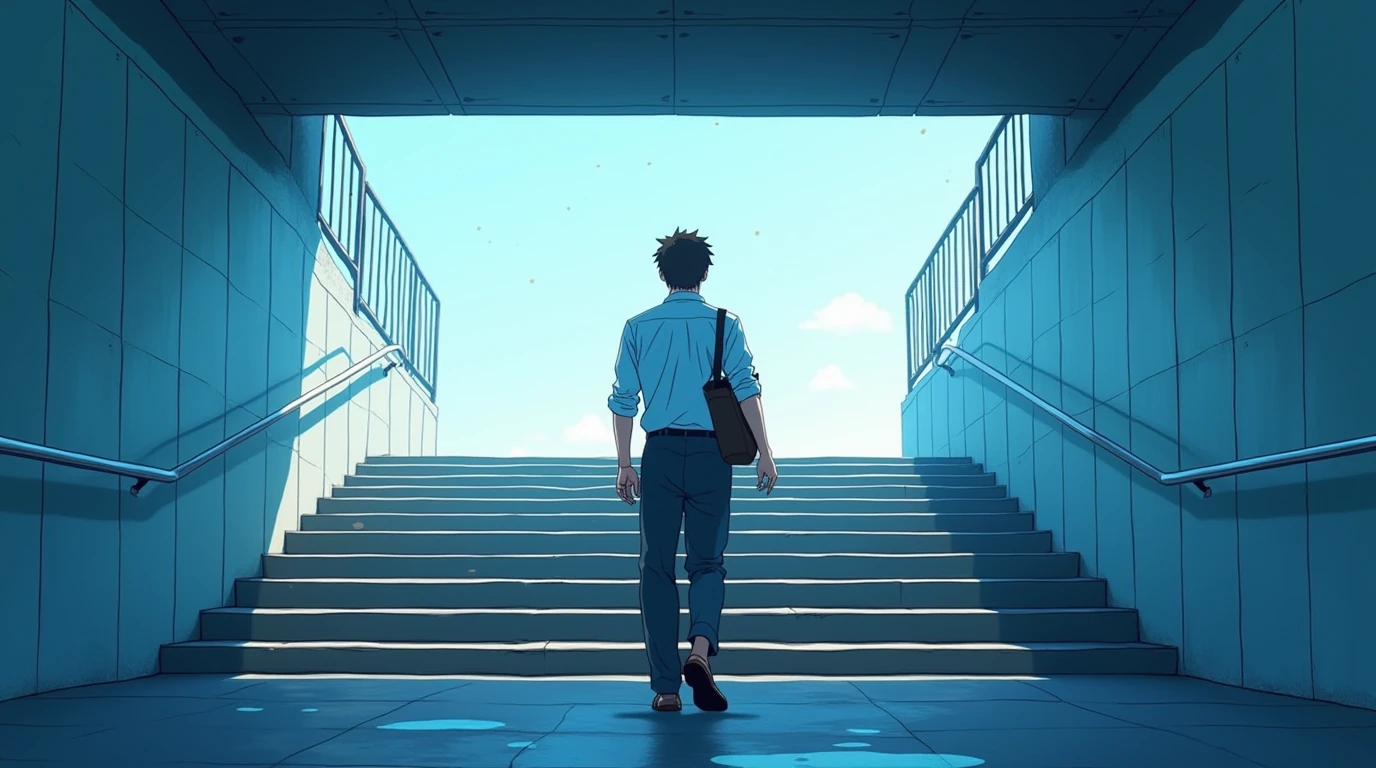
The advertisements on either side of the stairs were having their tubes replaced. A technician stood on a lift, the clink of tools echoing under the tiled ceiling. As I neared the ground-level exit, light poured down from above — bright and harsh, making me squint.
I raised a hand to shield my eyes.
The sun was blinding. These past few days had been clear ones. Rare for Taipei, that clean blue, no clouds, just the wind.
I stepped outside.