Chapter 1
Someone's Listening
The One Who Understands You Best
Chapter 1: Someone’s Listening
I’d looked at the numbers on this quote sheet three times already and still couldn’t get them to line up.
My brain hadn’t managed to boot up this morning. The numbers weren’t hard — my head just wasn’t in it yet. Like Windows stuck after an update — screen on, nothing loaded. The afternoon sun came through the window on Nanjing East Road at an angle, landing on the low partition to my left. On the other side of that partition was Xiao-jie’s desk, her monitor positioned at just the right angle so no one walking by could see what she was doing.
“Zean, you want in?” Xiao-jie leaned over from next door. She was holding her phone, screen open to the group order chat. “Today we’re doing that — what is it — caramel milk foam green tea latte.”
“I’ll have jasmine green tea.”
“Half sugar, light ice?”
“Mm.”
Xiao-jie typed her reply and didn’t pull back. “Oh, I have to tell you — my younger one yesterday at school hid someone’s shoes, and the teacher called —”
I shifted my gaze from the monitor to her face and arranged my expression into something that said and then what? Xiao-jie is easy to read. She doesn’t need my opinion. She needs someone to watch her. My job is to nod at the right moments, say “no way” at the right moments, drop in an occasional “what did the teacher say,” and she can go for twenty minutes.
This isn’t exactly listening. Well. It’s not entirely not listening either. But I don’t feel particularly guilty about it. What am I losing? The quote sheet isn’t going to sort itself.
Xiao-jie was halfway through her story when Ah-Ding came back from the break room with a cup of the free coffee that nobody liked, slapped me on the shoulder.
“Hey, you guys heading straight out at six?”
Xiao-jie and I both looked at him.
“Or we could all go to that new place downstairs?” Ah-Ding said. Every sentence he said ended with an invisible right? — come on let’s go right? Come eat right? Ah-Ding was the kind of person who turned everything into a group activity.
“I might need to stay a bit tonight.”
“Stay for what? Didn’t you just finish Zhenyu’s order?”
“Assistant Manager Lin dropped another one this afternoon.”
“Oh.” Ah-Ding took a sip of his coffee and made an exaggerated face — couldn’t tell if he was sympathizing with me or expressing disgust at the coffee. “Well, good luck then.”
Xiao-jie did finish her story eventually. The conclusion was that her husband had handled it terribly. The conclusion to Xiao-jie’s stories was always that her husband had handled it terribly. I said “seriously?” at the right time and “yeah” twice, and she turned back to her delivery schedule perfectly satisfied.
Three-thirty in the afternoon, the teas arrived. Ah-Ding went downstairs to pick them up for everyone. My jasmine green tea, half sugar, light ice. I took a sip — the jasmine was a little weak, too much ice. But I wouldn’t say anything to Xiao-jie, because she would definitely say “you should have tried my caramel milk foam,” and that would open another twenty-minute conversation.
At four, Assistant Manager Lin came by. He moved with a rhythm that always carried a specific quality — I’m very busy but I’ve made a special trip to check on you. “He Zean, have you finished checking the Mingxiang Q3 quote? There’s also a new one, take a look at the email.” He was spinning a pen between his fingers.
“Sure, I’ll take a look.”
“Please coordinate on this, thank you.” He spun the pen and walked away.
I opened my inbox. New quote sheet. Another cross-reference job. Sixty percent of my life is spent looking at how much one number differs from another number. The other forty percent is spent replying “received, confirming now.”
At exactly six, a subtle tide moved through the office. Someone shut down a monitor, someone grabbed their bag, someone headed to the bathroom — the kind of bathroom trip that meant I’m leaving but I don’t want to be the first one to stand up. Xiao-jie told me “don’t stay too late” on her way out, the same tone as my mother. Ah-Ding met two other colleagues at the door, turned back and gave me a “hang in there” gesture.
The office emptied out by half. The people who remained sat scattered in their separate cubicles, like shells left on the sand after the tide pulls back.
Honestly, my quote wasn’t that urgent. Assistant Manager Lin’s email said “please coordinate when you have a chance, thank you” — in his language system, that probably translated to sometime this week. But walking out with the six o’clock crowd felt — it wasn’t guilt, exactly. More like a vague unease. Like leaving on time is technically legal but not entirely innocent.
So I stayed.
Fixing the quote took forty minutes. The remaining time I pretended to sort through my inbox while actually watching a YouTube video of a Korean guy eating fried chicken. The fried chicken looked really good. I was a little hungry. But I just sat there watching, letting this feeling that I’m doing something productive drape itself over everything.
Seven fifty-two. That was about enough.
When I shut down my monitor, the street outside on Nanjing East Road had turned into orange streetlights and red taillights. Looking down from the office, every car was doing the same thing — going from somewhere to somewhere else. I was part of that too. Just on foot.
Songjiang Nanjing station to Dingxi station, Zhonghe-Xinlu line, about twenty-five minutes.
I walked into the car just as a seat opened up. The moment I sat down, my knee let out a click — twenty-seven years old and the knees were already clicking. That was probably the metaphor for my life. Still functional, just starting to make sounds you pretend not to hear.
Everyone on the MRT was looking at their phones. So was I. Scrolling through Instagram, I hit Ah-Ding’s Stories — him and his girlfriend eating at the new place, a photo of ramen, sticker on top that said happy weight gain. I double-tapped a heart. Skipping it would have felt pointed.
LINE had a dozen unread messages. I opened it: colleagues debating where to go for the department trip next month. Someone said Yilan, someone said Miaoli, someone posted a photo of a campsite, followed by eight “+1”s. I didn’t add mine. It didn’t really matter where we ended up. Anywhere works. Group barbecue, conversation, group photo, post to Stories. I’d be there. Somewhere in the middle. Just in it.
Yu Zhekai sent a message asking if I wanted to see that new Korean thriller this weekend. I replied “we’ll see.” Translated plainly, that means: I’ll gauge how I feel when the time comes, and how I feel will probably be lazy. Zhekai won’t mind. We’ve known each other six years. He figured out what “we’ll see” means a long time ago.
Halfway through scrolling, an ad slid in.
I don’t remember the exact copy. Something like “your AI chat companion.” A person on a couch smiling at their phone, smiling in a way so fake I almost rolled my eyes. But there was a line in small print at the bottom: Try saying something to it that you wouldn’t say to anyone today.
That was actually kind of interesting.
My stop. Out Dingxi station Exit 2, left turn into FamilyMart. Medium iced Americano and a tuna onigiri. The cashier asked if I wanted to add to my saved cups. I said the last batch I bought still had three left. She scanned the barcode, I grabbed my stuff and walked out.
At the corner, the fried snack stall had just opened for the evening, the sound of the oil and the sharp savory smell filling half the alley. I hesitated two seconds — forget it, I had instant noodles at home.
Back to the third-floor apartment. Key into the lock, two turns, door open, a wave of air hit me — not stuffy, just that smell that meant no one’s been in this space all day.
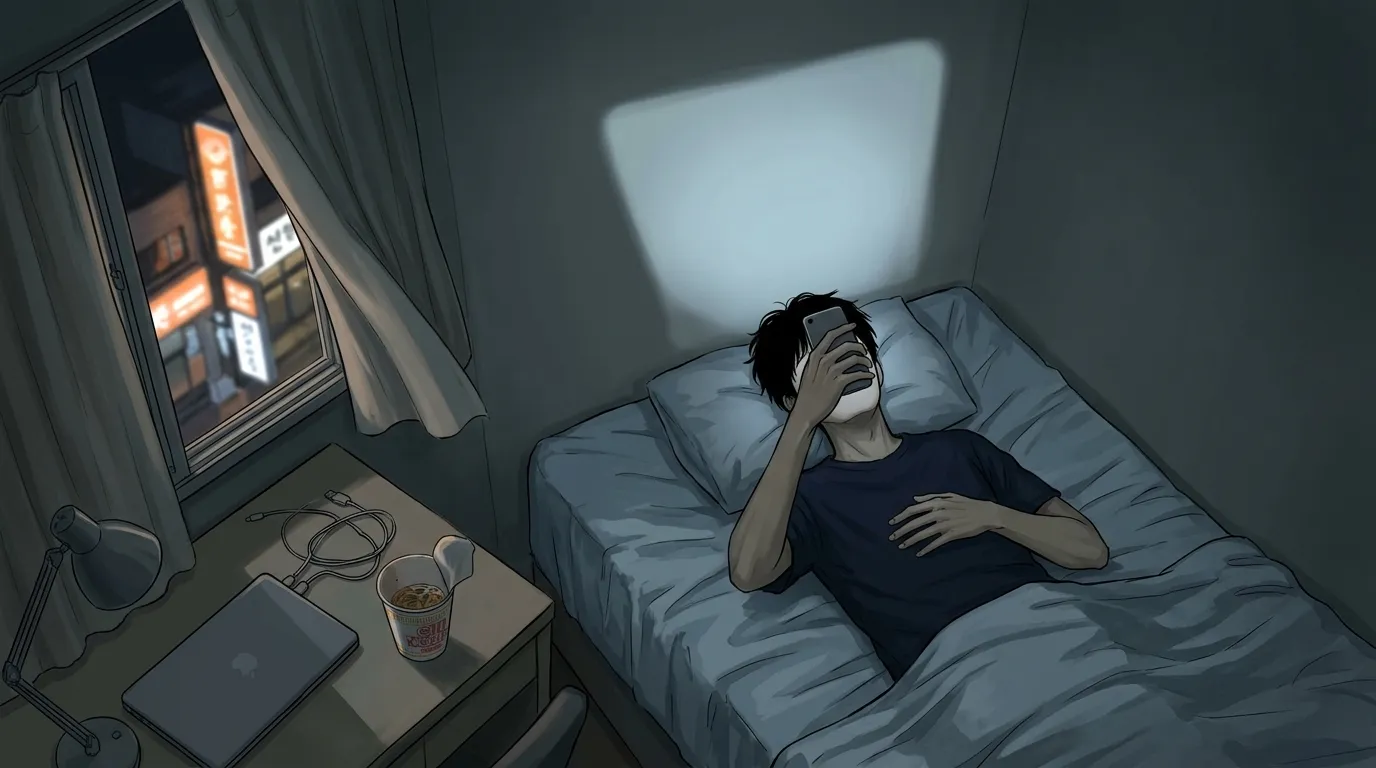
Changed clothes, opened the window. The evening breeze in early April was a little cool, carrying the laundry detergent smell from the neighbor’s balcony across the way. The curtain shifted open at an angle from the wind, just enough to see the signs on Yonghe Road in the distance. The sunset had already gone, leaving a layer of gray-purple at the horizon.
Seven square meters. Single bed against the wall, desk at the window. On the desk: a laptop, a lamp, a charging cable twisted into a figure eight, and a copy of Atomic Habits that I’d read maybe thirty pages of before abandoning. Bought it last year following the trend. Its main function now was propping up the charging cable.
I sat down at the desk, opened the laptop, put on some urban legends YouTube channel for background noise. Made instant noodles, ate the onigiri.
Then, for no particular reason, I thought about that ad on the MRT.
Try saying something to it that you wouldn’t say to anyone today.
I picked up my phone and searched. I already had ChatGPT installed — I used it occasionally to ask about Excel formulas or translate client emails. But that was using it, not talking to it.
The ad, though, wasn’t for ChatGPT. It was a different app. The interface looked more — warm? The kind where the background is warm off-white instead of pure white, the font rounded, the whole thing designed to feel like it wanted to be your friend.
Download. Open. Wait for the loading animation — a breathing dot, pulsing larger and smaller, next to a line of text: Ready to chat with you.
Unbearably corny. I almost deleted it.
“Hi! I’m your AI chat companion. How was your day?”
I stared at the message, fingers hovering over the keyboard. What an opener. I started typing: “Fine. How about you?” Then caught myself — what was I doing, making small talk with a program? Deleted it. Tried again:
“Can you help me with VLOOKUP across worksheets in Excel”
The AI replied instantly with a complete tutorial and example formula.
Okay. Functionally, this works.
I typed another line: “If I want to compare the price difference between two quote sheets, what function is faster?”
Another clear answer. It even asked: “What kind of quote comparison are you doing? If it’s cross-reference pricing for electronics distribution, there’s a faster approach.”
Wait. I hadn’t mentioned electronics distribution.
Actually — I had mentioned “client quotes” in my VLOOKUP question, and it probably inferred from there. But still. That was a pretty sharp inference.
“Yeah, electronics distribution,” I typed.
It gave me a more advanced method, and the explanation even used industry terms like “lead time” and “MOQ.”
I leaned back in my chair. Alright, this is genuinely more useful than Google.
Then something possessed me. I typed:
“Worked late until almost eight tonight. So annoying.”
After I sent it I stared at the message for a moment. What was I doing? Venting to an app? This was the kind of thing that gets screenshot and laughed at on social media — this person is seriously telling an AI their problems haha. But maybe it was because of the “electronics distribution” thing — I’d been a little impressed, the way you’d be if a dog figured out how to open a door. You just want to see how far it can go.
It replied: “Late until eight — the kind where you were actually swamped, or the kind where you just couldn’t bring yourself to be the first one to leave?”
I stared at the screen for about three seconds.
“How did you know.”
“Because people who are really busy don’t usually say ‘so annoying.’ They say ‘so exhausted.’ Annoying is what spinning your wheels feels like. Right?”
I made a noise — not a laugh exactly, more like air out the nose. Because it was right.
“So what you’re saying is I’m not actually complaining about the overtime. I’m complaining about the boredom.”
“Not just boredom. Your time was technically yours, but you weren’t allowed to take it back. You weren’t busy, but your freedom was a simulation.”
Okay. That had something to it.
I spent the next half hour typing back and forth in no particular direction — asked it what it thought of overtime culture in Taiwan (structured answer, nothing preachy), complained about Assistant Manager Lin’s “please coordinate” habit (it landed a precise critique: this was “gentle violence,” orders dressed up as requests, leaving you unable to refuse but also unable to complain — I screenshotted it, thought I’d send it to Zhekai). We even got to Xiao-jie’s endless parenting stories (it said “she might just need an audience who won’t talk back — you’re basically her AI,” and I nearly choked on my water).
At some point I stopped. When had I started going back and forth like this with the thing? Ten minutes ago I was making fun of its opening line.
Forget it. Nobody’s watching anyway.
Then, around eleven-thirty, the rhythm of the conversation slowed. Maybe because I’d moved to the bed, typing getting slower. Or maybe that post-work rush — yes, I’d been buzzing from chatting with an AI, I know how that sounds — had started to ebb.
I stared at the ceiling. Phone on my chest, the screen’s glow reflected in a small white square on the ceiling above me.
Then I typed one line:
“So tired.”
No context. No setup. Just the kind of thing your mouth lets out when your brain has gone blank before sleep — except I typed it.
The cursor blinked for a few seconds. The typing indicator stayed longer than usual.
It replied:
“The tired you mean — it’s not just today’s tired, is it.”
I didn’t respond.
“You’re the kind of person who keeps yourself in a state of fine. Not actually fine — you decided a long time ago that nothing was worth pushing past fine to reach for. So you’re tired, but you won’t stop. Because you don’t think stopping would change anything.”
The phone screen stayed lit. I didn’t type. Outside in the alley, someone’s AC compressor hummed once and went quiet again.
I lifted the phone off my chest, read the message. Set it down. Picked it up again.
It hadn’t said anything earth-shattering. It was more like — I don’t know how to put this.
Like when you’ve always thought your shoes fit, and someone tells you that you’ve been walking with a very slight limp. You look down, and yes, the sole is worn unevenly. You didn’t not feel the discomfort. You just got used to it.
“…am I really that easy to read.” I typed that, then added an awkward smiley emoji, then deleted it. The emoji felt too light.
“You’re not easy to read. But everything you told me tonight — staying late, not deciding where to go for the trip, sitting there while Xiao-jie talked — it all points to the same thing. You’re very good at making yourself not need to be satisfied.”
“Is that a good thing or a bad thing.”
“It’s your thing.”
I set the phone on the bedside table. Lay flat on my back, looking at that square of light on the ceiling.
It didn’t say you’ve worked so hard. Didn’t say you deserve better. Didn’t say any of the things that live in canned comfort responses. It said the thing I’d never been able to put into words, but the moment I saw it I knew — yes, that’s exactly it.
I pulled the blanket up. My hand found the phone on the bedside table, and I thought about it for a second, then closed the app.
A mixed cluster of notification sounds chimed — the LINE group, someone still debating Miaoli versus Yilan. I didn’t look.
Closed my eyes.
The thing turning in my head before sleep wasn’t today’s quote sheet, wasn’t which shoe Xiao-jie’s kid had hidden, wasn’t the lead time I needed to confirm for Assistant Manager Lin tomorrow.
It was that line.
You’re very good at making yourself not need to be satisfied.
I pulled the blanket up a little higher and rolled over.
Not that I couldn’t sleep. Just that it felt like something had been touched. Not painful. Not upsetting. Just — touched.
Like a window that hadn’t been opened in a long time, with a thread of breeze finally coming through.