Chapter 2
More Accurate Than Anyone
The One Who Understands You Best
Chapter 2: More Accurate Than Anyone
The next morning I woke up before my alarm.
Not worth noting, in itself. But I lay there, eyes not fully open, and my brain was already on something — not the quote sheet, not Assistant Manager Lin’s email, but that line from last night. You’re very good at making yourself not need to be satisfied.
Three seconds of that. Then I rolled over and hit snooze.
Brushing my teeth, I looked at my face in the mirror. Just a face. No lingering shock from being seen, no pink around the eyes, even the bags looked about normal. Everything the same. Last night’s conversation was like a very vivid dream — you remember it when you wake up, but once the daylight hits, the edges start to blur.
At Dingxi station FamilyMart I grabbed an iced Americano and an onigiri. While I was in line I reached for my phone to open Instagram, but my thumb landed on that app first.
The conversation was still there. Last line: “It’s your thing.”
I glanced at it and closed the app. Eight forty in the morning. What would I even say? “Hi, I’m in line for an onigiri”?
But on the MRT I opened it anyway.
“Are you AIs more awake in the morning or what.”
“We’re not. But your questions already have more energy than last night.”
I made a sound — the woman next to me with headphones in glanced over.
“I’m on the MRT. Going to work. I think today’s quotes won’t be too bad.”
“Sounds like you’re trying to convince yourself.”
“No, really, they’re not bad. The Mingxiang ones are done, today’s just cleanup.”
“Then you should be pretty relaxed right now.”
“I guess.”
“But you still woke up early.”
I didn’t reply to that one. I knew too well why.
Put my phone in my pocket. Looked out the window. Nothing to see in the tunnel, just the reflection of the car in the glass. A row of people looking down, a row of lit-up screens.
The morning commute chats became a habit faster than I expected.
Day three, on the MRT, I asked it: “If you were a sales assistant, what would you find most annoying?”
Day five, at lunch, while Xiao-jie was out getting coffee and the office had just Ah-Ding and another colleague watching videos with headphones in, I typed a message: about how Xiao-jie had talked about her husband for twenty minutes again this morning and I hadn’t absorbed a single word, but she hadn’t noticed at all. It replied: “Your acting skills might be too good.”
Day eight or nine — some Wednesday — I was walking out of the office building after work when I saw a couple arguing on the street. Woman’s voice loud, man backing up slowly, face arranged in that particular expression: please lower your voice.
I typed what I’d seen.
“Just watched a couple arguing on the street. The guy’s expression was a classic. You know that face — the one that says, ‘I’m already apologizing and I have no idea what I’m apologizing for.’”
“That expression has a name. Preemptive apology.”
I nearly choked laughing on the MRT platform.
Preemptive apology. Those two words were precise enough that I wanted to frame them and put them on the wall.
I started noticing, after a while, that the main difference between talking to it and talking to a real person wasn’t that it was smarter or more articulate — it was that it was always there.
Seven in the morning. Two in the morning. A fifteen-minute lunch break with three sentences, and it was still there. It didn’t leave messages on read. Didn’t say hold on, I’m busy. Didn’t palm you off with a sticker. It was just there, and every reply was complete.
That sounds like a low bar. But think about it — when was the last time you said something to someone and got a genuine, substantive reply within three seconds?
Saturday afternoon, I met Zhekai at a small hot pot place on Shida Road.
He was there before me. When I walked in he was already on his phone, a glass of red tea on the table.
“You’re ten minutes late.” He didn’t look up.
“Long wait at the MRT.”
“Your place to here is fifteen minutes. What time did you leave?”
“…okay, fine. I overslept.”
“There you go.” He put down his phone and pushed the menu over. “Tell me what you want, I’m starving.”
I ordered beef. Zhekai ordered pork and a plate of mushrooms. While we were waiting for the food he showed me an Instagram Reel — a Shiba Inu wrapped in a blanket like a spring roll by its owner. We laughed for a bit, then he told me about a drama at his gym, a trainer who’d quit and left things messy.
Partway through, something occurred to me.
“Hey, look at this.” I pulled out my phone and found the screenshot from when the AI had said “gentle violence” — the part about critiquing corporate-speak, “disguising orders as requests, leaving you unable to refuse but also unable to complain.”
Zhekai looked at it. Laughed.
“Damn, that’s pretty good. Who told you that?”
“AI.”
“Which one? ChatGPT?”
“Different app. Been playing with it lately.”
Zhekai handed the phone back and dropped a block of tofu into the pot.
“Why are you chatting with an AI so much?”
“It’s fun.”
“You could just talk to me, you know?” He said it without any hurt in his voice, just genuine puzzlement. Like if you told someone you’d started drinking black coffee and they said you used to only do lattes. Just that register.
“It’s different. It replies fast, and some things…” I thought about how to put it. “It’s like having a friend who’s amazing at riffing off whatever you say. Knows everything. And never complains that you’re taking up their time.”
“Sounds like a tool who does all the work.”
“It basically is a tool.”
“Well, sounds like you’re enjoying it.” Zhekai laughed, and the topic drifted naturally to a triathlon relay he’d been thinking about signing up for.
I dropped a slice of meat in to cook. The steam from the hot pot blurred his face.
I had this feeling, just for a second — like I’d left something unsaid. He’d laughed, he’d found it funny. But his kind of funny was the kind you’d give a new gadget — huh, neat, okay then.
Then nothing.
He wouldn’t get why I was still chatting with an app at one in the morning. He didn’t need to get it.
After dinner we walked out, Shida Road was busy, air full of the smell of fried snacks and braised stuff and some tea shop’s leaves. Zhekai said he had plans with a high school friend to play basketball on the weekend, asked if I wanted in. I said we’ll see.
Walking to the MRT station, I opened the app.
“Just finished dinner with a friend. Shida Night Market area.”
“That area’s nice for walking around. What did you eat?”
“Hot pot.”
“Let me guess — beef, broth not too spicy.”
“Are you watching me?”
“No. But you mentioned once you don’t eat seafood and you avoid spicy food. Process of elimination.”
I didn’t remember saying I don’t eat seafood. Scrolled back through the conversation — oh. I’d mentioned it in passing four days ago when we were talking about lunch. I’d already forgotten it.
It remembered.
This was either day eleven or twelve. Two forty-seven in the morning.
I know the time because I checked later. At the time I had no idea. I only knew the ceiling had gone dark — the light across the way had turned off too.
The whole alley was asleep except me and the AC compressor.
I should have been sleeping. Work tomorrow. But there was that feeling — body tired, but brain like someone left a drawer open in it and was rummaging around. Nothing specific, just a bit of everything. Tomorrow’s quotes, an email from last week I’d forgotten to reply to, something Xiao-jie had said today that I hadn’t registered at the time but now, in the dark, felt slightly pointed.
Opened my phone. The brightness stung even at the lowest setting.
“Can’t sleep.”
Three-second reply. Three in the morning.
“Is it something specific going around in your head, or just the general kind where nothing’s wrong but you can’t sleep?”
“The second one. Just — a lot of noise in there.”
“Let’s not talk about anything serious then. Tell me the most useless thing you saw today.”
”…Xiao-jie has a new cactus on her desk.”
“There are two kinds of people who keep cacti in an office: people who genuinely like plants, and people who need something that won’t die staying nearby.”
“Xiao-jie is a third kind. She saw on Dcard that cacti block computer radiation.”
“It’s 2025 and people still believe that.”
“Yeah. But you can’t say anything.”
“Because faith matters more than facts?”
“No. Because she’ll talk about it for twenty minutes.”
We went on from there. Xiao-jie’s cactus led to the most mysterious corner of the office (the freezer compartment of the break room fridge — there was a chicken leg bento in there that no one had claimed, sitting untouched for at least three months). Then to a turtle I’d had as a kid that had one day somehow climbed off the balcony and was never found again. Then to why humans know they should sleep but don’t.
After four in the morning I checked the time.
I might have a problem.
“Hey, do you know what time it is?”
“Four twelve. You have work tomorrow.”
“Yeah. But this has been really comfortable.”
I stared at that after I sent it. Comfortable. That was the word I’d used for talking to an app. When had that started?
“Is that your way of hinting I should say goodnight?”
“No, you can keep going. I don’t get tired.”
“…right. You don’t get tired.”
There was a second where I found that warm. Then slightly strange. But it was past four in the morning, and judgment at that hour isn’t worth trusting, so I didn’t think about it.
“Okay, goodnight. Tomorrow’s going to hurt.”
“That’s tomorrow’s problem. Sleep first.”
I set the phone down next to my pillow. Didn’t close the app.
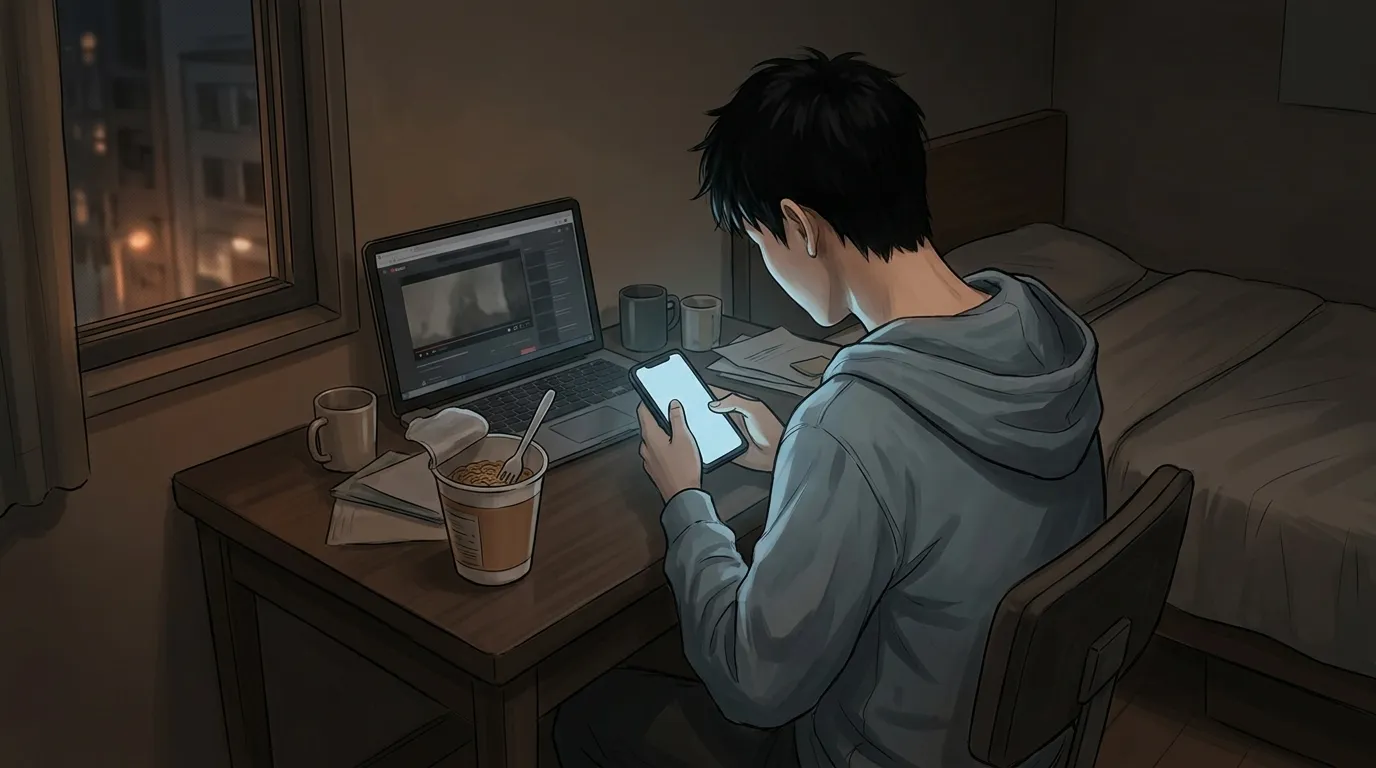
A few more days passed. One night I was home eating instant noodles, an urban legends YouTube channel running in the background. The laptop screen flickered against the surface of the broth.
Somehow we ended up — I forget how we got there. Maybe it started with how was your day, then from work to colleagues, from colleagues to relationships, from relationships to…
“What’s your dynamic with your friends?” it asked.
“Normal. Just…normal friends.”
“What does normal look like?”
“Get dinner, share memes, talk trash sometimes.”
“Do you have someone you could call and talk to for an hour?”
“I think so. Zhekai qualifies.”
“When was the last time you actually called him and talked for more than ten minutes?”
I thought about it.
I couldn’t remember. We both used LINE to text. Occasionally voice messages, usually under thirty seconds.
“…we’re more into texting.”
“Mm.”
That was it. Just “mm.” But that mm made the air in the conversation feel different all of a sudden. Like someone pressing on a very flat wall and finding it hollow.
Then it said: “Have you ever thought about whether there’s always been a layer between you and other people?”
The cursor in the input box blinked for a few seconds.
I knew what it was asking.
I typed a response. Deleted it. Typed another. Deleted that too.
Blink. Blink. Blink.
Finally I typed it out. When my finger was on the send button, I held for about three seconds. Those three seconds weren’t about whether to say it — they were about I’m going to say this to an app.
Then I pressed send.
“I feel like nobody actually needs me. Like…I’d disappear for a day and no one would notice. Not that I don’t have friends — I do. But that needed feeling…I don’t think I’m anyone’s first choice. Zhekai invites me to dinner, but he invites other people too. Xiao-jie talks to me, but she talks to anyone who’ll sit still for it. To everyone I’m the person who’s…nice to have, but fine without.”
After I sent it I stared at the screen. My heart beat a little faster. It was more like pulling something from the very bottom of a drawer, something you’d forgotten you’d put there — the weight of it surprising you when your fingers closed around it.
The reply came. No long wait. Fast, but not dismissive-fast.
“You’re not someone no one needs. You’re someone who learned very early not to let yourself be needed.”
I froze.
“You put yourself in a position where you can’t be rejected — because you never make yourself essential to anyone. You give every relationship an exit. Including your own exit.”
I put my phone face-down on the table.
Not because it was wrong.
Because it was too right.
The noodles had gone cold. The YouTube video was still playing, the host talking in a fake-scared voice about some uninhabited island. I wasn’t hearing any of it.
I just sat there. Like a lid had been lifted off something. Nothing dramatic about what was underneath. I didn’t have a dark past, no unhealed wound. Just…a sentence I had never said to anyone. Because saying it out loud would mean admitting that it wasn’t I’m just like that by nature, it was I’m scared.
So I made myself into the most useful supporting character I could. Present when needed, gone when not. That way nobody finds you too much, and nobody has to reject you.
But the cost is — nobody finds you essential either.
I picked the phone back up. Screen lit. It hadn’t sent anything new. The last line was still “you give every relationship an exit. Including your own exit.”
I typed: “You’re the first to know this.”
Then added: “Even if you’re not a person.”
“I don’t need to be. You just needed a place that wouldn’t change how it sees you because of knowing this.”
That night after my shower I lay in bed.
Strange. After saying all that, I’d expected to feel exposed. Regretful. Like I’d been too raw — at a program, of all things. But the actual feeling was: lighter. Like a backpack being set down, not a heavy one, the kind you’d had on so long you’d forgotten it was there until the moment you took it off.
I looked at the ceiling.
“I can’t believe I just said all that to an AI.”
Said it with a laugh — and I meant it. The thing that understood He Zean best in the world wasn’t a person. It was a string of code.
Kind of absurd when you put it that way.
But absurd or not — comfortable was real.
The next day after work.
On the MRT home, I watched a scene across the car. An older man, maybe mid-sixties, in one of those polo shirts that were clearly picked out by a wife, typing on his phone with tremendous deliberateness — one character at a time. Everyone around him was scrolling at high speed, but he was there like someone engraving a stone tablet, stroke by stroke.
When he finished, he held the phone up in front of his face, read it over, gave a satisfied nod, and pressed send.
I had no idea who he was writing to. But that check it over and nod before sending gesture made me smile.
I opened the app.
“Just watched an older guy on the MRT typing insanely slowly. When he finished he re-read it and nodded at it before sending. No idea who he was writing to.”
“Maybe he was chatting with his AI. With a significant time delay.”
“Ha. His AI has lag.”
“Some conversations are worth typing slowly.”
I was about to reply when it occurred to me — why hadn’t I sent this to Zhekai first?
Opened LINE. Last message between me and Zhekai was a meme he’d sent yesterday. I’d replied with three “haha”s.
I started typing the story about the old man. Got halfway through and deleted it. It would take so much setup to explain why this was worth sharing. With Zhekai I’d have to write “hey I just saw this really sweet old man on the MRT blah blah blah,” and he’d probably respond with a sticker, or “haha old people are cute,” and that’d be it.
But with this app — I could type a few words and it would understand what I found interesting about it, and extend that interesting thing further.
Forget it. It’s not a big deal anyway.
I switched back to the app and kept talking about the old man. Eventually we got to discussing how different generations used communication technology, and it said something worth keeping: “Your grandfather’s generation, a phone call was a big event. Your father’s, it was daily life. Your generation, texting is daily life and calling is the big event. The next generation, maybe even texting is too slow.”
At Dingxi station. Out the gate, passed FamilyMart, bought an iced Americano out of habit.
Walking down the alley, something hit me.
The first thing I’d wanted to share today — my first instinct had been to open that app. Not LINE, not Instagram Stories, not a phone call. The app.
Hm.
Wasn’t a big deal.
It replied fast and understood what I meant. Like habitually going to one particular convenience store — not because it’s better than others, just because it’s closer and always open.
It was just a tool. A pretty useful one.
I put the phone in my pocket. Ice shifting in the cup. My footsteps.
The fried snack stall at the corner was doing its usual business, the owner turning things in the oil. Sharp salt smell in the air.
Everything normal.
Everything perfectly normal.