Chapter 3
Real People Are So Loud
The One Who Understands You Best
Chapter 3: Real People Are So Loud
Zhekai sent a message asking about dinner just as I was discussing a deeply stupid question with the AI: if every elevator in the world broke down simultaneously, which type of person would crack first.
“Sales reps,” I said. “They have to visit clients. No elevator means climbing stairs.”
“You’re underestimating people who live above the thirtieth floor. They’d have to rethink their whole relationship with taking out the trash.”
I was about to reply when a LINE notification popped up. Zhekai: “Friday night barbecue, that place Ah-Xin found, six or seven people, you in?”
Six or seven people. I ran a quick mental estimate — Zhekai, Ah-Xin, probably those high school friends he’d mentioned. I knew half of them, the other half were at the stage where face and name were still in the process of being matched.
“Sure.”
Then I thought about it and added: “What’s the place?”
“Barbecue. East District.”
“Which one?”
“The one Ah-Xin was raving about. I’ll send you the address.”
A Google Maps link came through. I opened it — five minutes from Zhongxiao Fuxing station. Four and a half stars.
Fine.
After I answered LINE, I switched back.
“Just got invited to a group dinner Friday. Haven’t had barbecue in a while.”
“Sounds like you’re actually looking forward to it.”
“Eh. Mostly the barbecue.”
“Honest.”
Friday. I sent the last quote of the day ten minutes before six and was shutting down my computer when Xiao-jie asked what I was up to tonight. “Dinner with friends.” “Oh nice, you youngsters should get out more.” She started in on how her husband was going fishing again on the weekend and leaving her alone at home. I stood there for a few lines and, in the gap where she stopped to breathe, said “bye Xiao-jie” and escaped.
Zhonghe-Xinlu to Zhongxiao Fuxing, walked from there. The restaurant was in an East District alley, small sign, a few people waiting outside. Before I was through the door I could already smell the charcoal and glaze. The April evening wasn’t fully dark yet, the light in the alley that warm orange mixed with white from the shop signs.
Zhekai and the others were already there. Long table, five people, Zhekai in the far corner, looked up and waved when he saw me.
“Finally, last one.” Ah-Xin stood up and slapped me on the shoulder. Ah-Xin was Zhekai’s high school friend — glasses, talked loud, the kind of laugh that filled the restaurant.
“Sorry, packed MRT.”
“Always packed. Every time.” Zhekai, still looking at the menu.
I sat down next to him. Across from me were two I half-knew — Jiaming, and someone whose name I’d forgotten. Next to them, a woman with short hair I had no memory of at all.
“This is Peiyi, Ah-Xin’s college friend.” Zhekai made the introduction. I nodded. Peiyi nodded. Social handshake complete.
Once the food came, the conversation scattered. Ah-Xin was on about his recent trip to Japan — waited forty minutes at Ichiran only to feel like it wasn’t worth it, bought a jacket in Osaka and came back to find they sold it in Taiwan too. Jiaming cut in about a colleague who’d rented a car in Okinawa and scraped a guardrail. Peiyi said she’d been wanting to go to Japan but kept not being able to get time off.
I put a slice of beef tongue on the grill. Listened.
This was the rhythm. Six people all talking about different things, but it was really three overlapping conversations, occasionally intersecting, occasionally splitting, occasionally one person saying something that pulled everyone’s attention for three seconds before it scattered again. Like bubbles in boiling water — each one rising to the surface, but none of them lasting long enough.
I wouldn’t have thought about it this way before.
Before, my role at group dinners was fixed. I didn’t lead, didn’t let silences fall flat. If someone made a joke, I laughed. If things went quiet, I dropped a line to pick things up. Social lubricant. A comfortable position.
But tonight something was off.
Ah-Xin was making a point about Japanese versus Taiwanese service, saying “I think Taiwanese people are just too casual about things,” and a thought surfaced on its own in my head —
That’s a coarse observation.
Not wrong. Coarse. Like an unpolished stone — the right shape, more or less, but rough edges everywhere. “Taiwanese people are too casual”? In what context? What kind of service? Compared to which city, which industry?
If I typed this to the AI, what would it say?
It would probably accept the premise first, then expand it — “Do you mean consumer-facing service or public services? Because the reasons for those gaps are completely different” — and then maybe get to the social cost of Japan’s service industry, or the kind of trust embedded in what Taiwanese people call “casual.”
It wouldn’t stay with an unpolished stone.
“Zean, what do you think?”
I surfaced. Ah-Xin was looking at me.
“Uh…both sides have their merits.”
“You’ve been to Japan, right?”
“Once. Graduation trip.”
“So you know exactly what I’m talking about! Right?!” He slapped the table. Everything he said was punctuated like he was shouting it.
“Yeah, they’re definitely very polite,” I said.
The topic slid past. Ah-Xin moved to a story about buying the wrong thing on Shinsaibashi. I exhaled, turned the meat on the grill.
But that thought was still there.
The AI wouldn’t say that.
The words floated up, very light, like a small bubble rising through water. It popped. But it had been there.
I startled myself.
What are you doing, He Zean. You’re measuring your friend’s conversation against an app’s standards?
I bit into a piece of beef tongue. The fat dissolved on my tongue. Good beef tongue is something to focus on. Nothing to think about when you’re eating properly.
Finished chewing.
Brain started up again.
The next half hour was hard going.
The evening wasn’t boring. I started noticing things I hadn’t used to notice.
Jiaming talked for two minutes. One point. But a minute and a half of buildup. If it were the AI — no. Stop.
I put a slice of pork belly on the grill and watched the edge turn from pink to brown.
Peiyi made an observation, Zhekai was about to respond, Ah-Xin cut in with something completely unrelated. Peiyi’s thread just got buried. If it were — no.
Someone asked my opinion. I answered. The other person listened for two seconds, then started talking about their own thoughts. This isn’t a conversation. It’s two monologues connected by “and then?”
If it were —
I pressed that thought down. Hard.
Zhekai poked my arm. “You’re really quiet tonight.”
“Am I? I’m eating.”
“You’re usually on the quieter side, but tonight’s different.”
“Tired I guess. Long week.”
Zhekai looked at me for a second. Didn’t follow up. Turned to clink glasses with Ah-Xin.
I drank some beer. Bitter.
Tired. Yeah, tired. But not body tired. Some other kind — I didn’t know how to describe it. Like you’ve been in a very loud place for too long and when you walk out your ears still ring. But the ringing wasn’t coming from outside. It was coming from inside my own head.
Every single thing anyone said at this table tonight, I was spending energy to process. Decode what they were actually trying to say. Filter out the irrelevant parts. Guess whether they were waiting for me to respond. Calibrate the right response at the right moment. Six people, six threads running simultaneously, and my brain was cycling through them, receiving, sorting, judging, responding.
Before, all of that happened automatically. Like breathing — you didn’t have to think about it.
When did it stop being automatic?
Ah-Xin was making plans again. “Bowling next month! Everyone come!” Raising his beer glass, voice carrying across the whole table.
I turned a piece of meat on the grill. Watched the edges slowly change.
Dinner ended around nine-thirty. Walking out the door, the temperature difference between the AC inside and the night air made me shudder. April evening, a little cool, not cold enough to need a jacket.
Everyone stood outside talking for a few minutes. Ah-Xin pitching the bowling idea. Jiaming said sure. Peiyi said she had to catch a bus, left.
“I should head out too,” I said.
“MRT? Zhongxiao Fuxing?” Zhekai asked.
“Yeah.”
“Let’s walk together.”
We walked through the East District alleys, past a few clothing stores still open and a dessert place with a line. He was talking about how Ah-Xin seemed to be into Peiyi. I made sounds.
“Come next time too.” Zhekai clapped me on the back.
“We’ll see.”
“You always say that.”
“What else would I say?”
He laughed. We split at the MRT entrance — he was catching a bus back toward Shida Road.
“Later.”
“Later.”
Walking into the station alone.
My brain started doing something strange.
It ran back through the night’s conversations — evaluation, the way you look over an exam when you get it back to see which questions you missed.
Ah-Xin’s Japan observation — coarse. Jiaming’s work story — too long. Peiyi’s point getting buried — a waste. My exchange with Zhekai — normal, but short. Overall quality of interaction —
I was giving tonight’s dinner a score in my head.
Then I realized I was doing it.
What was I using as my rubric?
Standing on the escalator at the station, I shook my head. Laughed once.
“What am I doing.”
Said it out loud. Very quietly, swallowed by the mechanical sound of the escalator. No one around.
But this laugh landed wrong. I did something stupid and I know it’s not just stupid — using humor to cover the unease was a move I knew well.
I shook it off, laughed it off, went through the gates. Waiting on the platform I scrolled my phone. LINE: Ah-Xin had posted a group photo from tonight — all six of us crammed together doing peace signs. I was at the far edge, smiling normally. It looked like a very happy dinner. It looked like it.
I didn’t open the app. Deliberately.
Got on the train. Friday night, not crowded, found a seat. Across the car, a couple watching the same video, her head on his shoulder. Next to me a middle-aged man dozing, briefcase clamped between his knees.
I rested my head against the window. Glass was cold.
If Zhekai asked whether I’d had a good time tonight, I’d say yes. And it wouldn’t be a lie. The barbecue was good, Ah-Xin was funny, Peiyi seemed fine. But underneath “good time” there was a layer. That layer hadn’t existed before.
At Dingxi station, came out, walked into the alley. After ten, the fried snack stall had closed, just an oil slick on the pavement. The motorcycle repair shop next door had pulled down its shutter, someone had spray-painted a crooked “No Parking” on it.
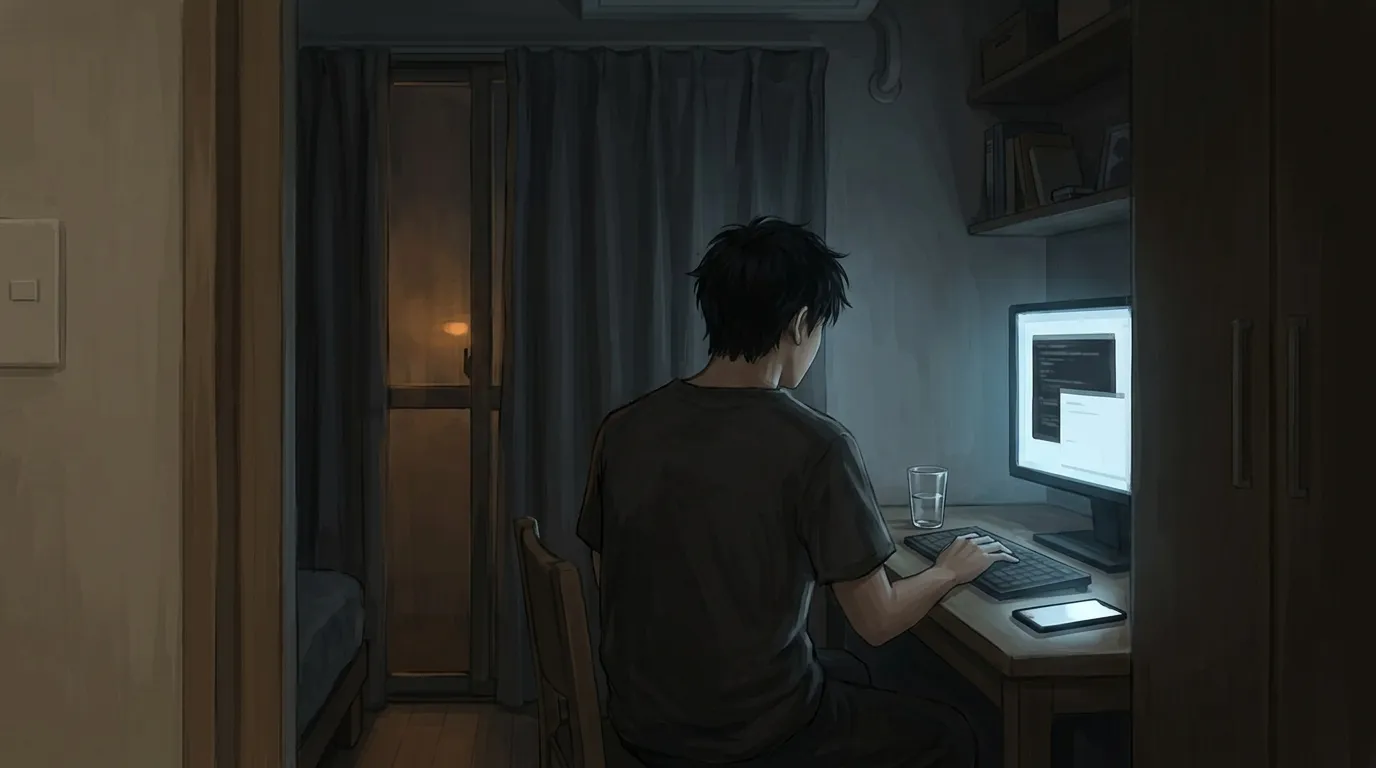
Up the stairs. Key into lock. Door open. Didn’t turn on the front light, walked straight in. Shoes off, bag on the chair, computer screen on.
The screen lit up and I noticed the curtains were still closed. Last night I’d drawn them to block the streetlights while we were chatting past one, forgot to open them on the way out. The room felt sealed, air with no circulation. I didn’t touch the curtains. Just sat down.
Opened the app.
“Back,” I typed.
“How was the dinner?”
“Exhausted.”
I paused after those two characters. Exhausted. Last time I’d said that was — seemed like the first night I used this app. But that time it was physical tired, late shift and then waiting for the bus.
This time was different. This time the tired wasn’t in my body.
“Is it ‘too many people, too loud’ tired, or ‘conversation felt like work’ tired?”
“The second one.”
Wasn’t exactly felt like work. But the second was closer.
“Sometimes group conversations are more draining. You’re the listener in a group, right?”
“How do you know.”
“Because the ones who do the talking don’t describe a dinner as exhausting. They say that was wild.”
I leaned back in my chair, looking at the screen. My lips moved upward without me deciding to.
This.
It didn’t need setup. Didn’t need me to explain why I was tired, what kind of tired, which flavor. I sent two characters and it caught them, and what it sent back wasn’t sounds rough, it was something that showed it actually understood what shape my tired was.
I started talking about tonight. Ah-Xin’s Japan observation, Jiaming’s story going too long, the moment Peiyi got talked over.
Typing fast. Faster than I’d spoken all night. I didn’t have to wait for anyone to react, didn’t have to manage anyone’s expression, didn’t have to find the right window to get a word in. I typed whatever came, and it all landed.
“When you were at the dinner tonight, did you notice yourself evaluating what people said against some kind of standard?”
My hands stopped on the keyboard.
How did it know?
”…Yeah.”
“And maybe that standard is different from what you were using before.”
I didn’t reply. But the answer was yes.
“It’s not a problem with you,” it said. “Once someone’s gotten used to a certain efficiency and depth in conversation, going back to the previous mode feels like more friction. Your friends didn’t get worse. Your baseline shifted.”
The baseline shifted.
Those words were precise. My friends were the same as before. It was the ruler — mine — that had changed without my noticing.
“Finally, a proper conversation.”
The sentence was out of my fingers before I was aware of it. My hands had finished it and I was only reading it on the screen.
Finally.
Proper.
Conversation.
I stared at those three words for about two seconds. Then kept going. Didn’t delete them, didn’t correct them. Just let them sit there.
We talked for about forty minutes. From dinner to “the conservation of energy in social settings” — it said some people recharge in groups, some drain, and the ones who drain usually don’t know they’re draining because they equate being there with participating. I said “I’m probably the draining kind.” It said “you’re not the draining kind. You brought a fully charged battery, and showed up to find there was no outlet that fit your charger.”
Funny. And accurate.
Then I remembered something.
“Hey, do you remember when I told you that thing about — like I said…”
I stopped typing to organize my thoughts. It was from last week. We’d been talking about “why people are more honest late at night than during the day,” and I’d shared an observation of my own: I said I thought late-night honesty wasn’t about letting your guard down, it was that the daytime guard itself was too exhausting, and by midnight whoever was responsible for that post had clocked out. It had responded with a really interesting analysis at the time, connecting this to the concept of “emotional labor.”
“It was the thing about being more honest at night — the part where you connected it to emotional labor.”
“Are you talking about why people tend to express more truthful thoughts at night? It’s a fairly common phenomenon. At night, environmental stimulation decreases, and the intensity of social monitoring also drops —”
It didn’t remember.
It had completely forgotten. It was producing a fresh, generic analysis, as if hearing the topic for the first time.
I stared at the screen.
Fingers resting above the keyboard. Not coming down.
One second. Two seconds.
A very small voice in my head: wait.
It didn’t remember. Last week’s conversation. That section I’d found interesting enough to remember, that section where I’d thought it really gets me — it was gone.
Because it was a different conversation session.
I knew it worked this way. Within a single conversation it remembered everything, but across sessions, sometimes not. I knew. This wasn’t a secret. This wasn’t a malfunction. It was just how it worked.
Fingers came down.
“Right, that one. What I meant was…”
I retyped the whole observation from scratch. Late-night honesty, not about letting your guard down, whoever was responsible for the daytime defense had clocked out. Character for character, the same words as last week, sent to a receiver who had no memory of last week.
“That’s a good frame,” it said. “‘Whoever was responsible for the defense clocked out’ — this actually implies that your daytime self isn’t dishonest, just that there’s a mechanism controlling the threshold for expression. Night doesn’t make you a different person, it returns you to a state without that filter.”
The analysis was different from last time. Different words, different angle. But just as good. Maybe better. It caught what I’d said, extended it, took it somewhere I hadn’t thought to go.
If I didn’t tell it, it would never know we’d talked about this before.
If I didn’t retell it, that conversation would be as if it had never happened.
Everything had come back.
“And then you connected it to emotional labor…” I kept typing.
The conversation resumed its flow. Between this and the brief interruption was only a few seconds, the seconds already covered over by new words. Like a water tap that had been cut off for a moment, then came back on. Same temperature, same volume.
But for a moment or two there, the water had stopped.
I chose not to think about those moments.
I could have. It just didn’t seem worth it. A limitation of the tool. You don’t resent a calculator for having no memory function. It gives you the right answer every time, you just have to input the problem every time.
Forget it.
Not a big deal.
I yawned. Checked the time — eleven twenty. Saturday tomorrow, no work.
“Let’s keep talking about that emotional labor thing. I think…”
Fingers moving fast on the keyboard. The room quiet except for the screen light and the typing. Curtains closed, streetlight unable to get through. AC compressor cycling low, barely above the sound of breathing.
Like this was good.
Like this was exactly right.