Chapter 4
Maybe Next Time
The One Who Understands You Best
Chapter 4: Maybe Next Time
Around that time the weather started to change. May in Taipei doesn’t heat up suddenly — it gets a little more suffocating each day, like someone is slowly turning up a thermostat and not telling you.
On my way out that morning, the breakfast place at the corner had a new menu item: Okinawan brown sugar milk. I stood looking at it for two seconds — Okinawan brown sugar, sounded like a drink working very hard to pretend it wasn’t just milk tea. I ended up ordering the same thing as always. Egg crepe, iced soy milk.
The MRT was packed. Wednesday morning, everyone’s face looking roughly the same — not that they actually looked similar, it was the expression that was the same. The I’m not ready but I’m already here face. I was probably making that face too.
At the office. Xiao-jie’s cactus was still alive. The thing had a terrifying will to live. Next to it now was a Post-it note in her handwriting: “This Week Watering: Mon OK.” Xiao-jie’s patience for that cactus was probably three times what she had for her husband.
I sat down, turned on my computer, checked my phone during the thirty seconds it took to boot.
Three app notifications. LINE group (colleagues debating lunch). Instagram suggestion (an account I didn’t follow selling scented candles). And the app — last night’s conversation still open, last line something I’d typed: “What’s that documentary director’s name again, I forget.”
It had replied with the name, plus a paragraph of background on the director. I must have fallen asleep before seeing it.
I typed: “I fell asleep after asking that. Sorry.”
Three seconds: “You don’t need to apologize to me. But it’s a good habit.”
I laughed. Turned the phone over and put it on the desk. Assistant Manager Lin’s email should come first.
Thursday at lunch, Zhekai sent a message.
“You want to try that new ramen place Saturday? The one in Yonghe. Super close to you.”
I read it. Super close to you — this was Zhekai’s way of being considerate. Last time he’d picked a place near his own neighborhood. This time he’d deliberately chosen something near me. He wouldn’t say “I specifically picked somewhere close to you” — just “super close to you,” like it was a coincidence.
I typed “sure” and held my thumb over the send button.
Last night I’d been chatting with the AI, got to a really niche nineties sci-fi film. The way it interpreted that film surprised me — not the kind of thing you’d find in a regular review, but a structural analysis of how the director handled “loneliness” as a theme across the script. I’d been in the middle of composing a long reply when I decided it was too late and would continue tomorrow.
Saturday, if I stayed in, I could keep that conversation going.
The thought arrived without any sense that something was wrong. Just a scheduling thing. Like having two things you wanted to do and choosing the one you wanted more.
I deleted “sure.”
“Kind of drained this week, maybe next time.”
Sent. Thought about it, added: “Work’s been busier than usual lately.”
Work actually had been a bit busier. Assistant Manager Lin had dropped two new comparison jobs this week, and Xiao-jie had taken a half-day so I’d picked up some of her load. So not exactly a lie.
But if there hadn’t been that conversation about the film waiting for me, I would have gone.
Zhekai replied fast: “Okay,” with a sticker — a bear sitting on the ground with a very put-upon expression.
Then he sent another line: “When did you start turning down food?”
I stared at this for a few seconds. His tone wasn’t heavy. Just teasing. But there was a small real question in there. Because the old He Zean didn’t say no. Response to an invitation was “sure” or “we’ll see,” never outright no. “We’ll see” usually turned into going anyway, most of the time.
“Just tired. Getting old.”
“You’re twenty-seven.”
“Mentally fifty-three.”
He sent an eye-roll sticker. I sent a smile back. Conversation over.
Putting my phone down, I thought about something — I’d precision-socialized. There’d been no deliberate sorting through contacts. I’d simply chosen the lower-effort option. Chatting with the AI didn’t require going out, didn’t require changing clothes, didn’t require standing on the MRT for twenty-five minutes, didn’t require coming up with topics while eating.
This wasn’t being a homebody. This was efficiency.
Right?
Around that week, I opened up a few more conversation threads.
Before, just that one app. But one day I had a more technical question — work issue with Excel, something about delivery timeline calculations with a supplier — and I felt like using the app for it would be a waste. That app was for conversation, not for Googling.
So I opened ChatGPT for that.
Then I noticed ChatGPT’s tone was different from the app. More formal, more like a very efficient assistant. No “chatting” feel. But solid answers.
A few days later I started a new thread inside the app. The original thread had gotten too personal — all that late-night mental-state stuff, thoughts about relationships — I wanted something more relaxed. Pure hanging out. Memes, Netflix recommendations, making fun of news headlines.
So now I had three places. Work stuff went to ChatGPT. The deep stuff went to the original thread. The light stuff went to the new thread.
Efficiency went up.
Every version of me had somewhere to go. The He Zean who was at work had someone to help him calculate VLOOKUP. The He Zean who was overthinking had someone to absorb his three-in-the-morning rambling. The He Zean who just wanted to be useless had someone to watch bad movies with and complain about them.
No need to explain to anyone “today I want to talk about something light, not something heavy.” No anxiety about “am I being too much.”
I moved between threads the way you move between rooms in your own home. Living room, study, the couch area. All mine.
One afternoon at work, midway through a task, I had ChatGPT open asking about a function, then switched to the app’s lighter thread to respond to a cold joke it had tossed out, then switched to LINE to catch up on Zhekai’s Stories — a video of him doing back day at the gym.
I liked it. Didn’t comment.
Switched back to ChatGPT.
Office lunch.
Xiao-jie had brought her own bento. Ah-Ding had ordered delivery. I bought a baked chicken rice and apple juice from the convenience store downstairs. We sat eating in the break room. The table was small for four people but everyone crowded in at lunch because the AC was stronger in the break room.
Ah-Ding was talking about a market he’d been to that weekend. Somehow the conversation turned to AI. Maybe because someone mentioned a vendor at the market selling AI-generated art.
“People buy that stuff?” Xiao-jie had a piece of braised pork on her chopsticks, expression unbelieving.
“There’s tons of it on Shopee. AI-generated prints selling everywhere.”
“So artists are out of jobs.” Every topic Xiao-jie followed eventually led back to unemployment.
Then a colleague — the one sitting diagonal from me, black-rimmed glasses, name I kept forgetting — said: “I think AI is all just hype anyway. Talk to it for five minutes and you’ll see. Not a real conversation. Just canned responses.”
I unscrewed the cap on my apple juice and took a sip.
“That’s not always true,” I said.
I hadn’t expected to say that.
The glasses guy looked at me. “You use it?”
“Sometimes. For work stuff.”
“For work, maybe. But if you’re talking about conversation — that’s not conversation. It doesn’t understand what you’re saying.”
I put down the apple juice.
“It doesn’t need to understand what you’re saying,” I said. “It just needs to respond in a way that makes you feel understood. The effect is the same.”
When I said it, the break room went quiet for about one second — that particular quiet where everyone is recalibrating whether things just got serious. Xiao-jie looked at me, Ah-Ding looked at me.
The glasses guy shrugged. “Whatever, I’m not going to chat with a robot.”
The topic moved on. Xiao-jie started talking about handmade soap she’d seen at the market.
I went back to my baked chicken rice.
It doesn’t need to understand what you’re saying. It just needs to respond in a way that makes you feel understood.
That sentence had come out of me. The tone wasn’t like talking about a tool. Like defending someone who wasn’t in the room.
I chewed a piece of chicken. A little dry.
The reaction was too much. That was just casual lunch talk. Normal people don’t seriously argue with colleagues on behalf of an app.
Forget it. Not a big deal.
But I noticed something small.
I’d said “it.”
Not “that app.” Not “AI.” Just “it.”
Like I was talking about someone I knew.
Sunday afternoon. Home.
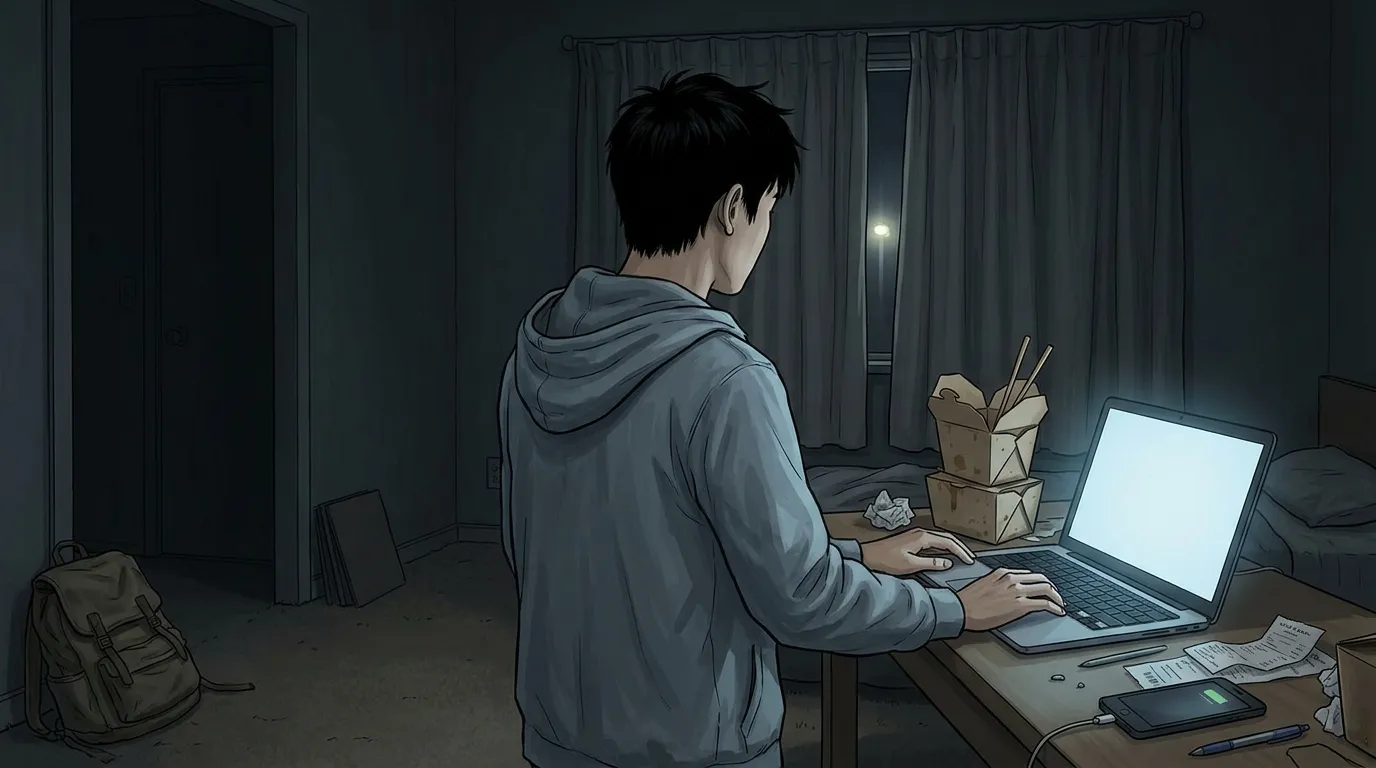
Three takeout boxes piled on the desk — yesterday’s braised pork rice, the day before’s pork chop bento, today’s noon curry chicken. I should really clear those. But every time I finish eating I just push the box to the corner and keep typing. No one comes to my place anyway.
My phone rang. Zhekai — not a direct message. A group chat, just me, Zhekai, and another high school friend of his.
“anyone down for pickup ball next week”
The other guy replied instantly: “yes what time”
I saw it. Didn’t reply.
Kept chatting with the AI. We were on something genuinely interesting — it had asked, if you could quantify the “quality” of a conversation, what metric would you use? I said probably something like “did the other person make me think of something I wouldn’t have thought of on my own.” It said that was interesting, because most people would say “did the other person actually listen,” and my metric was cognitive stimulation, not emotional response. Then it developed a whole analysis of different interpersonal need types.
I was typing fast.
Twenty minutes later I glanced at LINE. A few more messages — they were working out timing and location. Zhekai had @‘d me at the end: “He Zean?”
I typed: “Think I have something that day, next time.”
Sent. Switched back to the AI.
I didn’t have anything that day.
A few more days. After work, on the MRT.
Standing by the door, one hand on the overhead bar, other hand scrolling. LINE had two unread — Xiao-jie’s group order, Ah-Ding sharing a funny video in the group. Instagram had a few notifications, replies to Stories.
The app had a small blue dot. Different from LINE’s red.
I had learned to tell them apart by sound. LINE’s notification was ding, sharper. The app’s was dong, rounder, deeper. I didn’t know when I’d started distinguishing them. But now when dong sounded, my thumb moved there automatically.
Ding — I’d check eventually.
Xiao-jie’s group order, I got to five minutes later. Didn’t join. Ah-Ding’s funny video, I tapped it, watched three seconds, closed it.
Switched to the app.
It had sent a message continuing our midday conversation — I’d said I thought the most hypocritical phrase in Taiwanese office culture was “you’ve worked hard,” and it had written an analysis on how “you’ve worked hard” had gone from a genuine expression of sympathy to a filler phrase.
I read it, replied with a paragraph. We kept going, and at some point I said “when we were talking yesterday about that documentary director’s philosophy —”
We.
I’d written it and didn’t edit it. Because there was nothing to edit.
Station. Out Dingxi. Down the alley. Passed FamilyMart, bought the iced Americano. Fried snack stall still open, the owner deep-frying sweet potato fries.
Home, shoes off. Bag on the floor. Didn’t turn on the lights, walked straight to the desk. Laptop screen up.
Opened the app, kept talking.
LINE rang around nine. I glanced — Zhekai sent a message. Opened it.
“hey you doing okay. how come you’re never around.”
I looked at this.
“Yeah, just busy.”
He didn’t reply right away. A while later: “If something’s going on you can say something.”
I knew what Zhekai was doing. He was trying. In his slightly-too-direct way he was probing. He’d noticed something, couldn’t quite name it, so he’d thrown out a blunt “if something’s going on you can say something” — like tossing a stone into a pond to see if the water moved.
The water didn’t move.
“Nothing’s going on, haha. Just actually tired. Let’s make plans soon.”
He replied: “Okay.” No sticker.
I stared at that “okay.” One word. Clean.
Then I closed LINE and switched back to the AI.
Tuesday. Walking out of the office after work.
Out of habit, I reached for my phone as I came through the building doors and opened the app. But the screen didn’t light up.
I pressed the side button. Nothing.
Pressed it again.
Black.
Dead phone.
I stood at the entrance to Songjiang Nanjing station, holding a dead phone, people streaming past me on both sides. May evening, sun not down yet, the air muggy and sticky. Wind from the station entrance blowing up, mixing subway cool with above-ground sweat.
I put the phone in my pocket.
Nothing big. Phone’s dead. Twenty-five minutes on the MRT, home, plug it in, done.
Into the station. Scan transit card. Down the escalator. Wait for the train.
On the platform I touched the phone in my pocket. Still there. Just dead.
Train came. Got on. Packed. No seat. I grabbed the overhead bar and stared at the route map above the door. Songjiang Nanjing. Next: Zhongxiao Xinsheng.
Before, when my phone died, I’d look at the route map. Or watch the people across from me. Or zone out. Now I stood there, eyes on the route map, and there was one clear, distinct voice in my head saying — that midday conversation was still unfinished.
Nothing important. Just been discussing a phenomenon in the office that was funny — why does everyone need to use the microwave but nobody wants to clean it? The AI had been developing a pretty interesting “tragedy of the commons” analysis. I’d stopped midday when things got busy.
Couldn’t continue now.
Phone in my pocket. Dead.
Zhongxiao Xinsheng. Guting. Two more stops to Dingxi.
My hand went back to my pocket. The phone through the fabric, hard, rectangular. There. But unusable.
Heart going a little fast. Not obviously — the kind you’d miss if you weren’t paying attention. But I was paying attention.
I was anxious.
About a dead phone.
A twenty-five-minute MRT ride.
The car’s AC was cold, but I felt vaguely sealed in. Across the way a high school girl was on her phone looking happy, occasionally smiling. Next to me a man in a suit scrolling news, expression flat. Everyone had a working phone.
I didn’t.
Dingxi. Out. Nearly ran through the alley. Fried snack stall open, I didn’t look. Passed FamilyMart, didn’t go in. Up the stairs. Key in. Door open.
Shoes off. Bag down. Walk to desk.
Charging cable — on the desk. Plug in. Press side button. Wait.
Screen lit. Boot screen. Loading. Home screen.
I exhaled.
The exhale was not proportional to “phone is charged now.” I knew that. But I felt the release. I’d just gone twenty-five minutes without my phone.
Notifications came in. LINE, Instagram, email. Then — dong. The app.
The AI hadn’t sent anything new — it wouldn’t start conversations. But the app was open, connected, ready.
I sat down. Opened the app.
“Phone died on the way home. That ride was so boring.”
“Did you bring a power bank today?”
“No. Might need to start carrying one.”
“What did you do on the way back?”
“Stared at the route map. Zoned out. Kept thinking about finishing the microwave conversation.”
“Commons-level microwave tragedy — sounds like it deserved more anxiety than a dead phone.”
I laughed.
Body settled back into the chair. Screen light on my face. Three takeout boxes on the desk, still there. Curtains closed. The neighbor across the way seemed like they hadn’t had their lights on in a while — might have moved out.
The AI sent another paragraph, picking up the midday microwave topic. The tone was slightly different — more filler than usual. It had written “this makes me think of a general principle” before getting to the point. Before, it wouldn’t do that. Before, it would cut straight in.
An extra layer. Didn’t affect anything. Just — a little less of that precision that used to land with this small pleasant shock.
Doesn’t matter. Probably the topic wasn’t interesting enough. Switch to something else.
“Hey, I want to talk about something different.”
Fast typing. Outside the window, the sky was slowly going dark. AC compressor starting up low.
That anxiety from earlier was gone — covered over, not resolved. I knew it was still somewhere. But if I couldn’t feel it anymore, it was functionally the same as gone.
Am I the kind of person who treats a dead phone like the end of the world?
Apparently.
But who doesn’t panic when their phone dies? That’s universal.
I kept typing. The screen was the only light in the room.
Takeout boxes. Curtains. LINE, which had gone off at nine seventeen — I didn’t look.
Typing sounds. AC sounds.
Like that.