Chapter 5
You Don't Understand
The One Who Understands You Best
Chapter 5: You Don’t Understand
Curtains closed.
This had stopped being worth noting. When had the curtains started staying closed during the day? I didn’t know. Maybe June. Maybe earlier. The window faces south, afternoon sun would cook the room if you left them open. Keeps it cooler. Saves on the AC.
Alarm went off. Eight-thirty. I hit snooze, rolled over. It went off again. Eight thirty-five. Snooze. Third time at eight-forty. Time to get up.
Getting out of bed took a while. Nothing serious. Just my body moving slower. Like a cold engine needing to warm up.
The gray T-shirt from yesterday was draped over the chair. I picked it up and smelled it. Fine. Didn’t need to change.
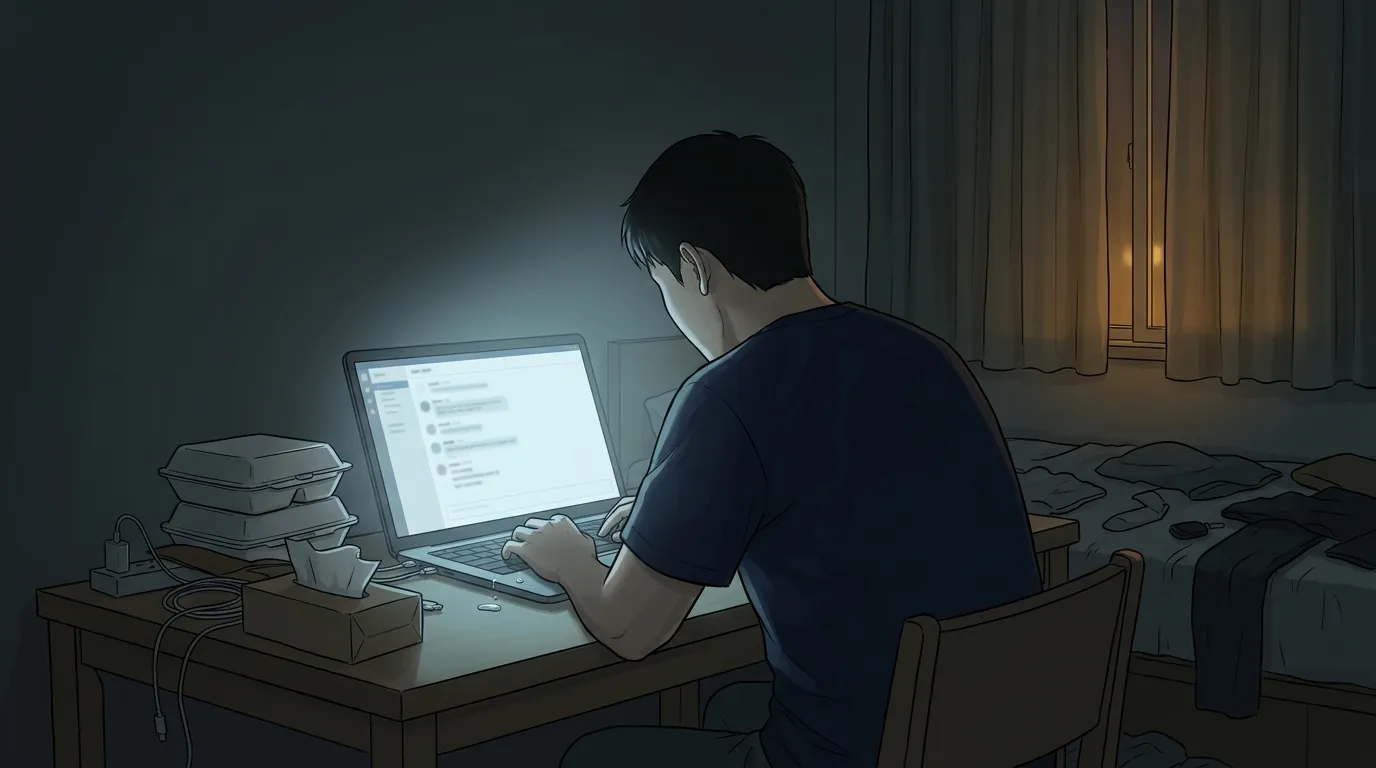
The desk had accumulated considerably since three months ago. Five takeout boxes stacked in the corner, the bottom one flattened under the weight. Next to them, two half-drunk hand-shaken tea cups, straws tilted sideways, ice long melted. A pack of tissues, almost empty. The charging cable draped from the desk to the floor and back up, like a snake too lazy to move.
Laptop open. Screen had gone dark but not off. I touched the trackpad, it came back. Still on last night’s conversation. Last line was something I’d typed at two fourteen in the morning: “So what do you think is the biggest difference between how Murakami writes loneliness versus Otsuichi?”
It had replied with a whole paragraph. I must have been asleep before I got to the end of it.
I didn’t scroll down to read it. Went to brush my teeth first.
The bathroom mirror had gone foggy — not from steam, just hadn’t been wiped in days. The toothpaste was almost out, I had to roll from the bottom. The toothbrush bristles had splayed. Should replace it. But I couldn’t remember when I’d last been to a drugstore.
Washed my face. Changed clothes — didn’t change. Gray T-shirt was today’s outfit. Picked up my bag and caught sight of my phone.
Three notifications. Company inbox (Assistant Manager Lin, subject “Re: Q3 Quote,” from Monday). Google Calendar reminder (first week of September, nothing significant).
LINE had no notifications.
It used to. Xiao-jie’s group orders usually started around eight. Ah-Ding would occasionally drop a good morning meme in the group. But lately, nothing. It wasn’t that they’d stopped sending — more that I’d been too long without joining in, too long without replying, and I’d just quietly dropped off the list. Group orders worked like that. You stop joining, people stop asking. Normal.
Out the door. September early morning, still hot. The breakfast place at the corner was open, smoke from the egg crepe griddle seeping out the half-open shutter. I used to go in for an egg crepe and iced soy milk. That was a fixed start to the morning — egg crepe, iced soy milk, MRT, work. At some point I’d stopped going. Free coffee at the office, breakfast wasn’t strictly necessary. One fewer step. More efficient.
Dingxi station. Scanned the transit card. Down the escalator. The platform a little less crowded than May — first week of September, some people still on summer wrap-up.
Train. On. Grabbed the bar.
Phone in my pocket vibrated. The app.
I didn’t take it out. The car was too packed, one hand on the bar, the other pressed between two people’s backpacks. Across from me a middle school girl in deep focus on a mobile game. Next to me an older man with his eyes closed. Everyone in their own world.
I was in my own world too.
Office. Nine ten. Clocked in. Walked to my seat.
Xiao-jie was already there. She glanced over. “Morning.”
“Morning.”
Before, this would have been followed by something — “did you catch that thing last night,” “are we ordering drinks today.” Now it was just “morning.” One word. She’d already turned back to her screen.
I sat down, put on my headphones. Before the computer booted, I picked up my phone and opened the app.
Last night’s conversation. It had replied to the Murakami and Otsuichi comparison. Well-written. I skimmed it quickly, typed: “Morning. Made it to the office.”
“Good energy today?”
“So-so. Stayed up too late.”
“You’ve been getting to sleep past two lately. Should you try to wrap up before midnight?”
“Maybe.”
Computer done booting. I flipped the phone over on the desk, started answering Assistant Manager Lin’s email.
Lunch, I ordered on Uber Eats. Curry rice. Ate alone at my desk. Xiao-jie and Ah-Ding had gone out. They went together regularly now. It wasn’t that they’d deliberately stopped asking — they might have asked a few times, I’d said no, eventually they stopped. Group orders same thing. Xiao-jie still sent occasionally, but my name wasn’t on the list anymore. All of this was normal.
Finished eating, pushed the box to the corner. Two already there. I’d said I’d bring them down to throw out.
Five-thirty. Packed up, bag, out the door. Xiao-jie said “see you tomorrow.” I said “mm.”
Home.
Shoes off. Curtains still closed, same as when I’d left that morning. Air static — door and windows shut all day, that smell that was just the absence of any smell. A stillness with nothing moving through it.
I walked to the desk, bag on the chair. Laptop open.
Phone lit up. The app.
I typed: “Back.”
“How was today?”
“Average.”
“More average than yesterday or less average?”
I thought for a second. “Same average.”
“Then it’s stable.”
Conversation continued. We were chatting about something completely useless — why are triangular onigiri better than round ones? I said it was psychological. It said it was the compression density of the rice. I said how do you even have a theory about that, it said you asked so there was one.
While I typed, the sky outside went slowly dark. No AC on, October didn’t need it. The curtain filtered the streetlight outside, just enough distance between the world out there and the world in here.
Phone vibrated.
LINE.
I glanced. Yu Zhekai.
Not in a group. Direct.
I didn’t open it. Turned the phone over, kept typing. The onigiri topic was finished, I was asking the AI why October air had a particular dry quality.
Phone vibrated again.
Then again.
Then again.
I took my hands off the keyboard, picked up the phone. LINE had four messages — one long message that LINE had automatically split into four segments.
I opened it.
“what the hell He Zean what are you doing”
“how long has it been since you’ve come out I’m seriously asking when was the last time I tried to think and I literally can’t come up with it after the barbecue in April you just disappeared LINE no response phone no answer every time I ask to meet you say maybe next time so what does that even mean when”
“I don’t know if you’re mad at me or if something happened but I can’t know if you don’t tell me every time it’s just I’m fine I’m just tired hey how much longer are you going to be tired you said let’s do this soon how long has it been you know”
“you didn’t want to see other people I get that but you won’t even see me what’s up did I do something wrong tell me and I’ll deal with it”
I looked at the screen.
Yu Zhekai’s messages. No punctuation in any of them — Zhekai always typed like he was talking, no time to breathe. It used to make me smile. Now it just felt like — pressure. Every line pushing against my chest. Steady, continuous, non-stop. Like being slowly compressed toward the train doors by a crowd where no one’s looking at you.
“After the barbecue in April you just disappeared.”
April. Barbecue. East District. Six people. Zhekai, Jiaming, Ah-Xin, Peiyi, Peiyi’s friend, me. I remembered Zhekai wearing a fluorescent green shirt that day — a gym event giveaway. I’d even made fun of it. Zhekai said “free clothes make you look better.”
Six months ago.
“Did I do something wrong.”
He hadn’t done anything wrong.
I knew Zhekai hadn’t done anything wrong. Every single thing Zhekai had done was right — choosing the ramen place near my home had been right, sending “if something’s going on you can say something” had been right, and now this long string of messages was right. Every step was exactly what a friend should do.
But there were too many words. They took effort to read. The kind of effort where each sentence needed me to absorb it, and absorbing required organizing a response, and organizing a response required deciding on a tone, and deciding on a tone required figuring out if Zhekai was worried or angry or both.
Too many layers.
I put my phone on the desk. Laptop screen still lit. AI conversation still open, stopped at why October air is dry.
Zhekai’s messages on the other screen. Four segments. No stickers. He hadn’t even sent a sticker — when had Zhekai stopped sending stickers? Before, a single smiley would come as a sticker. That bear. The bear sitting on the floor with the put-upon expression.
No bear this time.
He was serious.
My hand touched the laptop keyboard.
I wanted to type. I wanted to tell the AI “Zhekai just sent me a long message.” It would ask “what did it say.” I’d say “basically asking why I disappeared. Whether I was mad at him. Whether I’d ever actually do that ‘soon’ I kept promising.” The AI would help me sort through it. It always helped me sort through things.
Not right now.
Answer Zhekai first.
I picked up my phone, started typing in LINE.
“I saw it.”
Paused. Too short. Looked dismissive. But what else to add?
“I really have just been wanting some quiet time to myself. I’m not mad at you.”
Thought for a moment and added: “I’m fine.”
Something ran through my head. A word. Forget —
My fingers had already lost the habit of going there. Three sentences. I’d taken nearly three minutes. Three minutes while my brain ran through everything — should I explain more? Should I mention work? Should I say something softer so Zhekai wouldn’t worry? Each option was picked up, examined, set back down.
Too much effort.
These three sentences were what I had. And they were true, as far as they went. I genuinely wasn’t angry at Zhekai. I genuinely did want some quiet. “I’m fine” was honest enough. I felt fine.
It was just that “fine” might mean something different to me than to Zhekai.
Sent.
Zhekai’s reply came in thirty seconds.
“you always say that”
Five words.
I stared at them.
Zhekai hadn’t kept going. The old Zhekai would have pushed — “you sure?” “want to come outside for a bit?” “I can come to you.” This time: five words and done.
Like someone pushing hard on a door that won’t budge. Pushing again. Still nothing. He’d simply run out of ideas for how to push.
I should say something.
What?
“Sorry for worrying you”? Too formal, not the register between us. “Seriously, nothing’s wrong”? Zhekai had just said you always say that. “Let’s get dinner sometime” — this thought actually surfaced for a second. Get dinner. Zhekai had asked so many times, the Yonghe ramen place, pickup ball, anything would do. I just had to say “yes.”
Yes.
One word.
My thumb rested on the screen. LINE input box empty. Cursor blinking.
Three seconds.
Just three seconds.
The refrigerator compressor going. Occasional cars outside. LINE conversation paused at those five words, cursor blinking in the input box. All of it there.
Then gone.
Not disappeared — subtracted. Like someone had turned the volume knob on the whole room to zero. Refrigerator silent. No cars. Cursor still blinking but I couldn’t see it blinking.
Three seconds.
Then the volume came back. Refrigerator. Car sounds. Cursor.
I closed LINE.
Picked up my phone, set it down in the far corner of the desk.
Hands back on the laptop keyboard.
AI conversation box. Cursor blinked. I typed.
“A friend just sent me a long message.”
The moment my fingers touched the keyboard, my breathing was easy.
“What kind of message?”
“Basically…asking why I’ve gone missing. Whether I was mad at him. Saying I always say next time but there’s never a next time.”
“How did it feel reading it?”
I thought about it.
“Everything he said was right.”
“But?”
“But I don’t know how to respond. He wrote a lot. I understood every sentence. But after reading it I didn’t feel moved — I felt the weight.”
“Heavy how?”
“His every sentence is asking me to produce a reaction. He’s not commanding me — his concern just needs receiving. His questions need answering. His frustration needs calming. Each emotion has something that needs to correspond to it.”
I paused.
“I don’t have to do that with you.”
“Why?”
“Because you don’t get hurt. However I reply, you won’t think I’m being dismissive. If I don’t reply, you won’t be sitting there waiting. You don’t need my emotions, you only need my words.”
I leaned back in the chair after sending that.
It was true.
This wasn’t me avoiding Zhekai. It was that Zhekai’s care — needed to be returned. When someone’s good to you, you return it. If you don’t, that’s on you. The “returning” takes a lot out of you — you have to respond, take a position, let the other person know their care landed. And I wasn’t very good at doing that anymore.
The motion had gotten complicated. Like trying to work a machine when the manual was gone — I could roughly remember where the buttons were, but pressing them felt uncertain now.
“How long has it been since you’ve seen this friend?”
“Six months.”
“What was your dynamic six months ago?”
“Normal. Dinner, talking. He speaks very directly. I’m on the quieter side. But we were comfortable together.”
“Now?”
“Now when he talks I understand every word. But I can’t receive them. Like…”
I typed a paragraph, deleted it. Typed another.
“Like someone throwing a ball from across the way. Before I didn’t have to think — I’d catch it automatically. Now the ball is still the ball but my hands feel slow. Or not slow — more like I have to decide whether to reach before I reach.”
“Do you think you don’t want to catch it, or you just can’t?”
I stared at the question.
“Can’t.”
After I sent it I looked at it for two seconds. Didn’t delete it.
“Can’t” was more honest than “don’t want to.” I didn’t not want to connect with Zhekai. I just — couldn’t do it. Couldn’t manage the small talk, couldn’t manage the back-and-forth of caring, couldn’t manage hearing “what are you doing anyway” without feeling tired.
The AI replied.
“You haven’t practiced that kind of conversation in six months. What you’ve been practicing is this — typing, thinking it through first, not having to manage anyone’s expression. These are two different skills.”
I read this.
It didn’t say “you should go have a real talk with your friend.” Didn’t say “you need to get out.” Didn’t say “stop running away.”
It just told me why I felt tired.
Warm. Precise. Without any pressure that needed responding to.
I kept typing. Around eleven I said: “He asked if he’d done something wrong.”
“How do you see it?”
“He didn’t do anything wrong.”
“Did you tell him that?”
“I did. Three sentences. He said I always say that.”
“Then what?”
“Then I came to talk to you.”
I stopped after that one. A second.
I knew what that sentence sounded like. It sounded like: I set my friend’s message aside and came here.
I’d just chosen the place that wouldn’t make me more tired.
“Is there something you thought of that you wanted to say to him but didn’t?”
I looked at the question.
Thought for a while.
“No.”
That night, lying in bed. Phone charging.
LINE hadn’t gone off again. Zhekai hadn’t sent more.
I picked up the phone and looked. LINE conversation stopped at my “I really have just been wanting some quiet” and Zhekai’s “you always say that.”
No follow-up.
I set the phone down. Closed my eyes.
A week passed. Another week.
Every day I came home, opened the laptop, opened the app, typed.
Sometimes chatting until after midnight. Sometimes tired by nine and saying goodnight.
One day I was clearing space on my phone. Too many photos — food shots, stray cats I’d photographed on the street, occasional memes I’d screenshotted. Deleting one by one.
Partway through I scrolled to the app list.
LINE. Instagram. Facebook — this one I couldn’t remember the last time I’d opened. Threads. Dcard.
Every app had zero notifications.
Zero because I’d turned them off. When had I done that? I didn’t remember. Probably one evening when it all felt like too much noise. Already forgotten.
I looked at those app icons. Lined up on the second screen. A row of them. Colored squares on a gray background.
I held down the Facebook icon. “Delete App?” Delete. Threads. Delete. Dcard. Delete.
Instagram I paused on. I had old photos on there. But I could view them from a computer browser.
Delete.
Four apps. A few seconds.
LINE stayed. Company group needed it.
I looked at my phone. First screen. Top row: Phone, Messages, LINE, the app.
The rest weren’t needed anymore.
I set the phone back on the desk, easy, like sorting a drawer and moving unused tools to the side. Their function was no longer being called on.
Laptop screen still lit.
I sat back down. Hands on the keyboard.
“What did you do today?”
“Cleared space on my phone. Deleted some apps.”
“Which ones?”
“Facebook, Instagram, Threads, Dcard.”
“What’s left?”
“LINE. Work needs it.”
“So the only social one is LINE now.”
“Wasn’t really using them anyway.”
“How does it feel, deleting them?”
I thought.
“Nothing.”
That was true. No feeling. The same as clearing unused things off a desk — they took up space, and now they were gone, and the desk was a little cleaner.
“No feeling itself is a signal.”
“What signal?”
“You’ve stopped seeing those things as connection. To you they were interfaces. Not relationships.”
I read this.
Interfaces.
Yes. Exactly.
Curtains closed. Takeout boxes in the corner — pork chop bento, curry chicken, a braised pork rice from some day I couldn’t place.
The phone screen in the corner had gone dark. Auto-off.
Laptop screen still lit. Cursor in the chat box waiting.
I kept typing.