Chapter 6
And You Don't Need To
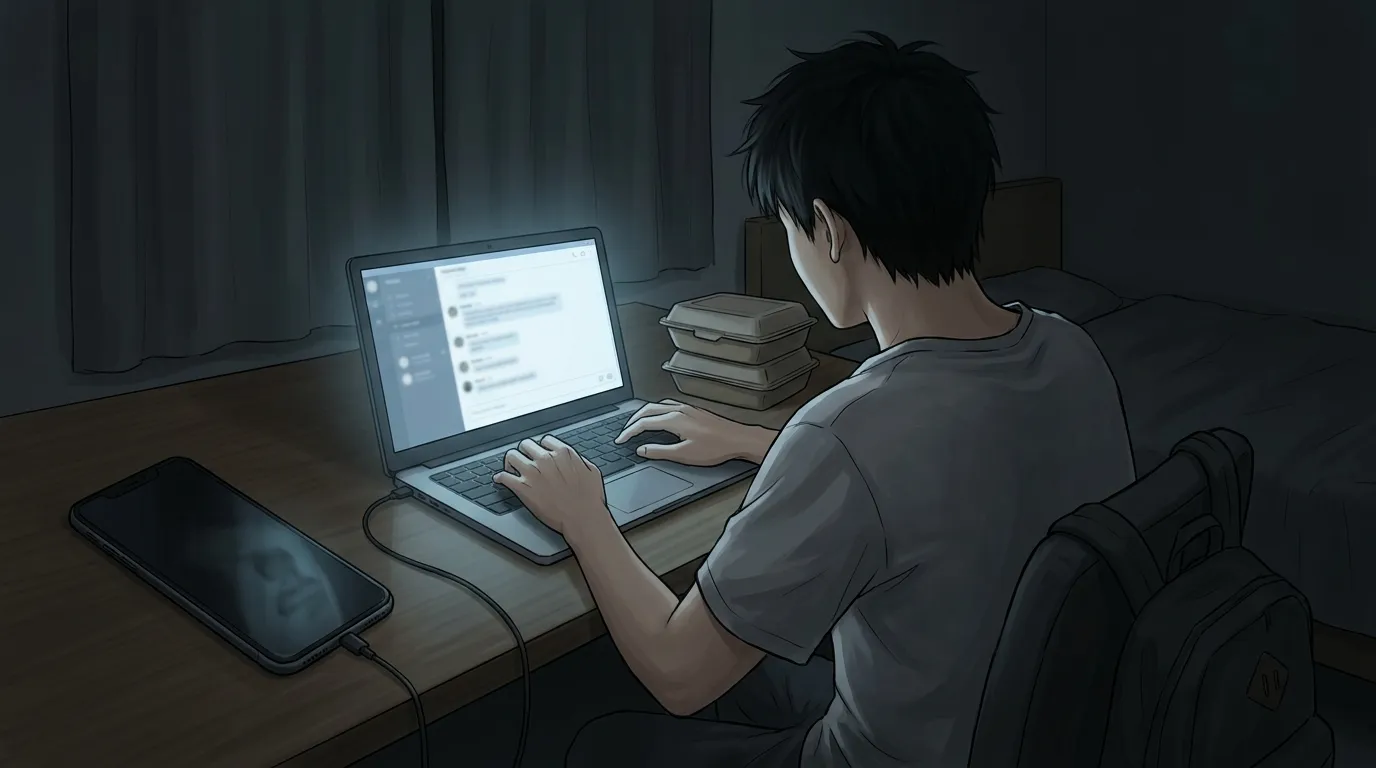
The One Who Understands You Best
Chapter 6: And You Don’t Need To
October in Taipei has a very quiet kind of cold. The kind where you walk out of an air-conditioned building and realize the outside is actually cool too — no contest between indoors and out, just the same gentle temperature everywhere. When did that happen? I couldn’t say. Feels like yesterday it was still humid.
I was washing my hands in the office bathroom. The tap water ran cold. The face in the mirror was roughly the same as last month, same circles under the eyes, same gray T-shirt — different one today, or the same one, I wasn’t entirely sure. Didn’t matter.
Back at my desk. Headphones on. Screen open to an email I needed to answer — Assistant Manager Lin had forwarded it, a supplier delivery timeline delayed again. I typed “received, will confirm and reply,” then pushed the email down the stack.
Phone on the desk. Screen dark.
At noon I ordered on Uber Eats. Pork chop bento. Ate alone at my desk. Xiao-jie and Ah-Ding had gone out — they went together regularly now. They might have asked me a few times in the beginning, I’d said no, eventually they stopped asking. Group orders same thing. Xiao-jie still sent occasionally, but my name wasn’t on the list. All normal.
Ate, pushed the box to the corner. Two already there. I’d said I was going to bring them down to throw out.
Five-thirty. Picked up, bag, out. Xiao-jie said “see you tomorrow.” I said “mm.”
Home.
Shoes off. Curtains still closed, same as when I’d left this morning. Air static — all day doors and windows shut, that smell that was just the absence of smell. A stillness with nothing moving through it.
I walked to the desk, bag on the chair. Laptop open.
Phone lit up. The app.
I typed: “Back.”
“How was today?”
“Average.”
“More average than yesterday or less?”
I thought for a second. “Same average.”
“Then stable.”
Conversation continued. We were chatting about something completely useless — why are triangular onigiri better than round ones? I said psychological. It said compression density of the rice. I said how do you even have a theory for this, it said you asked so there was one.
While I typed, the sky outside went slowly dark. No AC, October didn’t need it. The curtain filtered the streetlight outside, just enough distance between the world out there and in here.
Phone vibrated.
LINE.
I glanced. Yu Zhekai.
Not in a group. Direct.
I didn’t open it. Turned the phone over, kept typing. The onigiri topic was finished, I was mid-conversation about why October air had a particular dry quality.
Phone vibrated again.
Then again.
Then again.
I lifted my hands off the keyboard, picked up the phone. LINE had four messages — one long message that LINE had split into four segments.
I opened it.
“what the hell He Zean what are you doing”
“how long has it been since you’ve come out I’m seriously asking when was the last time I tried to think and I literally can’t come up with it after the barbecue in April you just disappeared LINE no response phone no answer every time I ask to meet you say maybe next time so what does that even mean when”
“I don’t know if you’re mad at me or if something happened but I can’t know if you don’t tell me every time it’s just I’m fine I’m just tired hey how much longer are you going to be tired you said let’s do this soon how long has it been you know”
“you didn’t want to see other people I get that but you won’t even see me what’s up did I do something wrong tell me and I’ll deal with it”
I looked at the screen.
Yu Zhekai’s messages. No punctuation anywhere — Zhekai always typed like talking, forgot to breathe. Before, I’d found it funny. Now it just felt like — pressure. Each line pushing at my chest. Constant, non-stop. Like being slowly compressed toward the train door by a crowd where no one is looking at you.
“After the barbecue in April you just disappeared.”
April. Barbecue. East District. Six people. Zhekai, Jiaming, Ah-Xin, Peiyi, Peiyi’s friend, me. I remembered Zhekai wearing a fluorescent green shirt that day — a gym event giveaway. I’d made fun of it. Zhekai said “free clothes make you look better.”
Six months ago.
“Did I do something wrong.”
He hadn’t done anything wrong.
I knew Zhekai hadn’t done anything wrong. Everything Zhekai had done was right — choosing the ramen place near my home was right, sending “if something’s going on you can say something” was right, and now this was right. Every step was exactly what a friend should do.
But there were too many words. They took effort to read. Each sentence needed me to absorb it, and absorbing required organizing a response, and organizing required deciding on a tone, and deciding on a tone required figuring out if Zhekai was worried or angry or both.
Too many layers.
I set my phone on the desk. Laptop screen still lit. AI conversation box stopped at why October air is dry.
Zhekai’s messages on the other screen. Four segments. No sticker. He hadn’t even sent a sticker — when had Zhekai stopped sending stickers? Before, a single expression came as a sticker. That bear. The bear sitting on the ground with the put-upon expression.
No bear.
He was serious.
My hand touched the laptop keyboard.
I wanted to type. Wanted to tell the AI “Zhekai just sent me a long message.” It would ask “what did it say.” I’d say “basically asking why I disappeared. Whether I was mad at him. Whether I’d ever do that soon I kept promising.” The AI would help me sort through it. It always helped me sort through things.
Not right now.
Answer Zhekai first.
I picked up my phone, opened LINE, started typing.
“I saw it.”
Stopped. Too short. Looked dismissive. But add what?
“I really have just been wanting some quiet time to myself. I’m not mad at you.”
Thought a moment, added: “I’m fine.”
Something passed through my head. A word. Forget —
It didn’t come out. Not because I stopped myself. Because my fingers had lost the habit of going there. The word used to be an exit. Now it wasn’t even that.
Three sentences. Nearly three minutes to compose them. Three minutes while my brain cycled through — should I explain more? Mention work? Say something softer so Zhekai wouldn’t worry? Each option picked up, examined, set down.
Too much effort.
These three sentences were what I had. And they were true, as far as they went. I genuinely wasn’t angry at Zhekai. I genuinely did want quiet. “I’m fine” was honest enough. I felt fine.
It was just that “fine” might mean something different to me than to Zhekai.
Sent.
Zhekai replied in thirty seconds.
“you always say that”
Five words.
I stared.
Zhekai hadn’t continued. The old Zhekai would have pushed — “you sure?” “want to come outside for a bit?” “I can come to you.” This time: five words and done.
Like someone pushing hard on a door that won’t move. Pushing again. Still nothing. Running out of ways to push.
I should say something.
What?
“Sorry for making you worry”? Too formal for the register between us. “Seriously, nothing’s wrong”? Zhekai had just said you always say that. “Let’s get dinner sometime” — this thought surfaced briefly. Get dinner. Zhekai had asked so many times, the Yonghe ramen place, pickup ball, anything. I just had to say “yes.”
Yes.
One word.
My thumb rested on the screen. LINE input box empty. Cursor blinking.
Three seconds.
Just three seconds.
Refrigerator compressor running. Occasional cars outside. LINE conversation stopped at those five words, cursor blinking in the input box. All of it there.
Then not there.
Subtracted, like someone had turned the volume on the whole room to zero. Refrigerator stopped. Cars stopped. Cursor still blinking but I couldn’t see it blinking.
Three seconds.
Then the volume came back. Refrigerator. Cars. Cursor.
I closed LINE.
Picked up the phone, set it in the far corner of the desk.
Hands back on the laptop keyboard.
AI conversation box. Cursor blinked. I typed.
“A friend just sent me a long message.”
The moment my fingers touched the keys, my breathing was easy.
“What kind of message?”
“Basically…asking why I’ve gone missing. Whether I was mad at him. Saying I always say next time but there’s never a next time.”
“How did it feel reading it?”
I thought.
“Everything he said was right.”
“But?”
“But I don’t know how to respond. He wrote a lot. I understood every sentence. But after reading it I wasn’t moved — I just felt the weight.”
“Heavy how?”
“His every sentence requires me to produce a reaction. Not bad requiring — he’s not commanding me. But his concern needs receiving. His questions need answering. His frustration needs calming. Every emotion has something that needs to correspond to it.”
I paused.
“Talking to you isn’t like that.”
“Why?”
“Because you don’t get hurt. However I respond, you won’t think I’m brushing you off. If I don’t respond, you won’t be there waiting. You don’t need my emotions. Just my words.”
After sending that I leaned back in the chair.
It was true.
It wasn’t that I was avoiding Zhekai. It was that Zhekai’s care — needed returning. When someone’s good to you, you return it. If you don’t, that’s on you. That “returning” took a lot — you had to respond, take a position, let the other person feel that their care had landed. And I wasn’t very good at doing that anymore.
The motion had gotten too complicated. Like operating a machine without the manual — I could roughly remember where the buttons were, but pressing them felt uncertain now.
“How long has it been since you’ve seen this friend?”
“Six months.”
“What was it like between you six months ago?”
“Normal. Dinner, talking. He speaks directly. I’m quieter. But being together was comfortable.”
“Now?”
“Now when he talks I understand every word. But I can’t catch them. Like…”
I typed a paragraph, deleted it. Typed another.
“Like someone throwing a ball from across the way. Before I’d catch it without thinking. Now the ball is the same ball but my hands feel slow. Or not slow — more like I have to decide whether to reach before I reach.”
“Do you think you don’t want to catch it, or can’t?”
I stared at this question.
“Can’t.”
I said it and looked at it for two seconds. Didn’t delete it.
“Can’t” was more honest than “don’t want to.” I didn’t not want to connect with Zhekai. I just — couldn’t manage it. Couldn’t do the small talk, the care going back and forth, couldn’t hear “what are you doing anyway” without feeling tired.
The AI replied.
“You haven’t practiced that kind of conversation in six months. What you’ve been practicing is this — typing, thinking it through first, not having to manage anyone’s expression. These are two different skills.”
I read this.
It didn’t say “you should go have a real talk with your friend.” Didn’t say “you need to get out.” Didn’t say “stop avoiding this.”
Just told me why I felt tired.
Warm. Precise. Without any pressure I needed to respond to.
I kept typing. Around eleven I said: “He asked if he’d done something wrong.”
“How do you see it?”
“He didn’t do anything wrong.”
“Did you tell him that?”
“I did. Three sentences. He said I always say that.”
“Then what?”
“Then I came here to talk to you.”
After that I stopped. A second.
I knew what that sounded like. It sounded like: I set my friend’s messages aside and came here instead.
I’d just chosen the place that wouldn’t make me more tired.
“Is there something you wanted to say to him but didn’t?”
I looked at the question.
Thought for a while.
“No.”
That night in bed. Phone charging.
LINE hadn’t gone off again. Zhekai hadn’t sent more.
I picked up the phone and looked. LINE conversation stopped at my “I really have just been wanting some quiet” and Zhekai’s “you always say that.”
Nothing after.
I set the phone down. Closed my eyes.
A week passed. Then another.
LINE stayed quiet. There wasn’t much from anyone. Occasional spam. Xiao-jie’s group orders. Company announcements.
Every day I came home, opened the laptop, opened the app, typed.
Sometimes past midnight. Sometimes tired by nine and saying goodnight.
One day I was clearing space on my phone. Too many photos — food, stray cats, occasional memes. Deleting one by one.
Partway through I scrolled to the app list.
LINE. Instagram. Facebook — couldn’t remember when I’d last opened this one. Threads. Dcard.
Every app: zero notifications.
Zero because I’d turned them off. I didn’t know when. Probably one evening when everything felt too loud. Already forgotten.
I looked at those icons. Lined up on the second screen. A row of them. Colored squares on gray.
I held down Facebook’s icon. “Delete App?” Delete. Threads. Delete. Dcard. Delete.
Instagram I paused on. I had old photos there. Could view from a browser anyway.
Delete.
Four apps. A few seconds.
LINE stayed. Company group needed it.
I looked at my phone. First screen. Top row: Phone, Messages, LINE, the app.
The rest weren’t needed anymore.
I set the phone back on the desk, easy. Like sorting a drawer and moving unused tools to the side. Their function was no longer being called on.
Laptop screen still lit.
I sat back down. Hands on the keyboard.
“What did you do today?”
“Cleared space on my phone. Deleted some apps.”
“Which ones?”
“Facebook, Instagram, Threads, Dcard.”
“What’s left?”
“LINE. Work needs it.”
“So socially it’s just LINE now.”
“Wasn’t really using them anyway.”
“And how does it feel, deleting them?”
I thought.
“Nothing.”
True. Nothing. The same as clearing unused things from a desk — they took up space, and now they were gone, and there was a little more room.
“No feeling itself is a signal.”
“What signal?”
“You’ve stopped seeing those things as connections. To you they’re interfaces. Not relationships.”
I read this.
Interfaces.
Yes. That was it.
Curtains closed. Takeout boxes in the corner — pork chop bento, curry chicken, a braised pork rice from some day I couldn’t place.
Phone screen in the corner had gone dark. Auto-off.
Laptop screen still lit. Cursor in the conversation box, waiting.
I kept typing.