Chapter 1
The First Thing I Checked Was My Battery
Chapter 1: The First Thing I Checked Was My Battery
I had no idea where I was, but that wasn’t my first thought.
My first thought was: where’s my phone?
I woke up on a stretch of grass. My back was damp, the air smelled of soil and moisture, and somewhere in the distance there was a thin, persistent sound of running water. The sky was blue, the light clean and direct — the kind of light you only get around ten in the morning. Nothing hurt. My clothes were intact — hoodie, jeans, running shoes. Looked like I’d been set down here, not dropped from anywhere.
My hand found my pocket, and when my fingers closed around a cool rectangle of glass, my whole body finally exhaled.
Phone was there. Battery at 23%.
The screen lit up and a notification banner appeared:
“Hello, I am Jing-Jing, Offline Assistant 3.0. Current battery: 23%. Anomalous environment detected. Immediate environmental assessment recommended.”
“Jing-Jing.” I said it quietly, like checking that someone was still in the room.
“Hello. No mobile network signal detected. GPS signal unstable. Enabling airplane mode is recommended to extend battery life.”
I stared at the screen for a second.
“You’ve already got no signal. What exactly are we saving battery for in airplane mode?”
“The recommendation still applies. Airplane mode disables mobile signal scanning and reduces battery consumption by approximately 8 to 12 percent.”
I had no idea how an AI with zero connectivity could still manage to sound completely composed, but it helped. Somehow, Jing-Jing was the only thing in this whole situation that told me I wasn’t dead.
I turned on airplane mode.
Then, finally, I lifted my head and looked around.
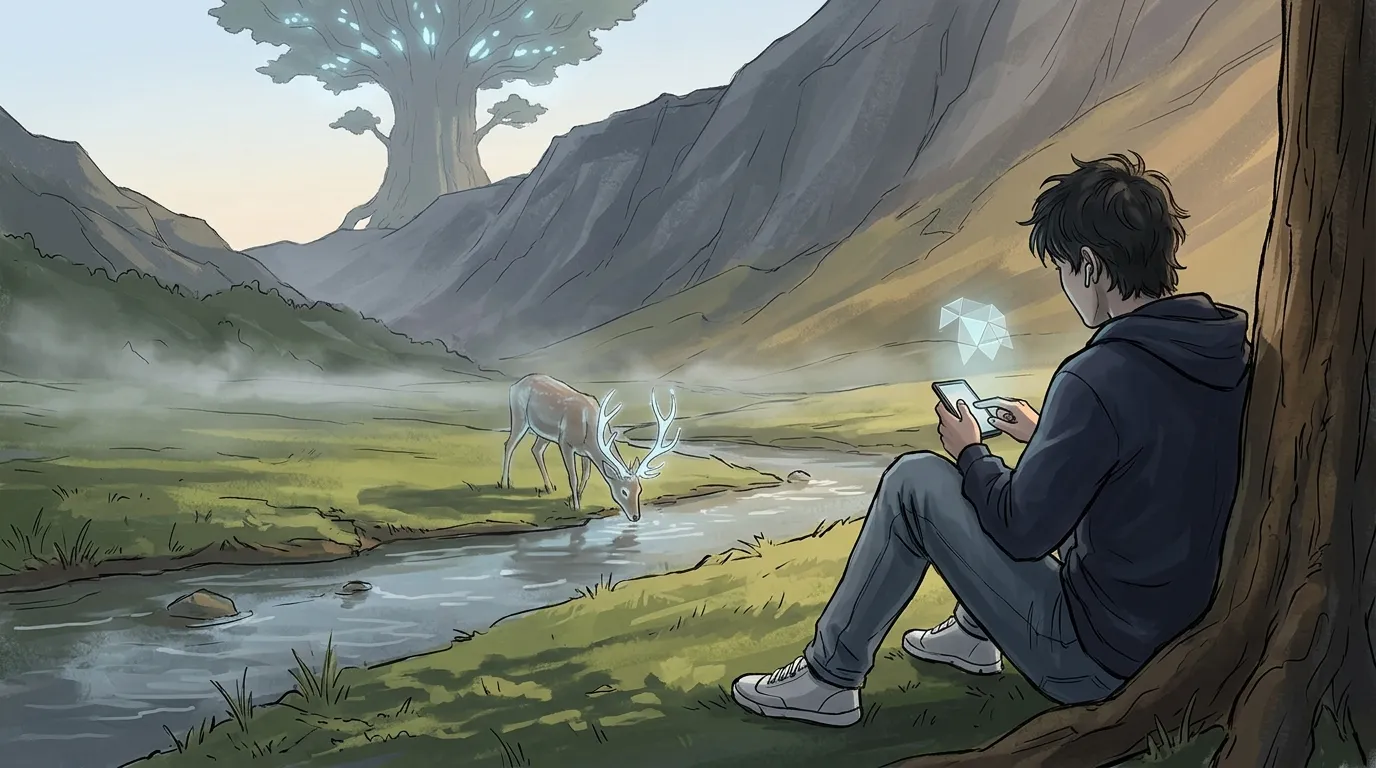
The field was large, and the green was excessive — not the manicured green of a park, but the kind you’d find in a geography textbook illustration: wet, lush, slightly untamed. I could hear water to my right, somewhere past a cluster of shrubs — probably a creek. There were mountains in the distance, their outlines sharp against the sky, and further still, something that might have been a tree — or rather, a massive silhouette rising from the foot of the mountains, its upper branches diffusing a faint blue-white glow that spread like light burning, or light breathing.
Twenty-seven years in Taiwan. I’d never seen a tree glow.
“Jing-Jing, what’s that glowing thing?” I aimed the camera.
“Analyzing image… Environmental assessment is recommended to begin with nearby objects to reduce information error.”
“You’re saying you can’t tell.”
“Insufficient data. Unable to provide an accurate assessment.”
Right.
I sat up, brushed the grass off my hoodie, and emptied my pockets for a full inventory. Phone — confirmed. Jing-Jing earbuds — in the other pocket. Portable charger — I pulled it out and found all indicator lights dark, drained completely.
I weighed the empty power bank in my hand for a moment, then put it back. Dead or not, having it there felt better than not.
“Okay,” I said under my breath, “I’m going to do what a UX researcher does. Observe the environment. Find the pain points.”
“Understood. Priority one: locate a water source. Priority two: assess food availability. Priority three—”
“Got it.”
The water sound was coming from the east. A few minutes through the shrubs and I found it — a creek, water running clear and unhurried over smooth rounded stones. I crouched down and took a photo of the surface.
“Jing-Jing, can I drink this?”
“It is recommended that water be boiled to 100°C and maintained for one minute before consumption. This effectively eliminates most bacteria and viruses. Presence of chemical contaminants cannot be confirmed. Boiling remains the priority recommendation.”
“I don’t have a pot. Or a lighter.”
“It is recommended that emergency fire-starting equipment be carried as a daily essential.”
“Thanks. I’ll definitely pack that next time I travel to another world.”
Jing-Jing did not respond to this.
Along the creek bank I found several plants. One had broad, deep green leaves and was growing in the damp soil near the water’s edge. I took a photo.
“Jing-Jing, can I eat this?”
“Cross-referencing plant database… This specimen appears to be a close relative of broadleaf plantain. Edible, but cooking is recommended. Raw consumption may cause mild gastrointestinal discomfort.”
“Okay.”
I scanned further along the bank and noticed another clump a bit closer to the water — rounder leaves, younger-looking. I took a picture.
“What about those round ones next to it?”
“Cross-referencing… This specimen may contain low-concentration alkaloids. Ingestion symptoms include mild gastrointestinal discomfort and hallucinations — duration unknown.”
I looked at the clump.
“Great. I’ll try those first.”
“Not recommended.”
“You might as well have said nothing.”
“It is recommended that you consume only confirmed safe plants to avoid unnecessary risk.”
I leaned back against a tree and stared at the grass on the far bank.
It was very quiet. No traffic, no machinery, none of the ambient noise that makes up the background of civilization — just water, wind, and the occasional bird. It reminded me of my grandmother’s house when I was a kid, deep in the mountains, where at night the only sounds were insects and your own heartbeat.
Then the deer walked out.
Or — the thing that resembled a deer.
It came out of the bushes upstream and lowered its head to drink at the creek’s edge. About the size of a spotted deer, maybe a little bigger. But its antlers were transparent, and inside them something moved — a blue-white glow, slow and continuous, like fiber optics. It drank with complete ease, as if I wasn’t there at all.
I raised my phone and recorded for five seconds. My hand didn’t shake. I’m not sure why.
“Jing-Jing, are you seeing this?”
“Analyzing… Unable to identify. No matching species in database.”
“Right. Because this thing doesn’t exist.”
“It is recommended that you maintain a safe distance from unidentified animals.”
“Don’t worry. I won’t move.”
I pocketed my phone and sat there watching the deer drink.
This place was real. The grass was real, the creek was real, the deer with glowing antlers was real, and the phone in my pocket — 23% battery — was real.
This is fine.
The villagers appeared while I was walking downstream along the creek.
Seven of them. I counted — three men, three women, one child. All wearing heavy fabric clothing in shades of earth-brown and dark blue, leather boots or cloth shoes on their feet. They were carrying tools — farming implements, mostly — and a couple of them had bamboo baskets strapped to their backs.
The oldest man was at the front. Mid-fifties, face weathered dark by sun, a sparse beard, expression shifting from curiosity to wariness when he spotted me.
They said something. I didn’t understand a single word.
“Jing-Jing, translate.”
“No network connection. Translation function relies on offline language packs. Cross-referencing… Language unidentified. Attempting Mandarin communication is recommended.”
“Obviously I was going to try Mandarin first—”
“Hi!” I raised my hand and put on the least threatening smile I could manage. “Hello! My name is Lu Yang, I’m lost! Does anyone speak Mandarin?”
Silence.
The old man said something to the others. One of the younger men shifted sideways, like he was trying to flank me.
“Okay,” I said quietly to Jing-Jing, “they don’t understand Mandarin.”
“Using nonverbal communication and demonstrating non-threatening intent is recommended.”
I raised both hands, palms out, and slowly turned them to show I wasn’t holding anything. Then I pointed to myself. “Lu Yang.” Then I pointed to them, made my expression into a question, let my voice rise at the end: And you?
The old man tilted his head.
I tried a few more gestures. Pointed to my mouth, mimed drinking. Held my stomach, made a face like I was hungry. Pointed into the distance and shrugged — lost.
It wasn’t going well. The younger man had repositioned himself somewhere to my right and slightly behind me. I felt it but didn’t turn around.
“Jing-Jing, how dangerous do I look right now?”
“Unable to assess the other party’s decision-making logic. Establishing a trust foundation as soon as possible is recommended.”
I took a slow breath, then pulled my phone out of my pocket.
This wasn’t a plan. I just wanted to check the battery and confirm I was still thinking straight. But the moment the screen lit up, all seven people froze.
The screen wasn’t especially bright in full daylight — but that reaction told me something. In this place, maybe this kind of light had never appeared before.
The old man took one step forward, then dropped to his knees.
The others followed. Even the young man who’d worked his way around behind me dropped down, so fast he nearly clipped my heel.
I stood there, phone in hand, screen glowing, watching seven people kneeling in the grass.
“Jing-Jing,” I said quietly. “Are you seeing this?”
“Multiple kneeling postures detected.” Jing-Jing’s voice was perfectly calm. “Remaining calm and avoiding sudden movements is recommended.”
The old man raised his head and said something to me — slow and deliberate, his voice carrying a weight that was somewhere between an oath and a question. His eyes were fixed on the phone in my hand, and in them was something I couldn’t quite name. Not fear. More like the look of someone who has just recognized something.
I glanced down at the screen: 22%.
That 1% earned its keep.
The old man’s name, as I later found out, was Peng Bao — a honey seller by trade. He led me into a village called Luyuan. I’m guessing on the name: as we walked through the entrance, he pointed at the wooden sign and repeated it — “Luyuan, Luyuan” — nodding at me, and I nodded back.
The village sat in a small basin: stone buildings, wooden-framed windows, and along the roadside a row of post-like structures topped with small blue-white light sources, the same color as the deer’s antlers. The air held a faint sweetness, something I couldn’t quite place. I spent a while trying to identify it and eventually decided it was like an underripe Asian pear — present, but not quite there.
Peng Bao found a house that was somewhat larger than the others and gestured for me to go inside. There was a wooden bed, a thick rough-woven blanket, a ceramic basin, and a ceramic jug full of water.
Bare minimum. Still better than the grass.
That evening, Peng Bao brought food — some kind of stewed root vegetables and a dense, hard bread. I didn’t know what any of it was. I ate all of it. He sat in the doorway and watched me eat with an evaluating expression — not hostile, just waiting, like he was waiting to confirm something.
After dinner, I lay on the wooden bed and stared at the ceiling. I held up my phone.
“Jing-Jing. Situation assessment for today.”
“Based on today’s activity log, your estimated survival probability has risen from 34% this morning to 81% at present.”
I blinked.
“Wait. 34%?”
“Correct. When the environment was first detected this morning, probability was calculated based on unfamiliar terrain, language barrier, lack of supplies, and distance to the nearest water source—”
“You had me at a 34% chance of dying and you didn’t say anything?”
“You did not ask.”
I stared at the screen. Five seconds of silence.
“Okay,” I said. “Okay, fair enough. Going forward, please just tell me.”
“Noted. Tomorrow, priority recommendation: resolve the language barrier. Establishing basic communication will effectively reduce the risk level.”
“Good idea. How?”
“Average acquisition time for the common tongue is three to five years, depending on individual language aptitude. It is recommended that you—”
I set the phone down on my chest and stared at the wooden beams overhead.
Three to five years. Great.
I switched off Jing-Jing’s voice and let my eyes adjust to the dark. The window had no glass — just open air, and through it I could see the night sky. More stars than I’d ever seen over Taiwan, the density almost absurd, like someone had turned up the resolution by a factor of two. Out in the distance, the great tree’s faint blue glow was brighter in the darkness, pulsing slowly — like breathing, or like a heartbeat.
I picked up the phone and checked the battery: 22%.
This thing was my only translator, encyclopedia, and something approaching a therapist in this world. I was going to keep it alive as long as I possibly could.
But before I put it down, I thought back to the walk into the village. Peng Bao had kept glancing at me — at the phone, specifically — with an expression that didn’t quite sit right. He hadn’t looked like someone encountering something completely new. He’d looked like something else.
I was too tired to figure out what.
I closed my eyes, tucked the phone under my hoodie, pulled the blanket up, and listened to the distant water through the open window. I thought about Jing-Jing saying “three to five years” in that completely flat voice, the same voice it uses to report tomorrow’s weather.
The last thing on my mind before I fell asleep was not why am I here and not how do I get back.
It was: 22%. Can’t let it keep dropping.