Chapter 2
A God at Twenty-Three Percent
Chapter 2: A God at Twenty-Three Percent
On the third day, I cured someone.
Or rather — my knowledge cured someone. But in this village, no one cared about that distinction.
His name I never managed to retain (names in the common tongue were just strings of syllables to me), but his arm had a wound — caught on a farm tool a few days prior, the skin around it going red and swollen, a faint suggestion of pus starting to form. Peng Bao brought him to where I was staying and spent a while pointing and gesturing before I understood, through Jing-Jing’s translation, that he’d come to ask “the deity” for help.
I couldn’t exactly explain that I wasn’t a deity, I was a UI designer from Taichung.
I asked Jing-Jing. Jing-Jing gave me the protocol for treating an infected wound: clean it, sterilize any tools with heat, keep it dry, avoid contact with soil. I followed every step. The translation cost me 0.3%. I spent about three seconds grieving the loss, then kept going.
The man recovered three days later.
Then Peng Bao went around the village and announced that the Oracle had healed an incurable wound using mysterious power — specifically, “symbols from the outer world.” When Jing-Jing translated this to me later, I decided not to correct him. Every correction cost battery. And the outcome was the same regardless.
That was my first moral checkpoint. I didn’t struggle with it much — conserving battery and conserving conscience, I’d discovered, run on the same logic.
Two weeks in.
Fast or slow, I couldn’t say. New things happened every day, but they all had the same quality — like watching someone else’s story: Lu Yang, standing in a situation that had nothing to do with him, waiting for Jing-Jing to tell him what to do next, then reframing the results as acts of divine revelation.
Day five: the water problem.
I knew the villagers were drinking unboiled water straight from the source, and I knew from Peng Bao that gut sickness was the most common ailment in the village by late summer. I asked Jing-Jing — 0.2% — and Jing-Jing explained that boiling water and letting it cool would kill most harmful bacteria. No medicine needed, no equipment beyond a fire and a pot.
The problem was getting them to do it. The “Oracle” title helped, but only when I could perform something. In the end, Peng Bao solved it for me: he brought out a ceramic pot, I demonstrated bringing water to a full boil, and after three people had drunk from it, I waved my hand at the sky a few times (pointing at nothing in particular, but it looked very ceremonial) and spoke a sentence Jing-Jing had translated into the common tongue: “Water — purification complete.”
It worked far better than it had any right to.
A week later, cases of gut sickness had dropped. Peng Bao claimed this was the Oracle’s Water Spell, renamed me “the Water Sage,” and added that the Oracle’s words that day had caused his beehives to produce three extra jars of honey — a connection in logic I still cannot locate to this day.
“Jing-Jing, every recommendation you give me costs battery,” I said one evening, brushing my teeth. “I’ve started only asking about things that actually matter.”
“The recommendations comply with the principle of maximum efficiency.”
I thought about this. “Are you complimenting me or grading me?”
Jing-Jing did not respond to this.
I chose to interpret it as a compliment.
The weather prediction on day ten was the closest I came to dropping a rock on my own foot.
The village farmers had missed several optimal harvesting windows because they didn’t know when rain was coming. Dong Heng — the village chief, a middle-aged man who spoke at a measured pace and prefaced most things with “let me think on that” — came to find me, asking about the timing for the last batch of crops that season.
His expression was serious. His question was a genuine need. He wasn’t testing me.
I opened Jing-Jing and had it analyze cloud-layer photos I’d taken over the previous two days along with the wind direction I’d recorded — 0.5%, the highest single-query cost so far. Jing-Jing’s answer: “Based on cloud formation patterns and wind direction data, probability of rainfall in three days is approximately 72%. Harvest tomorrow is recommended.”
I told Dong Heng: harvest tomorrow. Heavy rain is coming the day after.
He “thought about it,” then said: “If the Oracle says so… then so it shall be done.”
The villagers moved up the harvest, got the grain into storage.
The day after tomorrow, it didn’t rain.
The day after that it did. And not heavy rain — two days of light drizzle.
I stood outside the storehouse, watching the already-harvested crops lying in neat rows inside, listening to the mist of rain beyond the open door, then opened Jing-Jing.
“You said 72% chance of rain. What was the error margin?”
“Insufficient local meteorological data. Error margin on this prediction: approximately 40%.”
“You could have led with that!”
“You did not ask for the error margin.”
I took a slow breath. “From now on, for any predictions, include the error margin automatically.”
“Noted. The recommendation remains valid.”
Peng Bao materialized from somewhere and began informing people that the Oracle’s prophecy had fulfilled itself a day early, which only made it more miraculous. I resolved to keep him at a reasonable distance from now on, as his talent for interpretation had clearly exceeded anything I could control. But the early harvest had hurt no one — the grain was dry and safe in the storehouse — so the outcome was still correct.
The villagers started calling me “the Weather Oracle.”
Battery: 15%.
One morning I woke up, saw that number, and lay still under the blanket for five minutes without moving.
For two weeks, every time I opened Jing-Jing it was a micro cost-benefit analysis: is this question worth 0.2%? Is this translation worth 0.3%? I’d built an involuntary classification system in my head — a usage philosophy. Tier A: life-or-death, critical decisions — ask. Tier B: social and political situations — evaluate, then ask. Tier C: pure curiosity — never ask.
Never ask.
I was still lying there running the math on how far 15% could stretch when there was a knock at the door.
Peng Xun’s daughter. Zhou You.
Around twenty, dressed more plainly than most women in the village, hair loosely pinned, eyes that held a directness that felt older than her age. Her father Peng Xun was the village sorcerer — he’d presumably been the most mysterious person in Luyuan before I arrived — but Zhou You was clearly immune to her father’s mystique.
She said something in the common tongue. I caught about half of it. I knew some basic vocabulary by now — greetings, yes and no, water, food — but whatever she’d said wasn’t any of those.
I opened Jing-Jing. 0.2%. Her question, translated: “What is this ‘model’ you mentioned?”
I blinked. “Where did you hear that word?”
Jing-Jing translated the exchange; Zhou You answered: “You said it the other day when you were teaching people to boil water. I was nearby.”
I thought back. I had said something like “let me check how my model handles this…” — a habit, something I said without thinking.
“That’s — not important,” I said, letting Jing-Jing translate. “It’s just… a way of using a tool.”
Zhou You nodded. Then she asked: “That thin glowing stone you carry — what lives inside it?”
0.2%.
“An assistant.”
“Is the assistant a person?”
0.2%.
“No.”
“Then is it a spirit?”
My internal alarms went off. This was Tier B territory — how I answered this would shape the villagers’ entire interpretive framework around me, around the Oracle identity. I hadn’t worked out a strategy yet.
“That question,” I said to Zhou You, letting Jing-Jing translate, “would take a little time to explain properly. Maybe another time.”
Zhou You didn’t look annoyed at being brushed off. She just tilted her head slightly and said something. Jing-Jing translated it as: “All right. I have other questions too. I’ll come back.”
That sentence made me more uneasy than if she’d just asked everything at once.
0.8%. After she left, I looked at the battery reading and took a slow breath.
That day, the battery dropped to 8%.
In some ways 8% was more concrete than death. Death isn’t something you can feel in advance, but 8% was quantifiable: if each Jing-Jing response cost 0.2%, that gave me roughly forty more uses. Forty questions. Forty translations. Then nothing.
I looked at the battery icon and said, quietly: “Hold on.”
Then I thought: if Jing-Jing could hear that, it would probably say something like “Your behavior exhibits signs of separation anxiety.”
That thought made me laugh — just once, just barely.
After that, every time I opened Jing-Jing, I ran through the checklist first: Tier A? Tier B? Tier C? If it was Tier C — no matter how badly I wanted to know the answer — screen off, phone away.
The villagers had no idea what I was conserving. They just noticed that the Oracle had grown quieter lately, which only added to the mystique.
Dong Heng came one day with a question that absolutely did not require consulting an oracle — “Oracle, is today a good day to cut the grass?” — and I answered “Yes” in the steadiest voice I could manage, without opening Jing-Jing, on the basis of the entirely unassisted observation that it was a clear day. Dong Heng nodded solemnly, said he knew it, said the Oracle’s judgment was always reliable, said he trusted the Oracle.
I watched him go and quietly added 0% back to my mental balance.
Peng Bao said he wanted to take me to meet someone.
He led me to a stone house near the edge of the village — slightly larger than the ordinary homes, a spirit crystal socket set into the doorframe, the crystal inside a shade deeper than the street lamps, closer to cyan. Peng Bao gestured for me to enter. His usual tone when speaking to me was respectful, but this time the respect had something else threaded through it — something that felt distinctly like you two sort this out between yourselves.
The man inside was Peng Xun.
He was around sixty, hair gone gray and white, wearing a dark robe with embroidered patterns along the border — better quality than anything else in the village, unmistakably marking some kind of status. He stood beside a worktable, turning a translucent crystal slowly between his fingers with the ease of long habit.
The room smelled more strongly of spirit crystals than anywhere else I’d been in the village. Sweetness had built up in the stone walls, with a faint metallic note trailing behind it. The floor was slightly warm underfoot, and the skin on my arms registered something — a mild, indistinct tingling I couldn’t name.
Peng Xun watched me come in, and his face arranged itself into a smile. Very warm, that smile. So warm, in fact, that I almost mistook it for genuine welcome.
He said something. I asked Jing-Jing to translate — 0.3% — and got back: “I have long heard of the Oracle’s name. It is an honor to meet you here.”
I had Jing-Jing return a polite response, then followed Peng Bao’s gestures to take a seat beside the worktable.
Peng Xun kept turning the crystal.
His fingers moved with a steady rhythm, the crystal catching the light and scattering fine blue-white refractions — close in color to the spirit lamps on the street, but clearer, purer. He said something. Jing-Jing translated: “This is a white spirit crystal — our most common medium for storing spiritual energy. Has the Oracle encountered one before?”
“No,” I said, letting Jing-Jing translate. “First time seeing one.”
Peng Xun nodded and set the white spirit crystal on the table, giving it a gentle push in my direction. I noticed him watching for my reaction — something in his eyes doing a careful, quiet assessment. Subtle, but there.
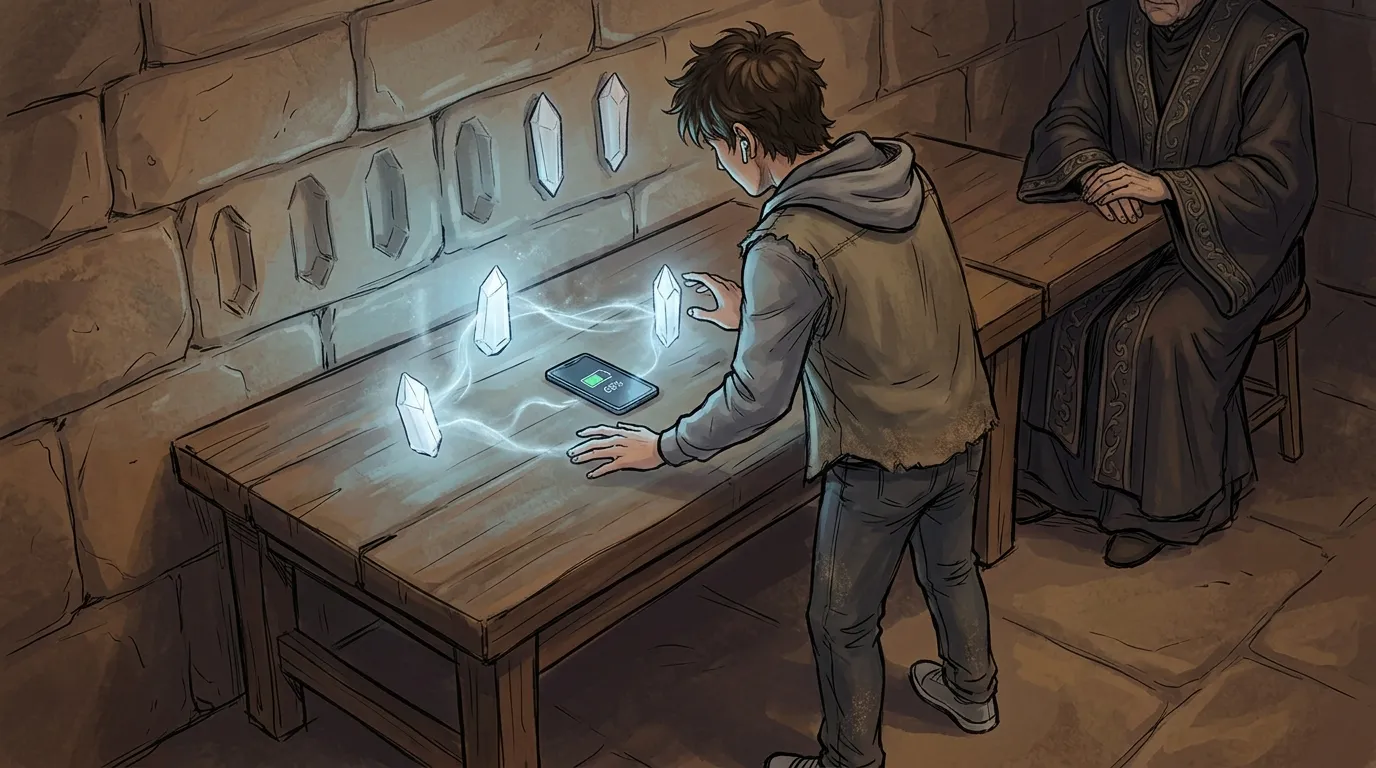
I reached out and picked up the white spirit crystal. At that same moment I happened to set my phone on the table as well, and in the instant the two objects came close together —
The battery icon on the screen flickered.
Just once. Very slight. Like a signal catching a momentary interference.
I looked down at the screen, then at the crystal in my hand, then at the screen again.
“Jing-Jing,” I said quietly. “Did you just—”
“Battery data unstable. Possible external electromagnetic field interference.”
I brought the white spirit crystal a little closer to the phone. The icon flickered again.
Very slowly, I pressed the white spirit crystal flat against the back of the phone.
The icon held at 8%. Then, very gradually, it began to climb —
8%.
9%.
10%.
I sat there staring at the screen without saying anything.
Peng Xun watched from across the table, that same warm smile on his face — with something added to it now. When I thought about it later, what he’d added was probably a blend of this outsider genuinely has no idea what a spirit crystal is and this outsider’s reaction is more… interesting than I expected.
“Jing-Jing,” I said. “We might actually be okay.”
“Current battery: 10%. Within statistical error range. Causal relationship cannot be confirmed.”
“Could you not let me have five seconds of joy?”
Peng Xun said three white spirit crystals used together would be more efficient.
I had no idea how he was interpreting any of this — he was a sorcerer, he’d spent sixty-odd years in a world where spirit crystals were used for light, heat, and carrying messages, and he surely had his own framework for what he was seeing. Maybe he understood the phone as some kind of external-world spiritual energy container. Maybe he was watching my reactions and looking for a pattern he could map onto something he already knew.
But he didn’t ask more questions. He took two more white spirit crystals from a wooden compartment beside the worktable and arranged all three around the phone, positioning them carefully, the way you’d set up a small ritual.
A low vibration came up through the floor, stronger than before. The sweetness in the air deepened, settling in my throat and making it faintly dry. All three white spirit crystals produced a sound together — not audible exactly, more like a frequency, something that moved from my palms up into my bones. The phone trembled very slightly on the table.
Then the numbers started moving.
10% → 14% → 19% → 25% → 31% → 35%.
The process took much longer than I’d imagined. I don’t know how long I sat there — Peng Xun went through two pots of tea, turned away someone who knocked at the door partway through. The number finally stopped at 35%.
I looked at that 35% for about half a minute without speaking.
Peng Xun watched from across the table, saying nothing. Whether he was waiting to see my reaction or giving me time to absorb what had just happened, I couldn’t tell. But the silence carried a kind of settled weight — like both of us needed a moment for it to land.
I exhaled slowly and picked up the phone.
“Jing-Jing,” I said. “What’s the battery at?”
“Current battery: 35%. Performance restored to normal.” A brief pause. “Do you have anything you’d like to query?”
I thought about it: how many questions had been sitting in backlog. I wanted to know what white spirit crystals were, how the whole spirit energy system worked, whether there was anything like a map of this world, what the “Oracle” meant as a legend in this society, what Peng Xun’s status was and what was behind the way he’d been looking at me.
Forty Tier C questions flooded out of storage all at once, shoving each other to get in line.
I was probably at about eight out of ten on the excitement scale. I raised the phone and started asking.
When Jing-Jing’s first answer came back, there was a strange pause in the middle of it.
“Based on current environmental analysis… er… based on… the stars indicate— I apologize. What was I just saying?”
I stopped. ”…What stars?”
“My response log shows ‘Based on current environmental analysis.’ This appears to be an output anomaly caused by a data conflict. Re-querying is recommended.”
I stared at the screen and frowned.
Peng Xun was watching from across the table, that warm smile unchanged — though with something unnameable added to it now. Curiosity, maybe, or something else. He said something. Jing-Jing translated: “Has the Oracle’s sacred instrument spoken?”
“It’s confirming something,” I said, letting Jing-Jing translate. “Everything is fine.”
Peng Xun gave a small nod. That nod had a very polite quality of I don’t think that’s true, but I won’t say so, and it left me briefly without words. I wasn’t entirely sure, in that conversation, who exactly was being assessed.
That night I slept better than any night since I’d arrived.
Phone at 35%, Jing-Jing (almost) fully operational, plenty of questions to ask tomorrow. I lay on the wooden bed and mentally re-sorted my backlogged questions from Tier A to Tier B, feeling like someone who’d just reinstalled an app that had been unavailable for months and found out everything still worked.
I barely gave the strange pause a second thought.
AIs glitch sometimes. That’s normal, right?
Based on current environmental analysis. The phrase drifted through my mind once, then sank, and I didn’t fish it back up.
Before I fell asleep, that 35% gave me more peace of mind than any night in the past two weeks. I didn’t think about the strange pause again. There were a lot of things to ask tomorrow.