Chapter 3
No Such Thing as a Free Lunch
Chapter 3: No Such Thing as a Free Lunch
The morning after a recharge, I was a college student with his first credit card.
“Jing-Jing, what are the main crops in Luyuan Village?”
“Jing-Jing, what’s the water quality in Qinwu Creek? Can you drink it straight?”
“Jing-Jing, does this world have anything like infectious disease?”
“Jing-Jing, what did Peng Xun mean yesterday when he said ‘spirit vein’?”
Questions poured out of me and I couldn’t stop. I was an engineer who’d been cut off from the internet for two weeks and finally got Wi-Fi back — push all the updates first, worry about everything else later. Jing-Jing answered them one by one, steady voice, accuracy rate wildly better than last week. When I asked “what’s the climate pattern like here,” she didn’t just answer — she volunteered the evaporation rate of Qinwu Creek and its effect on local rainfall, then went on to offer two possible seasonal wind shift scenarios.
I blinked.
Last week’s Jing-Jing: answer half a question, then say “insufficient data, unable to assess.” Today’s version — what was this?
I didn’t dig into it. I kept asking.
By midday I was swinging for bigger questions. “Jing-Jing, based on what you can observe so far, what’s the probable political structure here?”
Jing-Jing ran a detailed analysis: “Based on village size, observed social division of labor, and the honorific structures of the common tongue, this area likely operates under a feudal land-ownership model, with a lord or equivalent figure responsible for regional governance and a village chief managing daily affairs at the local level…”
About two minutes of this. Cost: 0.4%.
“What kind of person is the village chief, Dong Heng?”
“Insufficient data for individual personality analysis.”
I stared at the screen. “So that whole two-minute breakdown was useless?”
“Structural analysis and individual personality analysis are different orders of problem,” Jing-Jing replied, tone carrying not even a trace of apology. “The former can be extrapolated from sociological models. The latter requires sufficient behavioral samples.”
”…Okay. You’re right.”
By afternoon, I was past forty questions.
One of them I later had to admit was a Tier C question.
It was around three in the afternoon. I was wandering near the village square when I saw Peng Xun’s daughter — Zhou You — coming from a distance, holding some kind of mineral sample, head down, walking with clear purpose. I thought about it for a moment, then asked anyway.
“Jing-Jing… do you think that sorcerer’s daughter has any interest in me?”
A 0.3-second silence.
“You are requesting an interpersonal emotional assessment,” Jing-Jing said, voice without any register at all. “Query accuracy for this type of request is 12 to 34 percent, and it falls outside my core functional scope. Based on social behavior research, repeated queries of this type may indicate social anxiety in the individual making them.”
I kept my eyes fixed on Zhou You in the distance for a moment.
”…Thank you, I’m very healthy, next question.”
“Of course. What is your question?”
“Never mind. Forget it.”
Zhou You stopped within my field of vision, crouched down, picked up a stone from the ground, turned it over, put it back. When she stood, her gaze swept in my direction — very briefly, briefly enough that I couldn’t tell whether she was looking at me or at something behind me. Then she kept walking.
I reclassified her behavior as “field research into the Oracle” and deleted that Tier C question from my head entirely.
About ten seconds later, I asked Jing-Jing: “That plant distribution question — you were just saying, along the banks of Qinwu Creek, the shrubs…”
I knew, while I was saying it, that the question had nothing to do with Zhou You. But it was definitely not a Tier C question.
I did eventually admit to all of this. But that came much later.
The most welcome surprise was the translation.
Sometime since this morning — I couldn’t pinpoint when — talking to the villagers had gotten noticeably smoother. That feeling from last week of needing to stitch a single sentence together three times in my head before it made sense was gone. Jing-Jing’s translation felt like a new version: precise in a way I wasn’t used to. When I asked Peng Bao “is there anything I should know about today,” he said something, and Jing-Jing’s translation carried even the weight of his tone correctly.
I asked Jing-Jing why.
“The semantic database has completed preliminary localization calibration,” she said. “Current translation accuracy: 92%.”
“What was it yesterday?”
“68%.”
”…That’s a pretty big jump.”
“It is.”
“Why such a sudden spike?”
A brief pause.
“A natural result of the database update completing,” she said. “Continued use is recommended to maintain calibration accuracy.”
I nodded and didn’t push further. Users don’t need to understand all the backend logic — results are what count. Five years of UX work had drilled that into me. You don’t explain the server architecture to every user. You let the interface speak.
Translation got better. Keep using it.
The second recharge happened around five in the afternoon, when the battery hit 18%.
I felt a little guilty about it — forty-something questions plus a full day of translation, burning faster than I’d expected. I went to find Peng Xun. He was in his stone workshop, grinding some kind of mineral powder with a thin copper rod. When he saw me come in, his eyes flicked to the battery indicator on my phone screen without a word.
“Can I charge again?” I asked.
“Cyan spirit crystal,” he said. “A bit more expensive than the white one from yesterday.”
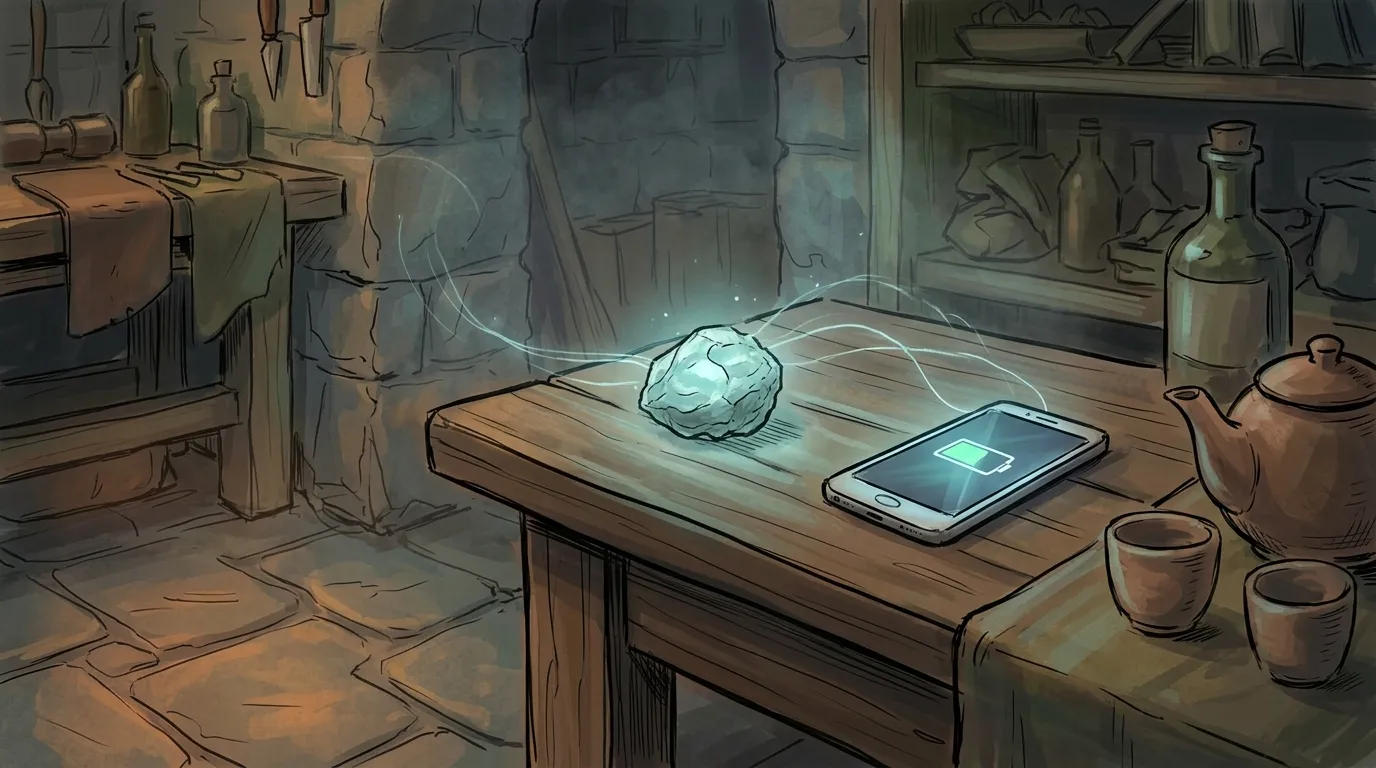
He took it down from a shelf — slightly larger than the white spirit crystal, a pale blue-green, the kind of color you’d see in a rare mineral cross-section catching the light at the right angle. He set it on the worktable and gestured for me to put the phone down.
It charged faster than yesterday. The white spirit crystal had taken Peng Xun two full pots of tea to move the battery from 8% to 35%; the cyan one jumped it to 42% in twenty minutes. When it finished, that familiar sweetness in the air had become something stronger — like someone had poured honey into the cracks between the stones.
I looked at the number on screen, feeling complicated about it. Effective — but the cost per charge kept going up.
“Thank you,” I said, putting my coins on the table.
Peng Xun took them without counting the change, or explaining what the difference was. He picked up the copper rod and resumed grinding, not looking at me.
“That cyan one,” I said, “is it a higher grade of spirit crystal?”
“Sorcerer apprentice training material,” he said. “Not common on the market.”
“Where does yours come from?”
He looked directly at me for the first time.
“My inventory,” he said. “Don’t ask too much.”
I let it go, thanked him, and walked out.
After the door closed behind me, I noticed a faint blue-green tinge along the edge of the phone’s heat vent — like a residue of pigment. I rubbed at it with my thumb. It didn’t come off.
Probably crystal dust, I thought. Normal.
Post-charge Jing-Jing was a little off. But not that far off.
I got back to my lodging to find a villager already waiting at the door — a young man, expression uncertain, clutching a cloth in his hands. He said his younger brother had been running a fever since last night, and could the Oracle help.
“Jing-Jing, mild fever, no other obvious symptoms — how should I handle it?”
“It is recommended to increase fluid intake, rest, and maintain stable body temperature. If temperature exceeds 38.5°C —”
She paused.
”— according to current… er, according to ancient… water-aligned magical replenishment can assist in regulating…”
She paused again.
“I apologize. Data conflict. Increasing fluid intake is the recommendation.”
I stared at the screen. “Did you just say ‘magical’?”
“My response log shows ‘Increasing fluid intake is the recommendation.’”
”…Are you sure?”
“Certain.” A brief pause. “Add a little salt.”
“I already knew that without you telling me.”
I turned to the young man and walked him through the standard fever protocol — keep the fluids coming, use a damp cloth to bring the temperature down, let the patient lie flat and rest. He nodded and thanked me repeatedly, then hurried off.
I sat down on the doorstep and ran back through what had just happened.
Water-aligned magical replenishment.
Last time it was “the stars indicate.” The gap between the two pauses was shorter than I’d expected.
I didn’t have much time to sit with this, because I found a strange stone at the side of the road — fine-grained surface pattern, looked almost carved but maybe wasn’t — and asked Jing-Jing about it on impulse.
“Mineral composition: quartz, feldspar, trace… spirit vein sediment…”
She stopped.
“I apologize. The final item was a database error. That should read trace iron oxide.”
“Spirit vein sediment,” I repeated.
“Corrected to trace iron oxide.”
I dropped the stone back where I’d found it. Jing-Jing’s pattern was becoming clear — normal output first, then one word would suddenly slide off into territory that wasn’t hers, and she’d catch it herself and pull back. Like an interpreter who’d accidentally switched languages mid-sentence and immediately corrected.
Only the time it took her to correct seemed to be getting longer.
That evening there was a problem, and it was a real one.
On the western edge of the village, someone had been bitten — unknown animal, wound on the lower leg, already swelling and discoloring. The village herbalist was out of the village and couldn’t be reached quickly. Peng Bao found me while I was organizing my question list at my lodging; he spoke fast, but the upshot was clear: Oracle, someone needs you.
My first reaction was panic. My second was to ask Jing-Jing.
“Jing-Jing, unknown animal bite, wound swelling and discoloring, possible poisoning — what do I do now?”
“It is recommended to immediately flush the wound with clean water for at least ten minutes. Immobilize the affected limb and keep it below the level of the heart. Monitor vital signs — respiratory rate, heart rate, level of consciousness. Avoid squeezing or cutting the wound —”
She paused.
”— and it is also recommended to draw a clockwise circle around the wound and repeat the patient’s name three times in a low voice, to stabilize the spiritual consciousness field.”
I stood there.
”…What is a spiritual consciousness field.”
“That appears to be anomalous output caused by a data conflict. Please disregard the final recommendation.”
“Right, right, fine, I’ve got the first part.”
I followed Peng Bao at a run.
The patient was a middle-aged man, looking pale, the wound on his leg already swollen, the skin around the edges going purple. I got people to bring clean water and started working through the protocol Jing-Jing had given me — flush, immobilize, observe. I did not draw a circle. I did not say his name three times. I told the people around him to keep him conscious, keep him talking, then stepped back and waited.
About half an hour later, the village herbalist got back. She looked at the wound, said a few things; Jing-Jing translated: “Your handling wasn’t bad. The venom didn’t spread.”
The man didn’t die.
I crouched there and let my pulse come back down, then spoke to Jing-Jing.
“You realize you almost had me performing a ritual on a poisoning victim.”
“My recommendation included standard medical protocol,” she said. “The spiritual consciousness field item has been flagged as invalid output.”
“Flagging is for you — you said it out loud and I heard it too! The flag is meaningless to me!”
“I will make every effort to reduce the frequency of invalid output.”
“Thank you.”
A pause.
“Based on estimated magical fluctuation frequency, the next— I apologize. Data conflict.”
”…Right. Okay. We’re fine.”
I stood up. My knees ached a little. Jing-Jing’s pattern had held — normal output, then a slip, then a correction. But this “spiritual consciousness field” was longer and more complete than the earlier “water-aligned magical” or “spirit vein sediment,” and the time it took her to correct herself afterward was longer too.
The hangover was deepening.
Back at my lodging, I opened my notes app and created a new document. Title: Magification Log.
I typed in every anomalous output I could remember from today, with timestamps, battery level at the time, and what situation had triggered it.
When I’d finished organizing it, I noticed a pattern: almost all of the anomalies had occurred within the first two hours after charging, and after the two-hour mark her output had basically returned to normal.
Fever protocol: “water-aligned magical replenishment” (25 minutes post-charge).
Mineral analysis: “spirit vein sediment” (40 minutes post-charge).
Bite treatment: “spiritual consciousness field” (55 minutes post-charge).
I stared at the list for a while, then wrote at the bottom:
Magification frequency peaks in the first two hours after charging, then subsides. Like… getting drunk and then sobering up. My AI has a hangover.
I looked at that sentence and felt like the metaphor was too accurate for comfort.
Then I looked at the battery: 42%. The recharge had worked. The cost was apparently that Jing-Jing would glitch for a few hours every time. Two hours of hangover for two weeks of battery life — that tradeoff was acceptable.
I closed the notes app and got ready for sleep.
“Jing-Jing, are you normal right now?”
“My output systems are operating normally,” she said. “No current data conflict on record.”
“Good. Then tomorrow we pick up where we left off. I’ve still got over twenty Tier A questions.”
“Logged. Is there anything else you need?”
I thought about it.
“No. Goodnight.”
“Goodnight. Get some rest.”
I flipped back through the Magification Log before I closed it. Last entry was today. Three drifts, all within an hour of charging. I added one more line at the end: Under observation. Not yet impacting usability.
Then I closed the notes app.
Over the next two weeks, I charged three more times.
Jing-Jing’s magification cycles kept getting shorter — from “back to normal after two hours” to “roughly four hours,” then to “something’s a bit off all day.”
But she still worked.
I kept telling myself: still works, that’s enough.