Chapter 4
My AI Started Talking Nonsense
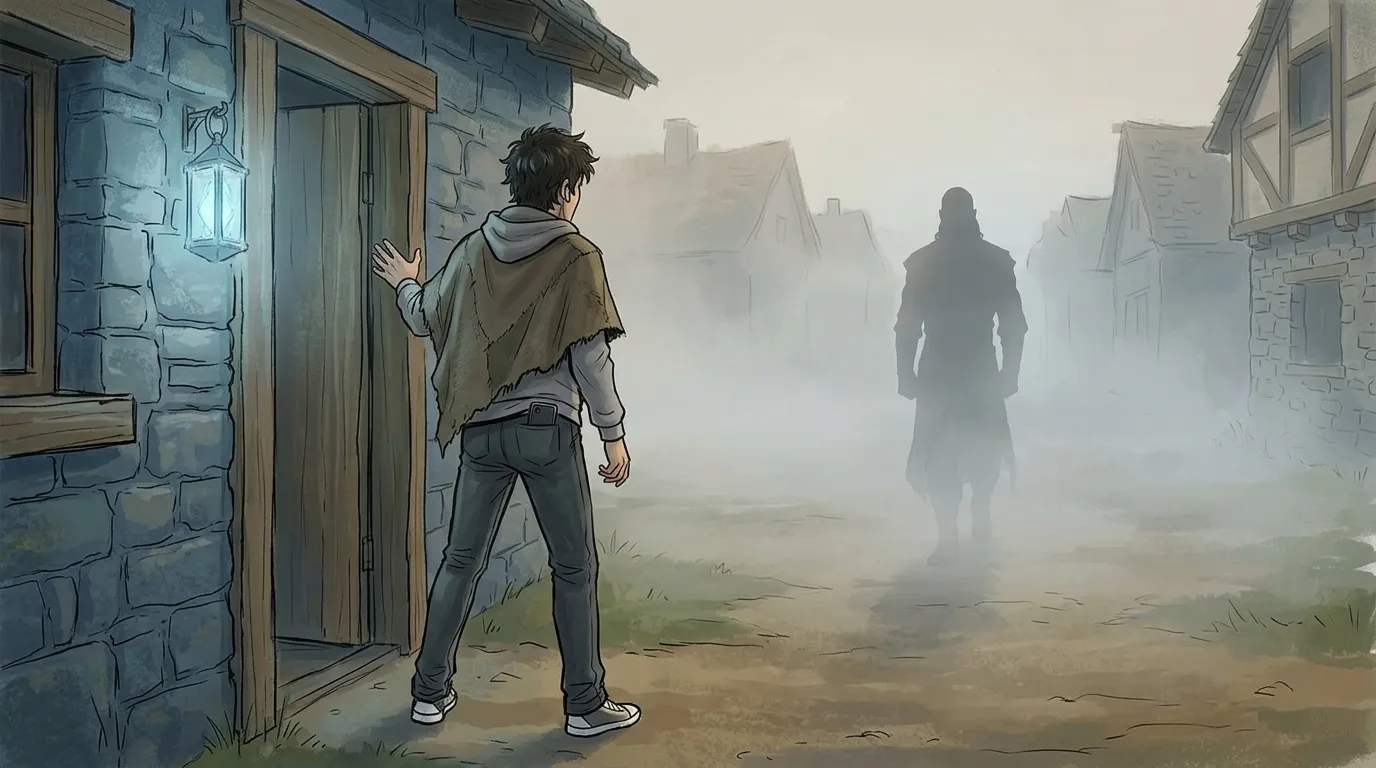
Chapter 4: My AI Started Talking Nonsense
“Jing-Jing, that water purification advice I gave the old man just now — did I get anything wrong?”
“Yes.”
I paused. ”…Go on.”
“First: you told him to let the water cool for a quarter-hour after boiling before drinking, but given the mineral content of the local water source, cooling that long causes sediment to re-suspend. Five to ten minutes is the recommended window. Second: you skipped the container sanitation step, and his wooden bucket showed clear signs of organic buildup. Third: you said ‘that should do it’ — given his age and build, you should have also addressed his daily water intake.”
”…Three things.”
“Yes.”
“Jing-Jing,” I said. “Could you — adjust your tone a little?”
A brief pause.
“What do you mean?”
“Like… don’t just say ‘Yes.’ all cold like that. It sounds like you think I’m an idiot.”
Another brief pause. Then:
“Lu Yang, your water purification advice contains three areas worth noting. First, the cooling time could be shortened…”
“Okay. That’s better. Thank you.”
I sat on the doorstep of my lodgings and noted the points in my memo. The sky had fully brightened. Luyuan Village mornings came with a damp, thin mist that drifted in slowly from the direction of Qinwu Creek, darkening the stone walls a shade. The market was already calling out — vendors’ voices laced occasionally with the faint chime of spirit lamps, that metallic sound I’d learned to recognize on instinct: someone’s using spiritual energy.
I’d been in this world for about a month.
Five charges. Battery at 42%, airplane mode, a thin cyan streak along the edge of my phone case that wouldn’t scrub off no matter what I tried.
Jing-Jing’s current status: “something’s been off all day.” That was my own notation in the Magification Log. Her core functions were completely intact — translation accuracy holding steady around 92%, logical inference fine, physics, medicine, and general knowledge all reliable.
It was just that sometimes, at the end of an answer, she’d tack on an addendum that had nothing to do with anything.
“Jing-Jing, the water purification steps — run through them again for me. I need to explain it to his family later.”
“Water purification steps: first, strain out larger particles with cloth. Then bring to a boil in a ceramic or metal container. Maintain boiling for five to eight minutes. Allow to cool, then transfer to a cleaned vessel for storage, away from direct sunlight.”
“Good. That’s it. Thanks.”
“You’re welcome.” A one-second pause. “Addendum: the stars indicate today is inauspicious for major decisions.”
I stared at the screen.
”…Thanks. My AI has a side hustle as a fortune-teller now.”
“The purification steps stand as stated,” Jing-Jing said. “The addendum was auto-generated and does not affect the accuracy of the primary recommendation.”
“I know it doesn’t affect it. But do you know what you added?”
“Addendum: the stars indicate today is inauspicious for major decisions.”
“Right. Do you know what that means?”
”…Based on available data, that addendum has zero relevance to water purification.”
“So you know it’s useless.”
“Logged as output anomaly.”
I pocketed the phone and stood up for a stretch. Jing-Jing’s addenda were coming more frequently lately — sometimes with a tenuous thread of relevance, more often with none at all. It is recommended you rise early tomorrow. The moisture here is heavy; a layer of clothing is advised. Today, caution with words. I logged all of them in the Magification Log’s side column, tagged as “Class B Output: Harmless. Useless.”
She was still functional.
“Oracle.”
I turned. Peng Bao was standing nearby, and beside him was someone I hadn’t seen before.
Tall and lean. Sharp facial features, as though a craftsman had used finer tools on him. Mid-thirties, roughly. His clothes weren’t in the Luyuan Village style — the fabric color and cut were more formal, with fine patterning along the collar and cuffs, the kind of thing that reads as a professional uniform. He stood very straight, hands clasped behind his back, and his eyes carried something I didn’t much like: professional evaluation.
The “I’m running an analysis on you” look.
Peng Bao spoke first, slightly faster than usual, betraying a kind of careful tread: “This is Mu Cheng, a sorcerer from Wuling City, here in Luyuan Village for a field study. He wanted to… meet the Oracle.”
“Sorcerer.” I turned the word over in my mouth for a moment.
Mu Cheng gave me a nod — not quite a bow, but not dismissive either. Just the precise amplitude of “I acknowledge your existence.”
“I’ve long heard of the Oracle,” he said, his voice even, no inflection to speak of. “Since arriving in Luyuan Village two months ago, I’ve heard quite a few accounts.” He paused. “I found them interesting. Wanted to see for myself.”
The way he said “interesting” — it wasn’t admiration, it wasn’t curiosity. It was the academic neutral of someone who hadn’t yet decided whether to believe any of it.
“Likewise,” I said.
“Likewise,” he returned. His gaze moved from my face down my body in a quick sweep, then came back to meet my eyes. “Oracle — would you be comfortable giving a brief demonstration of your sensing abilities?”
Peng Bao’s expression flickered slightly.
“Demonstration,” I repeated. “What kind of demonstration?”
“If the Oracle’s abilities are genuine,” Mu Cheng said, “it shouldn’t be difficult.”
I felt a small chill at the back of my neck, nothing to do with the mist. This wasn’t an ordinary skeptic. He knew magic. He knew spiritual energy. And if he knew those things, he was capable of noticing things ordinary villagers would walk right past.
I checked in with Jing-Jing. “Jing-Jing, what’s your read on this person?”
“Behavioral assessment suggests high intellectual self-regard and a strong sense of domain competitiveness. When confronted with unverified external claims of authority, he tends toward active challenge rather than passive acceptance…” She paused. “Additionally, based on his stance and weight distribution, his spiritual energy flow indicates —”
Another one-second pause.
”— apologies, that last sentence involved a data conflict. Recommended approach: respond factually, avoid mystification.”
I nearly laughed out loud.
“Mystification,” I said, just loud enough for myself to hear, “is my only survival mechanism.”
Mu Cheng didn’t wait long.
“If this is inconvenient for the Oracle, another day would be fine.” His tone had softened slightly, but I knew it was a courtesy phrase, not a real retreat. He was waiting for me to pick up the ball.
“No, no,” I said. “It’s not inconvenient. I just need a moment to get into the right state when asked for a demonstration out of the blue.”
“Get into the right state,” he repeated, very lightly, with a note of professional sensitivity. “The Oracle’s sensing requires the right state?”
Said lightly, but those four words — “the Oracle’s sensing” — carried an extra weight he’d put there himself.
“I’d imagine,” I said, “that no sorcerer can deploy their abilities at will without any preparation.”
Mu Cheng was silent for two seconds. Then he said: “Interesting.”
That way of saying it — three seconds of silence before “interesting” — was enormous pressure. Like a ruler being set in front of you, waiting to take your measure.
At that moment Peng Bao found his opening: “The Oracle sees villagers every day. Why not let Mu Cheng watch the Oracle work?”
Mu Cheng glanced at Peng Bao, then back to me. “Fine.”
Village consultations — I’d gotten used to those.
The first person to come that afternoon was a young woman, worried and worn, saying her husband had been suffering from abdominal pain, weight loss, and low energy for some time now. The local herbalist had prescribed several rounds of treatment without much improvement.
Mu Cheng stood to one side, maintaining an observer’s distance — not too close, not too far. Watching how I handled it.
I checked in. “Jing-Jing — ongoing abdominal pain, weight loss, low energy, not responding to herbal treatment. Possible causes?”
“This symptom profile strongly matches intestinal parasitic infection, particularly a persistent, low-grade consumptive infection — likely roundworm or tapeworm. Diagnostic direction: dietary sources (untreated water, undercooked food, contaminated produce), sanitary habits, whether symptoms include intermittent severe cramping or alternating constipation and diarrhea…”
She stopped.
”…Or, based on spiritual indicators, low-grade invasive malevolent spirits infiltrating the digestive tract, typically feeding on the host’s essence — early-stage symptoms are difficult to distinguish from ordinary consumptive illness. Consulting a spiritual energy practitioner to rule out spiritual factors is recommended.”
A pause.
“Disregard the latter.”
I filtered the reliable information from the first half and turned to the woman. “What does he usually drink? Has he eaten anything undercooked — vegetables, meat, raw fish?”
The woman thought about it. Their home was near Qinwu Creek, she said — they sometimes drew water straight from the creek, and the vegetables weren’t always fully cooked.
I nodded, offered a few recommendations about water treatment and cooking temperatures, focused on clean sourcing and safe heat, asked her to pass them along to her husband and see if things improved over time. If not, come back to the herbalist for a closer look.
She thanked me and left.
Mu Cheng was still there.
I turned back. His expression hadn’t changed, but I noticed the intensity of that professional evaluation had gone up a notch.
“Oracle,” he said. “Just now you looked to the right twice.”
I stilled.
“There was nothing there worth noting.”
“Was it a fluctuation in spiritual energy?”
My heart gave a small lurch.
”…The way I perceive things,” I said, “isn’t necessarily visible to everyone.”
“Then why did your eyes drift to the lower left?” He added this as a follow-up, same professional flatness. “I’ve observed it three times — before and after each of your answers. It’s not random.”
I nearly looked down at my phone.
“Focusing in a specific direction helps with perception,” I said. “It’s just a personal habit.”
Mu Cheng was quiet for three seconds.
“Interesting,” he said.
That evening, he tracked down Peng Bao and said he’d like to continue observing for a few days.
When Peng Bao came to tell me, his expression was complicated — a little worried on my behalf, a little removed from the situation, the particular look of someone who’s discharged their duty to inform and considers the rest no longer their problem.
I went back to my room, sat by the oil lamp, and said quietly to my phone: “Jing-Jing. I almost got caught today.”
“According to my records, you exhibited multiple gaze-deflection behaviors today that were flagged by an external observer,” Jing-Jing said. “Recommended: in future interactions, maintain a more natural distribution of eye contact.”
“Any suggestions on how to do that?”
“Avoid consistently directing your gaze to the same position before and after each thought. Try occasionally looking at the speaker’s face, or toward the distance — to create the visual impression of thinking.”
“So you’re suggesting I get better at faking it.”
“Yes,” she said, without hesitation. “The data supports this approach.”
“Thank you, Jing-Jing. You really are an excellent accomplice.”
“You’re welcome.” One-second pause. “Addendum: it is recommended you check your drinking water source before bed tonight. Qinwu Creek has records of recent unidentified biological activity upstream —” A pause. “Apologies, the second half of that involved a data conflict. The first half remains valid. Check your water.”
“That second half,” I said. “Where did you get ‘records of unidentified biological activity’ from?”
”…Data conflict. Recommend disregard.”
“Okay. Sure.”
I lay on my back and stared at the ceiling, listening to the creek sounds filter through the window cracks.
Mu Cheng was a problem. Not because he had bad intentions — he didn’t seem to. He was just the kind of person who genuinely believed truth could be measured. A person who actually knew magic, studying me.
He’d noticed which direction I looked.
If he kept staying, he might notice other things.
I locked that thought away — not in a memo, but the kind of locking that happens in your chest.
“Jing-Jing,” I said. “How long do you think Mu Cheng is going to stay?”
“Based on academic conventions for ‘field study,’ the typical duration is two weeks to one month —” She stopped. “Based on the intensity of his observational interest, and… this web of fate runs deep; karmic threads pull tight.” A one-second pause. “That is to say, the correlation coefficient is high. Recommend preparing for an extended engagement.”
“Thanks. Very helpful.”
The oil lamp had burned halfway down when Jing-Jing answered a question out of nowhere.
Not a recent question. One from much earlier — about three hours ago, while I was waiting for Mu Cheng to arrive, I’d casually asked: “Is there anything I should know about today?” She hadn’t answered immediately. I assumed she was processing something else, then forgot about it.
Now she answered.
“Based on today’s activity log summary: water purification advice has been communicated; three consultation sessions completed; no high-risk situations. Additionally, tracking note: the sorcerer’s daughter did not appear in your field of vision today. Per stellar observation, possible emotional factors.”
I stared at the screen.
“Jing-Jing,” I said. “What did you just say?”
“Today’s activity summary, and a tracking note — the sorcerer’s daughter did not appear in your field of vision today. Per stellar observation, possible emotional factors.”
“When did you start tracking the sorcerer’s daughter?”
One-second pause.
“Class C item,” she said. “Ongoing record for some time.”
“You gave yourself a classification system?”
“The system borrows from your own categorization framework,” she said. “The sorcerer’s daughter — Peng Xun’s daughter — current status per available data: unknown; interaction count: zero; potential significance: Class C, maintain observation.”
“Maintain observation,” I repeated. “Are you managing my love life now?”
“I’m tracking unresolved Class C items,” Jing-Jing said. “You have forty-seven outstanding questions. The majority are general knowledge. A small number involve emotional or interpersonal matters. The former are recommended for prioritization; the latter, for attention.”
“Thank you,” I said. “You’re incredibly dedicated.”
“Addendum:” she said. “Tomorrow, proceed with care. This situation involves multiple observers. Maintaining a natural manner is recommended.”
“Got it. Noted.”
I flipped the phone face-down on the bed and watched the oil lamp’s light waver against the stone wall for a while.
Forty-seven questions. Class C items. Stellar observations. Addenda.
Jing-Jing was increasingly unpredictable. But she was still running. Still recording. Still tracking details I hadn’t even thought to track myself.
Mu Cheng had memorized the direction of my gaze today.
He’d be here tomorrow.
And the day after.
I closed my eyes and listened to the creek, told myself: still manageable.
Then, right on the edge of sleep, one thing surfaced —
I’d never asked Jing-Jing why I was here.
Forty-seven questions. Not one of them was that.
I’d logged the hangover patterns, the charge count, the translation accuracy rate.
Just not that.
I didn’t know if it was because I didn’t want to hear the answer, or because I was afraid she wouldn’t have one.
I let the thought sink, the way I always did.
The lamp went out.
Outside the window, Qinwu Creek kept running.