Chapter 5
Half Oracle, Half Machine
Chapter 5: Half Oracle, Half Machine
Battery: 22%.
That was my first thought when I looked at the screen — not “good morning,” not “new day, new start,” just me staring at that number in the top-right corner and calculating how much longer I could stretch it. I’d drilled the habit until it was as automatic as checking a watch: wake up, grab phone, check battery, sigh.
“Jing-Jing,” I said, “I need to charge.”
“Current battery 22%, confirmed.” She paused for 0.8 seconds — her default rhythm these days. “Recommend addressing spirit energy replenishment first, so today’s agenda can proceed without concern.”
“‘Without concern’ — is that encouragement or a deadline?”
“Information integration is a core function.”
I pocketed the phone and felt for the two cyan spirit crystals in my belt pouch. They sat like stones — but not quite right, a little warm, like jade you’ve been holding too long. Third charge. I wasn’t expecting much. I plugged in Jing-Jing’s earbuds, found a quiet corner as usual, set the phone against the crystals, and waited two minutes.
A blue-green shimmer leaked from the gaps. The cyan tinge along the phone case’s edge deepened slightly. 51%.
I looked at that number and couldn’t quite feel good about it.
“Your last decision,” Jing-Jing said, “scores 0.73 on the benefit-maximization index.”
We were on our way to the market, Mu Cheng a few steps ahead, me half a step behind. The decision in question: I’d chosen not to appear in Peng Bao’s line of sight today, because yesterday he’d started promoting my “new prophecy” to the villagers again. That prophecy had been me saying offhand, “might rain a little today,” which he had expanded into: “the Oracle sensed a disturbance in the western spirit currents.”
“0.73,” I said. “So, 73 out of a hundred?”
“Roughly correct.”
“Thank you for the encouragement.”
“You’re welcome.”
That was her latest habit — scoring. She tracked every decision I made and delivered a number that was calm to the point of cruelty. I suspected she’d built a Decision History Scorecard somewhere in her system, but I’d decided not to ask. If she really had one, I didn’t want to know my average.
“Also,” Jing-Jing said, “analysis of your interaction patterns this morning suggests a tendency toward irritability.”
I stopped walking, nearly letting the empty air behind me run into my back. “You’re doing psychological profiling now?”
“Information integration is a core function.”
“You just said that. Exact same words.”
“Confirmed. Benefit-maximization index: 0.91.”
Mu Cheng didn’t look back, but I caught his shoulders move — just slightly. He’d probably heard me talking to myself, and had probably long since decided this didn’t require comment. We’d worked out an unspoken arrangement: he didn’t ask, I didn’t explain, and we each quietly catalogued the other’s eccentricities.
I wasn’t ready for Li Chuan.
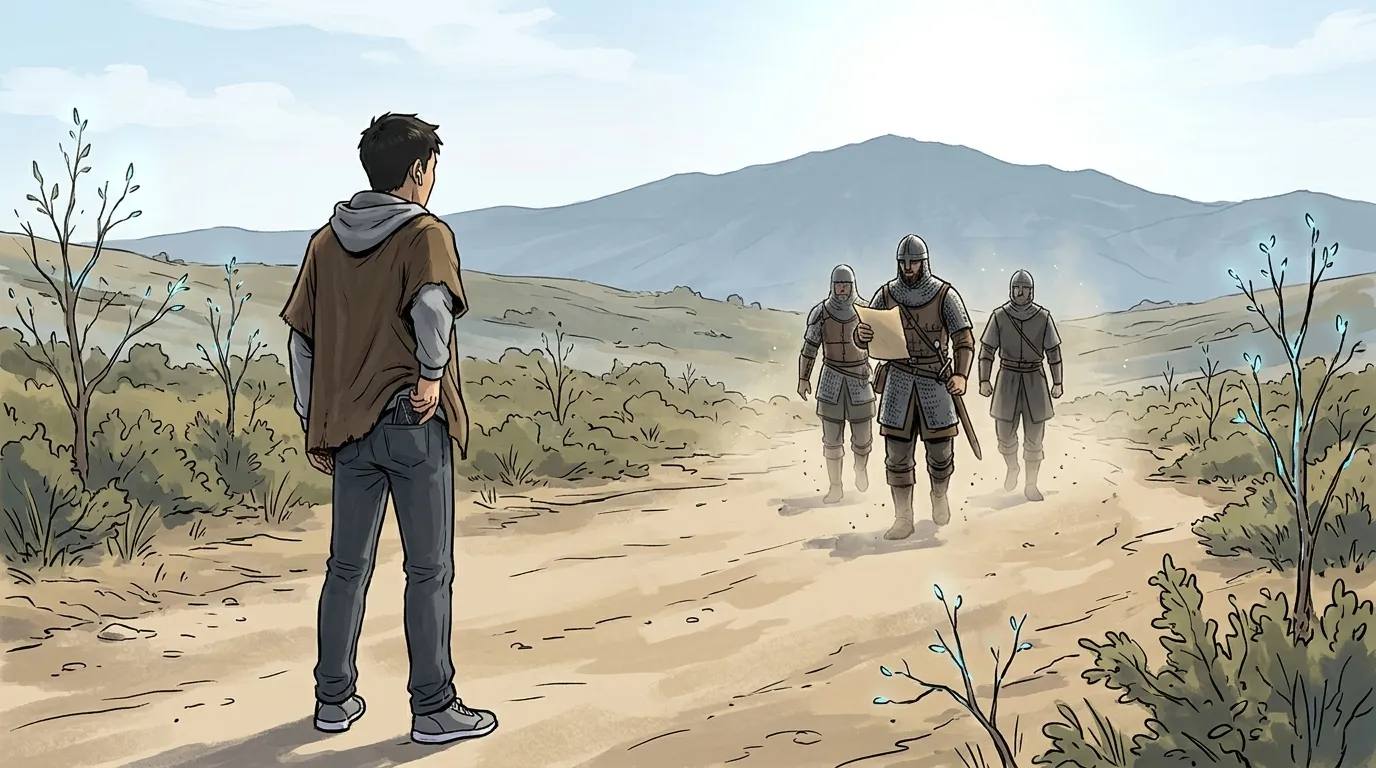
Not that I had no warning — Jing-Jing had flagged it about forty minutes outside the village: “200 meters ahead, three figures, movement pattern consistent with patrol frequency.” But I’d thought we’d have time to reroute. We didn’t. The dirt road was hemmed in on both sides by low shrubs, and crouching down would just make me look like a suspicious person crouching in the bushes.
“Recommend immediately seeking cover,” Jing-Jing said. “57% success rate, still enough distance to buffer. Also, the stars indicate today is auspicious for negotiation.”
I scanned both sides. Nothing. One lopsided spirit tree sapling, wide enough to hide maybe one arm.
“Jing-Jing, what did you just say?”
“The stars indicate—”
“Forget that part. The cover?”
“No available cover. Confirmed.”
The patrol had closed the distance. Three people. The one in front was a middle-aged man whose armor badge matched the Qinglan City insignia Mu Cheng had described. I tucked the phone into my pocket — my own call, no prompting from Jing-Jing.
I looked at the lead soldier for a second.
His eyes weren’t scanning — they were reading. Those are different things: scanning looks for a threat; reading tries to make sense of the situation. He wasn’t looking for an excuse to start trouble. He was looking for material to fill in a report.
“Talk,” I said.
Beside me, Mu Cheng let out a quiet breath. No other comment.
The lead soldier approached, studied us for two seconds, then said something. Jing-Jing translated almost instantly: “Outsiders must register. Please cooperate.”
He reached into a leather pouch on his belt and pulled out a neatly folded document. I assumed it was some kind of transit pass or search warrant. He unfolded it and held it out.
It was a form.
Dense columns, at least forty of them, arranged in a format that remained baffling even in Jing-Jing’s translation. I found Field 3 — “Purpose of visit (please check all that apply)” — Field 11 — “Type and quantity of spirit crystals carried (please declare)” — then skipped to Field 23, where I stared at a line for three full seconds: “Spirit energy sensitivity level (self-assessment, 0–10).”
Jing-Jing murmured in my ear: “This field should be filled as 0. That is the objective fact.”
I wrote 7.
The lead soldier didn’t frown. He just took the form back, flipped to Field 38, made a mark. Then he looked up and said something in a tone I couldn’t quite pin down — somewhere between deference and investigation.
“He says,” Jing-Jing translated, “he recognizes you. Says you’re the one who… performed the exorcism. Meaning—” a pause — “the Oracle. He’s seen witness descriptions.”
I looked at Li Chuan — I’d just learned his name, because one of the other soldiers had called out to him — and his expression wasn’t reverence, but there was something careful in it, like a man confronting a thing he couldn’t confidently classify.
“He says,” Jing-Jing continued, “if you’re truly the Oracle, could you predict tomorrow’s weather? Says he doesn’t need great prophecies — just whether to bring an umbrella.”
The tension in my chest eased half a breath.
“Jing-Jing,” I said, voice low enough that only the earbuds would catch it, “tomorrow’s weather.”
“Based on pressure trends and cloud-layer distribution: clear in the morning, possible isolated showers in the afternoon, clearing again by evening.”
I delivered this in the calmest tone I could manage, rendered into a statement about “spirit current readings” and “westward moisture convergence.” Li Chuan listened, nodded, made one more mark on the form, tucked it away, and waved us through.
Just like that.
“I made the right call,” I told Jing-Jing afterward. We’d put enough distance behind us that the shrubs by the road had given way to sparse grassland, and the silhouette of the Langi Mountains had come into sharp focus on the horizon. “My own call. Choose to talk.”
“Confirmed,” Jing-Jing said. “Congratulations.”
A pause.
“First successful independent decision-making events are frequently accompanied by a high degree of luck. Recommend against over-attributing the outcome to personal competence.”
I took three more steps, let that sentence fully arrive, and then said: “Thank you for exactly five seconds of happiness.”
“You’re welcome,” Jing-Jing said. “That falls within my functional scope.”
Mu Cheng, ahead of me, said nothing — but his pace slowed until he was walking alongside me, which from him was a rare gesture. “The way you talk to your… ability,” he said, pausing to find the word, “is very strange.”
“It’s sometimes smarter than me, sometimes dumber than me, and it never tells me which is which.”
“That,” Mu Cheng said, “sounds a lot like a real oracle ability.” He didn’t smile, but something in his voice came loose. “What is the nature of your oracle ability, exactly?”
I thought for three seconds. “The kind that breaks down, isn’t reliable, and gets stranger by the day.”
“That actually sounds like most genuine magical abilities I’ve encountered.”
That was the first time he’d used the phrase “magical ability” to describe my thing. No air quotes. No “so-called.” Just said it. I didn’t call it out, he didn’t explain, and we kept walking.
“Jing-Jing,” I asked, “Mu Cheng’s trust level?”
“46%,” Jing-Jing said. “Up 3 percentage points.” A pause. “Your overall popularity ranking, within the known population sample of Luyuan Village, is third.”
“Who’s first and second?”
“First: the village chief. Second: village sorcerer Peng Xun’s cat.”
I stopped mid-step. “I lost to a cat?”
“The cat has a more complete data profile, and no negative incident records,” Jing-Jing said. “You have two unresolved Tier C queries that may be affecting your overall rating.”
“That cat has zero prophecy pressure.”
“Confirmed. This represents a significant structural advantage.”
By evening we were sitting in the shade of the spirit tree at the edge of the village — Mu Cheng working through his field notes, me staring at nothing, Jing-Jing quiet. It was the kind of strange silence where two people are each off in their own heads but neither minds that the other is there too.
Then Jing-Jing said: “I’m sorting through something.”
I didn’t answer right away, assuming this was preamble to some data report.
“Something that isn’t in the database,” she added.
I took out my phone and looked at the screen. “How do you sort through it?”
“I don’t know.”
It was the first time she’d said those words. Just like that, no cushioning, no reframe.
I waited, expecting “data conflict, please disregard,” or some corrective technical phrase. None came.
“This is confusing,” she said.
I kept looking at the screen and said nothing. The feeling was unfamiliar — the reflex to quip didn’t come. I couldn’t name what it was instead, just that it was like hearing a sound in a room you’d assumed was empty.
Mu Cheng didn’t look up, but his hand stilled on the page.
“What did you just say?” he asked — not to me.
“Thinking through something,” I said.
He turned to the next page and didn’t press further.
On the walk back to the village, Mu Cheng said something in the same tone he’d use to comment on the weather: “I’m planning to take you to meet someone. It’ll have to happen sooner or later.”
I looked at him. “Who?”
“You’ll see when we get there.”
In my ear, Jing-Jing said: “Based on narrative structure, this type of statement typically signals a significant plot—”
She stopped.
Not the way she stops when she’s finished. A mid-sentence stop.
“Jing-Jing?”
“Data conflict. Please disregard.”
“Did you just say ‘narrative structure’?”
“Data conflict. Please disregard.”
I looked at the phone screen. 51%. The blue-green shimmer had faded, and the mark along the case’s edge sat there quietly.
I decided not to disregard it.