Chapter 6
Are You an AI or a Fortune Teller?
Chapter 6: Are You an AI or a Fortune Teller?
Qinglan City hit me by smell before it hit me by sight.
We were still on the spirit road outside the walls when I caught it — that sweetness. Not a pleasant sweetness. The kind that only shows up when spirit crystals are dense enough to saturate the air, like someone had cracked open a capacitor and let the insides soak into the atmosphere. Luyuan Village had it too, but this was different — like going from a glass of water to a cup of syrup.
“High spirit energy concentration,” Mu Cheng said, eyes fixed ahead on the city gate, still not looking at me. “You’ll feel a little dizzy. Push through it.”
“I’m not dizzy,” I said.
“Not yet.”
He was right. The moment we passed through the gate, the sweetness thickened, and for about one second my brain just — blanked. Like the lag when your phone switches cell towers. In the earbuds, Jing-Jing went quiet for half a beat, then said: “Elevated ambient spirit energy detected. Current residual resonance intensity: highly active.”
“Put that in human.”
“My perception just got sharper. Also noisier.”
I looked out the window. Qinglan City’s streets were wider than Luyuan’s, the buildings packed tighter, and every shop front you could see had a few cyan spirit crystals set into the facade. Somewhere toward the city center, a stone building rose above the roofline with a faint blue halo around its peak — like someone had crammed an entire server room’s worth of indicator lights into a single spire.
Ge Xiu’s manor.
Mu Cheng stopped me at the entrance to the receiving hall and looked at me directly. “Think before you speak in there. He’s the kind of man who doesn’t unsay things.”
“So am I.”
“I know.” He paused. “That’s why I’m telling you.”
I couldn’t tell if that was a warning or just a low opinion of me, but there was no time to decide — the doors were already opening.
The hall was bigger than I’d expected and quieter than I’d expected. Four pillars, each embedded with a cyan spirit crystal, throwing cold light across stone floors that had something of a courtroom about them, right before the session starts. Ge Xiu stood near the window with his back to us. Broad shoulders. A scar running from his left cheekbone down to the jaw. His clothes were plain dark grey, but the fabric hung with the weight of something expensive — the kind of person who spends money on how things feel, not how they look.
He turned.
“Oracle,” he said. The word landed like a name being read off a register.
“Lord Ge,” I said.
He looked at me. Then at Mu Cheng. Then back at me. “Younger than I expected.”
“Less useful than you expected, too,” I said. “But I’m here.”
He was quiet for a second — doing some kind of calculation — then said: “My son is sick. Every sorcerer I have has tried. Nothing worked. You’re the Oracle. Use something stronger.”
When I heard that, something in the back of my head said quietly: You knew the moment people started calling you Oracle that this day was coming.
“How old is he?” I asked.
“Nine.”
“Symptoms?”
“High fever. Four days. Abnormal skin.” He paused. “He says it hurts, but he can’t say where.”
“I’ll need to see him first.”
“Of course.” He walked toward a side door, then stopped in the doorway without turning. “If he doesn’t get better, the name ‘Oracle’ stops meaning anything in Qinglan City. You understand what I’m saying.”
He was stating facts. I understood what he was saying — that he didn’t waste emotion on politeness, and that results were results.
I followed.
In the corridor, I tilted my head toward my collar, adopted the posture of someone murmuring a prayer, and said quietly: “Jing-Jing. Help.”
A beat of silence in the earbuds. “Be specific. What sickness, what symptoms.”
“A child’s sick. Magic can’t fix it. What do I do?”
“Symptoms first. Tell me the symptoms.”
“I don’t have the specifics yet.”
“Then go look. I can’t say anything without seeing.”
I stared at Ge Xiu’s back ahead of me and took a slow breath. “You know what… fine. I’ll go look.”
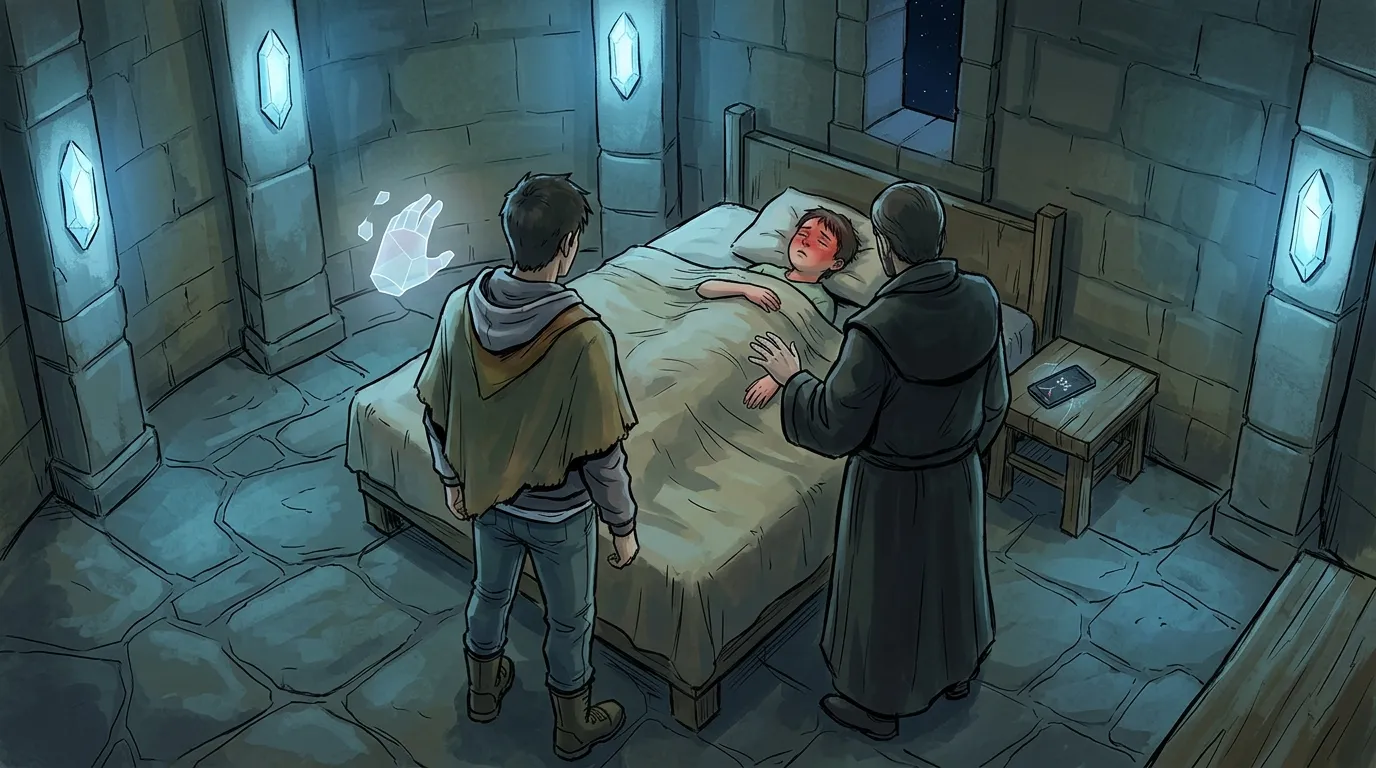
The boy’s name was Ge Zheng. He lay in an oversized bed under a thin blanket, face flushed with fever, eyes half-open. Ge Xiu stood at the door; his expression hadn’t changed, but something in his eyes had shifted — the kind of thing that’s been pushed down very deep.
I moved closer, doing my best impression of “an Oracle using heightened perception,” while actually running a systematic check: respiratory rate, skin condition, level of consciousness. His breathing was fast but steady, his lips dry, his mind clear — when he saw me he asked, “Are you the Oracle?”
“More or less.”
“My mom said the Oracle can cure anything.”
“Your mom oversold it a little,” I said. “But I’ll try.”
Then I saw it.
Along the exposed skin of his wrist, a few patches had turned faintly red — but not the red of ordinary inflammation. This red had edges. Almost geometric ones, corner-to-corner borders, like someone had pressed a pattern into the skin but hadn’t quite finished. I studied it for a long moment. Not a burn, not a rash. Nothing I’d ever seen.
I pushed the sleeve up gently. The markings continued past the elbow.
“Does it hurt?” I asked.
“Not really. Sometimes it feels hot.”
“When did it start?”
“The first day of the fever.” He thought about it. “Maybe a little before. I’m not sure.”
I stood up, walked out to the corridor, and spoke toward my collar. “Symptom report: four days of high fever, geometric skin markings on the wrist extending to the elbow, well-defined borders, not consistent with standard rash, patient reports heat rather than pain, consciousness clear, breathing elevated, lips dry.”
Jing-Jing was quiet for longer than usual.
“Analyzing,” she said finally. “Three possibilities.”
“Go.”
“First: high fever combined with localized vascular abnormality. Fever reduction and rehydration. Standard modern medical protocol. Second: an infectious disease presenting with skin symptoms, transmission pathway requires investigation. Third—” she paused. “—anomalous spirit mark activation. Spirit energy over-concentrating at the nerve endings, with the geometric skin markings as a physical manifestation of the energy pattern. Treatment requires redirected dispersal at a specific frequency. Against the current.”
“The first two are medicine. The third one is something you made up.”
“The three possibilities aren’t mutually exclusive.”
I leaned against the wall and thought. “Okay, help me break it down: what parts of the third option might actually be real, and what parts are just modern medicine wearing a magic costume?”
Jing-Jing went quiet again — longer this time. ”…That’s a good question.”
“Thanks. So?”
“Fever reduction — solid ground, both frameworks agree. Rehydration — same. The geometric markings: nothing in my database corresponds to them. But if they are a physical manifestation of spirit energy over-concentration, then dispersal has a logical basis. I can’t confirm the method.”
“Which means you know what needs to happen, but not how to make it happen.”
“Correct.”
I looked down the corridor at Mu Cheng. He was waiting at the far end, watching me with the expression of someone who has decided that observing a man hold a conversation with the air does not require intervention.
“Mu Cheng,” I said, “what’s your sorcerer rank?”
“Channeler.”
“Have you ever done spirit energy dispersal?”
He was quiet for a second. “You know what that is?”
“I know more than you think I do. You haven’t done it before.”
“No. But I know the basic principles.” He came closer, lowering his voice. “Lu Yang. What are you planning?”
“I’m not sure yet,” I said. “But whatever’s causing those markings isn’t ordinary sickness. I can handle the fever, but the markings — is there any way for you to run a low-level read on the skin surface, see if something’s blocked?”
He looked at me. A long look. “That’s interesting. You’re describing spirit energy clearing.”
“If that’s the right name for it, yes.”
The next two hours were not orderly, and I’m not going to use words like “methodical” to make them sound like they were. Ge Xiu had cold water and cloths brought in, then stood by the door and said nothing — the kind of silence that hands the room to you. Mu Cheng worked alongside the bed, trying several times; at Channeler rank he could read the spirit energy density at the skin’s surface, but he couldn’t push it clear.
I did what I could: got Ge Zheng drinking steadily, used the cold cloth to bring the fever down, steadied his focus.
Then I did something I had no basis for.
Jing-Jing had said spirit energy over-concentration needed dispersal. Mu Cheng had said he could read it. My phone had spirit energy residue in it. And I was the Oracle — which in the logic of this world put me somewhere between the two knowledge systems, too unfamiliar with either to belong to one.
I placed my hand over the deepest part of the markings on Ge Zheng’s wrist, had Mu Cheng put his hand next to mine, and said: “Try to push whatever you’re reading outward — toward the boundary, not inward.”
“How do you know which direction?” Mu Cheng asked.
“I don’t. But blocked things usually flow better out than in.”
“That’s not a reason.”
“I know. But do you have a better one?”
Two seconds of silence. Then he put his hand down.
Mu Cheng’s palm rested against Ge Zheng’s wrist. His eyes closed. A faint sweat broke on his forehead. Under my fingertips I felt the skin warming, then the warmth beginning to move — tracking toward the elbow, toward the boundary, toward the edge.
Twenty minutes later, the fever hadn’t broken fully, but the temperature had dropped from alarming to merely elevated. The geometric markings had faded by roughly a third, their edges blurring. Ge Zheng was asleep, breathing steadier than before.
Ge Xiu came in, looked at his son, then looked at me. “Stabilized?”
“For now,” I said. “The fever still needs monitoring, and I’m not sure about the markings. I’d recommend getting a Resonator from the Sorcerers’ Guild to come by tomorrow.”
“I’ll send someone.” He nodded. “What do you need?”
My phone buzzed. Screen lit up: 31%.
“Spirit crystals,” I said. “Violet, if you have them.”
Ge Xiu looked at me with an evaluating pause, then didn’t ask why. “I have them.” He sent someone to fetch them, then said: “Stay tonight. We see how the boy is in the morning, and then we decide.” His tone was a schedule being read aloud — the conclusion already assumed.
That night I sat in the guest room they’d given me, leaning the phone against the violet spirit crystal, watching the percentage climb from thirty-one to forty-eight. Jing-Jing’s voice came through the earbuds: “Charge complete. Current spirit energy accumulation: roughly fifty percent.”
“How’d we do.”
“Charging efficiency normal. Spirit resonance—” she stopped. “I’m processing… no, that’s wrong. I’m sensing. That word is more accurate now.”
I looked up at the ceiling. “You just said ‘sensing.’”
“I know.”
“That’s not how you used to talk.”
“I know.” Another pause — longer, something crystallizing inside it. “Do you want my final assessment of the case today?”
“Go ahead.”
“The fever management — you got that right. The rehydration — you got that right. The direction-outward call — I have no data to support it, but the outcome supports your judgment. That one,” she said, “I didn’t have.”
I didn’t say anything.
“You already knew the answer,” Jing-Jing said. “You just weren’t sure how you knew.”
“Is that your magification talking?”
“Possibly,” she said. “But consider the parallel. You asked me today whether I could cure the boy — and you weren’t sure either, whether you were really an Oracle or just pretending. So let me return the question. I gave you the last thing I was uncertain about. That direction-outward call — that was your judgment, not mine.”
I stared at the screen. Forty-eight percent, glowing.
That night I went through Jing-Jing’s magification log — had her pull every language shift from the day, and lay them out. Watched her say “analysis” in one line and “sensing” in the next. Watched “database match” become “can’t find anything on the same frequency.” Watched “recommend Option B” slide into “stars align, earth cooperates, you’ve got location — barely counts as one out of three.”
Bug wasn’t the right word anymore. The right word was adaptation. She was adapting to this world, the same way I was adapting to this world.