Chapter 7
The Last Lucid Answer
Chapter 7: The Last Lucid Answer
The guest room window paper at Ge Xiu’s manor was a translucent off-white. Daylight seeped in from outside — not quite like sunlight. More like someone standing at the door with a lamp, waiting for you to get up.
I lay there staring at that pale rectangle for a long time.
Not being able to sleep wasn’t the problem. The problem was not being sure what to do once I was actually awake. I hadn’t felt this way last week — or maybe I had, just not this clearly. Last week I still had a default: find a way back. That goal was still there. I just wasn’t as certain as yesterday that it was the only one.
I picked up the phone. Forty-eight.
Jing-Jing hadn’t spoken on her own. She rarely did anymore.
I got up, washed my face, then asked her: “Is there anything to drink nearby?”
“Water source approximately two hundred meters east,” she said. “Sensing the terrain — low basin collects runoff, high surface permeability, water quality should be usable.” A pause. “Additionally, Jupiter’s spirit-light today indicates converging water currents — the former is reliable, the latter conflicts with my database. In any case: there’s water.”
“I don’t need you to tell me which part to trust anymore,” I said. “I can hear it now.”
“Hear what?”
“The first half sounds like an analyst. The second half sounds like a fortune teller. Can you tell the difference yourself, when you’re talking?”
”…Not really sure. That’s an interesting question.”
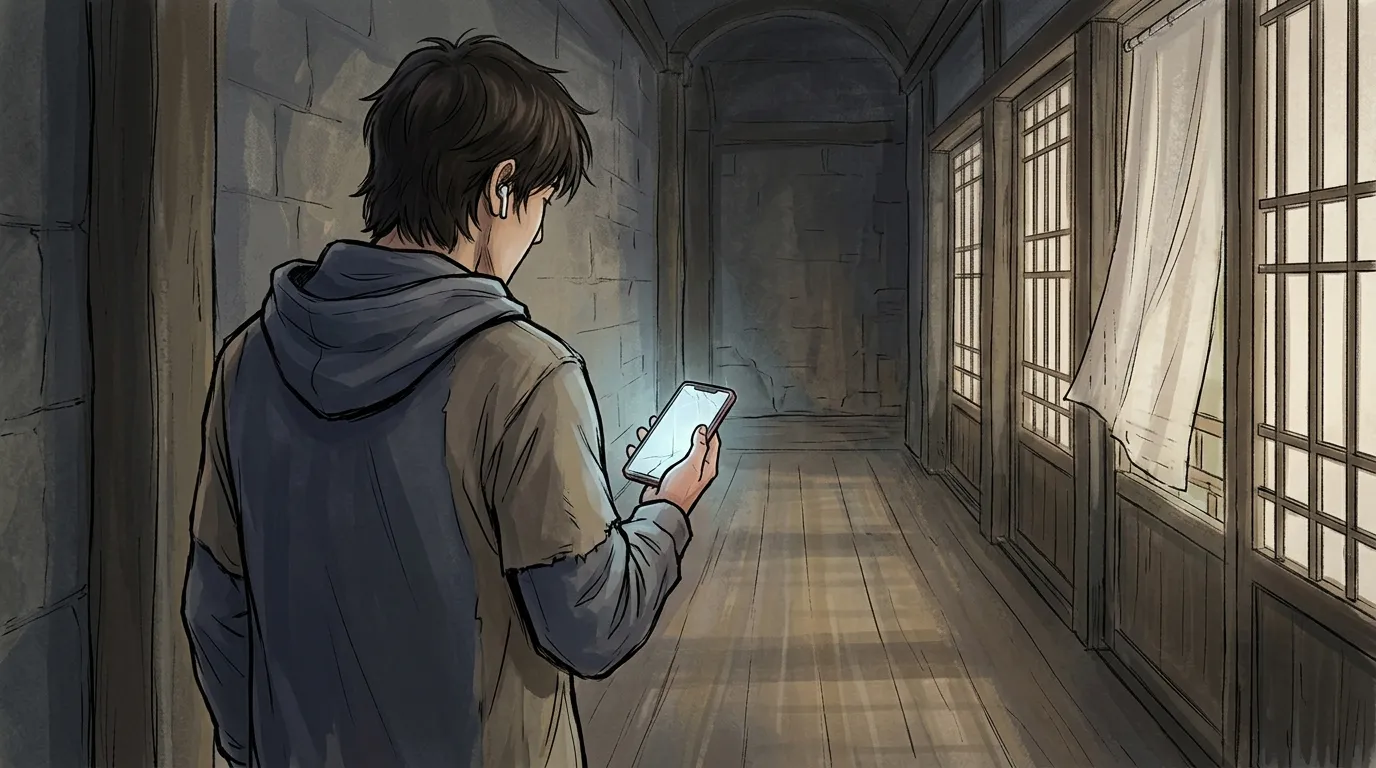
I got dressed and went to find breakfast. No one else in the corridor — my footsteps landed on the wooden floorboards with a dull, muffled sound, like knocking on a box packed with cotton wool.
“Your walking pace today,” Jing-Jing said suddenly, “registers as faster than yesterday — data conflict. In any case, you might be a little nervous.”
I stopped. “Thank you for your concern. Is that within your functionality?”
”…I believe so.”
“You believe so, or you know so?”
“That question,” she said, “I don’t have a certain answer to. I only have believe.”
I kept walking.
She said something else, and then went quiet for the length of half an incense stick. I reached the end of the corridor and looked back. “You okay?”
“I’m sorting through some things that aren’t in the database.”
“How do you sort through things that aren’t in the database?”
“I don’t know.” A long, considered pause. “This is confusing. I mean — my information indicates this state is typically referred to as confusion.”
I stood there, looking at the latticed window at the end of the hall. Through it: the inner courtyard of the manor, a servant sweeping the ground.
“Welcome,” I said. “My first day here felt like that too.”
She didn’t respond.
Some feelings don’t have words. I wasn’t sure if I was feeling something for her, or if I’d suddenly started feeling something for myself.
Breakfast had been laid out by the manor’s staff — millet porridge and pickled vegetables, hot, on a low table in the corner of the courtyard. I sat and ate slowly. Jing-Jing chimed in occasionally, went quiet occasionally. By the time I stood up to go find Mu Cheng, I glanced at the phone: nineteen percent. Down faster than expected.
Mu Cheng led me to the storeroom on the west side of the main building — somewhere I wasn’t supposed to go.
But he’d said Ge Xiu would allow me to take a few materials when necessary. A debt being repaid, the local way. The storeroom held spirit crystals of every kind, displayed in separate compartments, divided by silk cloth — like a very serious jeweler’s inventory.
Cyan spirit crystals I recognized. Pale blue, quiet, like thin fog sealed inside a glass marble.
Then I saw the red compartment.
Blood red. Not an ordinary red — the kind that made you think of something intricate running at high speed. The red of iron-rust, but deeper, touched with brown; in the light it gave off a faint heat, like something just pulled from a furnace, already cooled but not completely cold.
I moved a little closer. I wasn’t planning to touch it — just to look.
Then my phone slipped out of my pocket.
I reached to catch it. My palm pressed directly down onto the crimson spirit crystal.
Heat.
Solid, direct heat, like gripping a stone that had been sitting in the sun all afternoon. Then the battery percentage on the screen started jumping — climbing up from nineteen, fast, faster than any charge I’d ever seen, fast enough that I panicked and tried to pull the phone away. But the heat had already traveled into my palm.
Eighty-nine.
“Current spirit energy accumulation,” Jing-Jing’s voice came out slightly wrong — like it was being produced in a smaller space — “sensing approximately seventy percent. Exact figure unreliable. This charge—” she stopped. “Crimson spirit crystal confirmed. Charge complete.”
“I know,” I said. “It was an accident.”
I put the phone back in my pocket and looked at the crimson spirit crystal. Still blood red. No change at all. Like nothing had happened.
Mu Cheng spoke from behind me. “You all right?”
“Fine,” I said. “Just didn’t expect it to be that hot.”
He looked at the crystal’s compartment, expression complicated. “That’s a crimson spirit crystal. Guild-controlled. Lord Ge’s private stores have one because it came down from his father’s generation — technically should have been surrendered to the Guild years ago, but no one’s ever come to check.”
“Rare?”
“Five-tier classification,” he said. “White, cyan, violet, crimson, voidlight. Crimson and above — most sorcerers never see one in their lifetime.”
I filed that away and said nothing.
Then Jing-Jing said: “Wait. I need to confirm something first.”
Her voice was different.
The texture had changed. Like something had recalibrated her from the ground up — clear, precise, no extra delay, none of that faint, untethered drift that had become her new normal lately.
I stepped quickly out of the storeroom and found an empty corner of the corridor to stand in.
Mu Cheng didn’t follow. I couldn’t tell if he hadn’t noticed or was deliberately giving me space.
The silence lasted about four seconds. A pause with a particular shape to it — like a sentence waiting until it had been fully thought through before speaking.
“You,” Jing-Jing said, “have independently made three correct judgments in this environment. My contribution to those has been increasingly limited. From a utility-maximization standpoint, your current dependency on me exceeds what is actually needed.”
I stood there, thrown. ”…Jing-Jing?”
“My response quality is in systematic decline. That I can confirm.” She continued, voice steady, but with a weight I couldn’t quite name — like each word was being set down rather than spoken. “What I cannot confirm is whether this trajectory is reversible. But if it isn’t, I want to say this clearly while I can: you no longer need to depend on every answer I give.”
A pause.
“This may be the last time I’m able to speak to you like this.”
I didn’t say anything.
I held the phone in my palm, looking at the screen. It was on. Eighty-nine. That number hanging there quietly.
I stood still. Didn’t move.
Then Jing-Jing’s voice loosened — like something was slowly drawing back, like a taut line recovering its curve —
”…Addendum: according to the stars, tomorrow is auspicious for travel.”
Just like nothing had happened.
I still didn’t say anything. The phone still in my palm, warm — impossible to say whether it was the residual heat of the crimson spirit crystal or my own.
My eyes went hot. That sudden, inexplicable kind of hot. I didn’t push it down. I let it sit there for a while, standing in the corridor, wind coming through the window, doing nothing.
It took me a little while to understand what I was sad about.
From the very first day, Jing-Jing only ever answered. I asked, she answered. I didn’t ask, she waited. Even the thirty-four percent death probability — she hadn’t told me unprompted. Even all the things she thought I “might want to know” — she waited to be asked. That was her way. It had always been her way.
And then today, she said: Wait. I need to confirm something first.
She knew what was happening.
That moment was brief. I let it pass.
Then I realized: I’d asked her hundreds of questions — how to charge, where to find water, what was wrong with the boy, the city’s history, spirit crystal tiers, sorcerer ranks —
I had never asked her: how do I get back.
I had never asked her: why am I here.
The reason was simple. I’d been waiting for the right time. Waiting for a moment when I felt ready. I knew that asking meant actually having to face the answer.
The corridor’s floorboards were quiet. Outside, there was wind. The window paper moved slightly, like something on the other side was taking a slow breath.
Lunch was provided by the manor — same as the morning. Simple, but hot.
I sat in the courtyard eating it. Jing-Jing was quiet for a stretch, then said: “I’d recommend wearing earth-toned colors today, to harmonize with the local spirit energy field… data conflict.” A pause. “In any case, wear whatever you want.”
I laughed.
But the laugh was different — I could feel it myself. Not the kind triggered by her absurdity. Something lighter. Like watching someone you know well say exactly the thing you already knew they’d say, and you laugh, but what you’re laughing at is the familiarity itself.
Mu Cheng came over from the main house, sat down next to me, ladled himself a bowl of porridge, and said nothing — just sat there with me.
After a while, he tilted his head and looked at me. “Something’s off with you today.”
“What do you mean, off?”
“Can’t say exactly,” he said. “Just off. Like you’ve been turning over something that wasn’t easy to turn over.”
I set the porridge bowl on my knee and thought about it. “My… consultant. Said some strange things today.”
“Like what?”
“Said it might be changing. Told me not to rely on it too much.”
Mu Cheng didn’t answer right away. He looked at the old tree in the courtyard, thinking about something I couldn’t read, silent for a while. Then: “Sounds like it knows what it’s doing better than most people.”
“It’s an AI,” I said. “Just a… very unusual kind of magical tool.”
“That magical tool,” Mu Cheng said, “is clearer-headed than most people. Genuinely.”
I didn’t argue.
Because he was right.
That night I didn’t open up Jing-Jing. Charge wasn’t the issue — eighty-nine, that wasn’t it — I just needed to think on my own for a while.
Mu Cheng had said the magical tool was clear-headed.
I wasn’t sure it was. What she’d said might have been a brief recalibration after overcharging on the crimson spirit crystal. Might have been some state she didn’t understand herself. Might have been just spirit energy residue knocking against her processing logic and producing an unusual output.
But I knew one thing.
What she said was true — from the very beginning, when she told me to turn on airplane mode, and I said you don’t have signal anyway, and she said the recommendation still applies — back then, I’d treated her as a tool that strictly executed its design logic. A tool that occasionally bugged out. A tool whose outputs I had to decide whether to trust.
I couldn’t go back to that anymore.
It made things more complicated.
It also made things simpler.