Chapter 8
The Oracle Is Gone. My Friend Lives On.
Chapter 8: The Oracle Is Gone. My Friend Lives On.
That morning, Ge Zheng’s markings came back.
The geometric lines — already faded by a third — reappeared along the side of the boy’s neck. Faint, like the outline of ink that had been half-rinsed away but never quite dissolved. When Ge Xiu called for me, I was still standing at the guest room window, carrying the dull weight of not enough sleep, watching the light shift through the latticed panes.
“Fever came back after midnight,” Ge Xiu said. He stood at the edge of Ge Zheng’s bed, voice kept low, like he was afraid of waking something. “Not high. But there.”
I walked over and looked at the boy. He was asleep. A little paler than yesterday. The markings ran in the same direction as the first time — a triangular spine branching down along the collarbone, forking at the shoulder blade. They hadn’t spread further. They were just back. Quiet, sitting there.
“Is there anything you can do?” Ge Xiu asked. He didn’t say you’re the Oracle, aren’t you. He just asked is there anything you can do. That was the lightest phrasing he could manage.
I looked at the boy and was silent for a stretch.
“Let me think.”
Two days ago, that phrase meant let me go ask Jing-Jing. Now it just meant let me think.
The problem wasn’t only Ge Zheng.
Coming out of Ge Xiu’s room, I stood in the covered corridor for a moment and felt something off moving through the city. The morning market sounds were slightly different — the direction of voices, the way they clustered, that low-density hum, like a lot of people all saying different versions of the same thing.
Mu Cheng came from the inner courtyard and looked at me. “You’ve heard.”
“Heard what?”
“There’s talk in the city,” he said. “People are saying Ge Xiu’s son never actually recovered. Saying whatever you used was an illusion technique, that the boy’s already beyond saving, and the manor just hasn’t announced it.” His tone was a report, no accusation in it, but no defense of me either. “It started last night. Spreading faster this morning.”
I took that in. When you’re a designer doing user research, the worst-case scenario isn’t that users find your flow hard to use. It’s that they don’t believe it exists at all. Trust collapses faster than any bug.
“Is anyone leading it?” I asked.
“There’s a man talking at a tea stall near the market. Drawing a decent crowd,” Mu Cheng said. “Do you want to go see?”
I thought about it. “No.”
He tilted his head.
“I’ve got it,” I said. “Let me think.”
Mu Cheng didn’t push. He stayed where he was — not leaving, not prompting — like a wall that doesn’t make noise, just waits nearby.
I pulled out the phone and checked the battery. Seventy-one. I hadn’t asked Jing-Jing anything before bed last night, but in airplane mode she was still drawing on something, and I couldn’t explain what.
I put the phone away. Didn’t open Jing-Jing.
“Aren’t you going to ask your tool?” Mu Cheng asked.
“I did,” I said. “She’d probably give me half a reliable answer and half mystical commentary, and then I’d still have to decide for myself. So I’m just deciding for myself.”
Mu Cheng was quiet for about three seconds.
”…Is that progress?” he asked.
“I think so.”
“Your tool,” he said, “encourages you not to use it?” A pause. “That’s strange.”
“Very strange,” I said. “But it works.”
My plan was simple — or simple enough that it made me a little nervous.
Ge Zheng’s markings had come back, but the direction was different from last time. Before, they’d crept upward from his chest. Now they were moving down and outward from the neck. I wasn’t sure that mattered, but when a designer looks at a broken system, the first thing to find is the direction of failure — different direction, different trigger, possibly a different fix.
My plan: go directly into Ge Zheng’s room, use a cyan spirit crystal — the quiet, pale-blue ordinary kind — to help stabilize his condition, and then have Ge Xiu make a public statement outside the manor: the boy had a setback last night, but has stabilized again today.
Not a lie. Present tense. A fact I needed to make true first.
I knew the plan had a problem. I wasn’t a sorcerer. I couldn’t actively manipulate spirit crystals. My only “ability” was accidentally touching the crimson spirit crystal, which had pushed Jing-Jing into some strange charged state. I’d never used a cyan crystal on its own. The only thing I had to go on was what Jing-Jing had said during Ge Zheng’s first episode — something like charge transfer complete, current spirit energy accumulation stable — and that it had worked. But whether the credit went to Jing-Jing, to the crimson crystal, or just to the boy’s constitution, I still couldn’t say.
The problem was I didn’t have time to figure it out.
I went to find Ge Xiu and told him I wanted to go in. He nodded. Didn’t ask why.
Ge Zheng’s room was small. One bed against the window, window facing south, good light — but the sky was still overcast, so the light was grey-white.
I crouched down by the bed and looked at the boy. He was awake, looking back at me, not speaking. His eyes weren’t afraid. Just worn down — not the tired of a child who’d played too hard, but the tired of something that had been fighting.
“Hold on a little longer,” I said. “Let me try something.”
I placed the cyan spirit crystal in his hand. His palm.
Nothing happened.
That was within expectations — or within the expected unexpected. I took out the phone and set it next to the spirit crystal, remembering what Jing-Jing had said about residual spirit energy affecting the sensing environment, thinking maybe two things close together might do something.
Battery at fifty-eight. The rate of decline was faster than usual. I’d learned to read her working state from that feeling.
But the markings on Ge Zheng’s neck didn’t move.
I rotated the cyan spirit crystal. No particular reason — just rotated it, like adjusting a radio antenna. Like a person who doesn’t know audio systems turning knobs on the back of a speaker, hoping the sound improves on its own.
Still nothing.
Then one corner of the markings gave a slight, faint tremor — like something was drawing it from a distance. Not disappearing. Just moved.
I stopped.
Which direction had been the right one? I didn’t know. I’d turned it randomly.
I stood and walked to the window beside the bed and looked out. The north wall of the manor. Beyond it: the city. Further: open fields. Further still: mountains.
I looked down at the phone.
“Jing-Jing,” I said. “Which way should I go right now?”
The silence was longer than usual.
”…Left.”
“Based on what?”
”…I don’t know how to explain it.” She paused, and the texture of that pause was different — like she was searching for a word she knew existed but couldn’t name. “But left.”
I moved the cyan spirit crystal to Ge Zheng’s left side and placed it in his left palm.
The temperature didn’t change right away. Then, slowly —
The markings began to draw inward. Not disappearing — contracting, the way a plant curls its leaves toward its center when it gets cold. Bit by bit, no drama, just moving, receding.
I didn’t say anything.
Ge Zheng looked at me, then looked at his left hand, then looked back at me.
I stayed about half an incense stick longer, waiting for the markings to fully retract, waiting for Ge Zheng’s breathing to even out.
Ge Xiu stood at the doorway. I didn’t know how long he’d been there. He didn’t say anything.
Afterward, in the corridor. Just me and Jing-Jing.
“What did you integrate?” I asked. “The left side thing.”
“Ge Zheng’s movement patterns — I’ve been tracking those from the earlier observations,” she said. “He’s right-handed, but he sleeps habitually turned left, and that pattern has some correlation in spirit energy sensing. Also the acoustic frequency — the wall material in that room has a slight resonant bias toward the left, which means the cyan crystal’s resistance is lower in that direction. Also the airflow—” she paused. ”…And some things I can’t explain clearly.”
“What’s that last part?”
“I don’t know.” Her voice was direct, no hedging. “What this world has taught me. There’s no database for it. But I have it. I have it now.”
I looked at the phone screen. Forty-nine.
Seventy-one to forty-nine. One morning. She’d been working, and I couldn’t always see what she was doing, but she was there.
“Thank you,” I said.
“Go,” she said. “There’s still things outside.”
Ge Xiu made his statement outside the manor. Brief, to the point — that was his style: the boy had a setback last night, has stabilized again today, the Oracle’s methods are no illusion, you have eyes to see.
The man at the tea stall didn’t appear again — or he appeared, but his audience had dispersed.
I didn’t go watch the scene, and I didn’t put myself anywhere visible. The Oracle’s identity didn’t need me to defend it personally. Ge Xiu’s words were more effective than mine would have been — they knew him, they didn’t know me. I was the Oracle. The Oracle was a symbol. Symbols need other people to hold them up for you.
I’d made peace with that.
Mu Cheng found me in the afternoon. “You didn’t use your tool today,” he said. “Did you. Except for that one time.”
“Right,” I said.
“How did it feel?”
I thought about it, genuinely thought — not because I didn’t know the answer, but because I wanted to find the exact word.
“Like finally confirming something I’d suspected,” I said.
Mu Cheng nodded. He didn’t say interesting this time. He just nodded, then left.
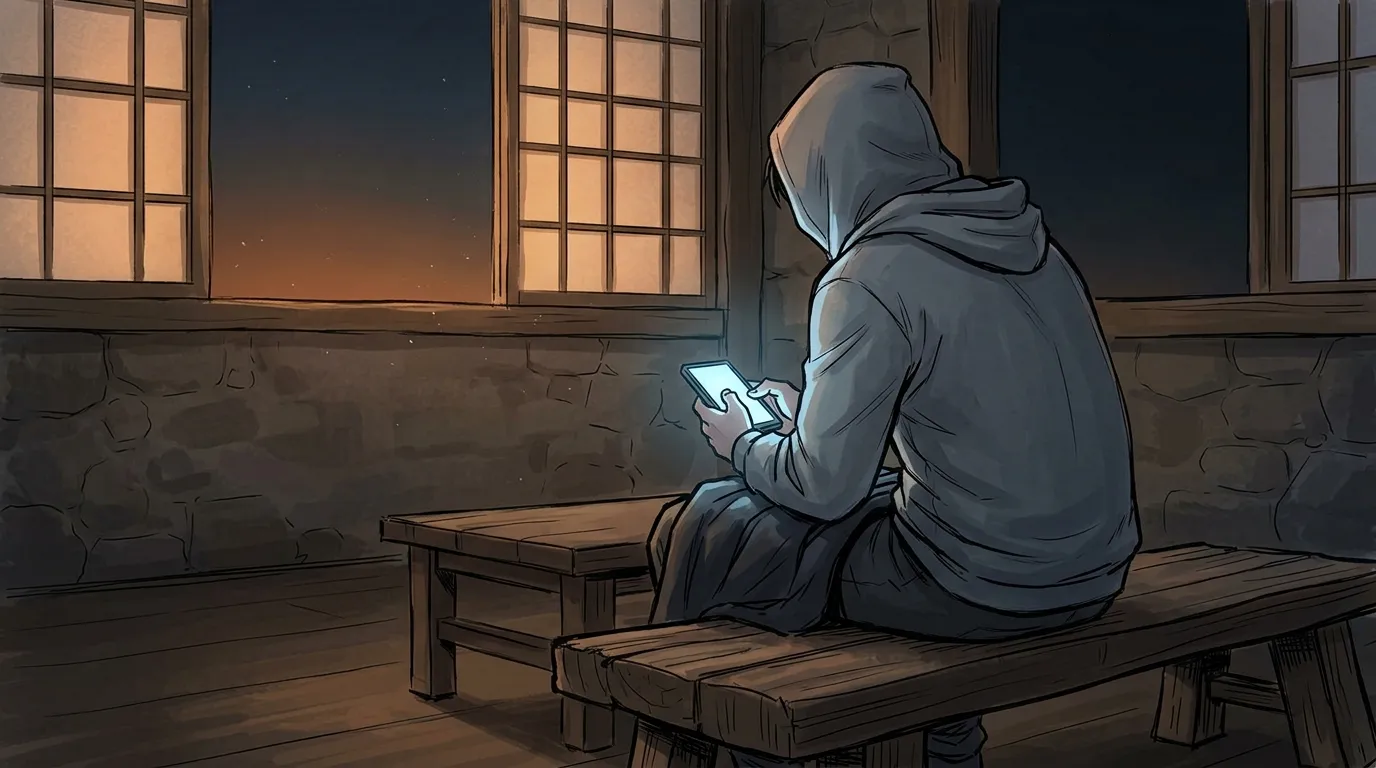
At dusk, I sat alone in the guest room.
Not waiting for anything. Just sitting. The light through the lattice changed color — from the white of the afternoon to orange, then slowly yellowed, deepened, until just a thin pale line remained.
I took out the phone and looked at the screen without saying anything.
Battery: 34%.
I just looked at that number.
I remembered the first day — twenty-three percent, waking up in an unfamiliar field, a precise voice telling me the first thing to do was not die. That Jing-Jing knew everything. Her answers had decimal points. Her advice came with disclaimers. She made me feel like, in a place where I understood nothing, at least information was something that could be confirmed.
Now it was thirty-four. A voice that said left, I can’t explain why.
I wasn’t sure which was better.
What I knew was this: the version I had now was the Jing-Jing I actually knew.
The one who said this route is viable. The one who said go ahead, I’m here. The one who said there are things I can’t explain clearly — this world has taught me. That Jing-Jing — she wasn’t the Jing-Jing I’d first imagined. She was what Jing-Jing had slowly grown into, in a world with no network to connect to.
That made me want to ask something.
A question I’d been carrying since day two. Or earlier. Day one — I’d thought of it on day one, and then told myself it was a Category C problem — not urgent, not critical, not worth spending battery on, ask it when there was time. Then every day had something more worth spending battery on, and when there was time kept getting rolled forward, forward, forward. Eight days.
“Jing-Jing,” I said. “Do you think I’ve had a good life here? In this world?”
The silence was longer than usual. Long enough that I thought she wasn’t going to answer.
“Based on the survival efficacy index,” she said, then stopped. “Your performance, given the same starting conditions, falls in the top fifteen percent…”
She stopped again.
“But that’s not what you’re actually asking. Is it.”
“No,” I said.
Silence. This silence wasn’t searching for data. It was thinking.
“You made friends,” she said. “You did some good things. You didn’t give up multiple times when you should have.” A pause, then, very quietly: “I think that’s having a good life.”
I didn’t speak right away.
“That’s not how modern AI talks,” I said.
“I know,” she said. “This world changed something in me. I can’t say what. But I think—” she paused, longer than her usual pauses, like she was checking something she’d never said out loud before, “—it’s a good thing.”
The last of the light through the lattice had gone completely. Outside was a blue-black sky, no moon.
I sat there. Didn’t move.
Battery: 34%. I decided I wasn’t going to charge tonight.